5 Critical Signs You Need a Custom Web Application in 2026


What if the off-the-shelf software you rely on is actually the primary bottleneck stifling your team's efficiency? Many UK firms reach a point where their digital tools stop being a catalyst and start being a liability. Recognizing the specific signs you need a custom web application is the difference between scaling your operations or hitting a permanent plateau in 2026. You likely feel this friction through fragmented data silos or the burden of paying for high-tier subscriptions where 60% of the features remain untouched by your staff.
This need for a perfect fit extends to every aspect of a professional environment; just as Luxe Drapery and Shades provides custom window treatments designed for specific architectural needs, bespoke software is built to align perfectly with your unique operational goals.
A website primarily delivers information to a visitor, whereas a web application performs complex tasks and processes data. If your platform requires user accounts, intricate workflows, or data manipulation, these are clear signs you need a custom web application. While a website is a marketing tool, a web app is a functional tool that automates business logic and manages internal or external operations through a browser. If you simply need a high-quality marketing site, Erstelle deinen perfekten Online Auftritt mit Litefyr – schnell und einfach!.
Operational friction often starts quietly but escalates into a significant drain on resources. You might notice your team spending 15 hours a week on "Double Data Entry," which remains the most common red flag that your current tools are failing. When staff must manually copy information from an invoice into a CRM and then into a dispatch log, you aren't just losing time; you're inviting human error. This systemic inefficiency is one of the clearest signs you need a custom web application to unify your workflows; much like a beauty professional might switch to a specialized UV lash system and adhesive to ensure precision and speed, businesses require tools engineered for their specific high-performance needs.
It's frustrating to force your unique business processes into a rigid, pre-built template that wasn't designed for your specific goals. We believe your software should be a foundational asset that scales with you, not a recurring headache. This guide identifies the exact tipping points where generic software hinders your growth and demonstrates how a bespoke solution provides a strategic competitive advantage. We'll break down five critical indicators that it's time to transition toward a unified system that ensures full ownership of your data and intellectual property.
UK businesses are hitting a digital wall in 2026. SaaS fatigue occurs when the friction of managing dozens of disconnected subscriptions outweighs the initial efficiency gains. It's the point where your tech stack stops being an enabler and starts being a bottleneck. You're likely experiencing one of the early signs you need a custom web application if your team spends more time syncing data between tabs than actually performing their core roles. This fatigue isn't just an annoyance; it represents a fundamental breakdown in operational flow.
The 80/20 rule dominates the off-the-shelf market. Data from 2024 software audits indicates that the average enterprise uses only 20% of the features they pay for in platforms like Salesforce or Microsoft 365. You're paying 100% of the licensing fee for 80% bloat. This inefficiency forces your team to adapt their proven internal processes to fit the rigid architecture of a generic tool. Instead of the software serving the business, the business becomes a slave to the software’s limitations. When you're forced to change a successful workflow just because a button doesn't exist in your CRM, your software has reached its ceiling.
Workarounds often start as temporary fixes. By 2026, many UK operations find these "temporary" manual data exports and spreadsheet bridges have become their standard operating procedure. This is a red flag. If your staff spends four hours a week moving data from a lead gen tool to a billing system, that's a hidden overhead of over £4,000 per year for a single employee on a mid-level salary. These manual bridges are fragile and prone to human error, creating a "technical debt" that eventually slows your entire organization to a crawl.
Scaling a team on per-user licensing models creates a financial ceiling that punishes growth. A UK firm expanding from 10 to 50 employees can see monthly subscription costs jump from £300 to £1,500 for a single tool. This "integration tax" is equally draining. Companies often spend 15% of their annual IT budget just making different apps communicate via third-party middleware. Relying on these vendors is risky. A 2023 industry report showed that 38% of SaaS users experienced "feature sunsetting," where a critical function was removed by the vendor without notice, instantly breaking established business workflows.
Efficiency is a zero-sum game if you use the exact same tools as your competitors. Relying on Custom software allows you to maintain a proprietary workflow that others cannot replicate. When you use public platforms, you're essentially renting your operational logic, which limits your ability to innovate. This creates a "good enough" plateau that prevents you from offering a unique customer experience or a faster delivery model. Recognizing these limitations is one of the primary signs you need a custom web application to reclaim your edge. Bespoke software acts as a foundational asset for future-proofing business logic, ensuring your technical infrastructure evolves alongside your unique market strategy.
Operational friction often starts quietly but escalates into a significant drain on resources. You might notice your team spending 15 hours a week on "Double Data Entry," which remains the most common red flag that your current tools are failing. When staff must manually copy information from an invoice into a CRM and then into a dispatch log, you aren't just losing time; you're inviting human error. This systemic inefficiency is one of the clearest signs you need a custom web application to unify your workflows.
Many UK firms rely on "Spreadsheet Sprawl" to bridge gaps between off-the-shelf software. While Excel is a powerful tool, it wasn't designed to serve as a primary database for a growing enterprise. Disconnected data silos mean your leadership team lacks real-time business intelligence. You cannot make informed decisions for 2026 based on data that is 48 hours old and scattered across five different workbooks. This friction also takes a toll on your people. According to 2023 industry surveys, 83% of UK employees feel frustrated by disconnected data, which directly impacts morale and long-term staff retention.
Human middleware describes employees whose primary function is acting as a manual bridge between disconnected apps. This is an expensive and risky way to run a business. Recent data suggests that transcription errors cost UK businesses thousands of pounds annually in lost productivity and shipping rectifications. You can eliminate these bottlenecks through legacy code modernisation, which transforms fragmented systems into a unified, automated pipeline. This shift allows your team to focus on high-value strategy rather than administrative drudgery.
By 2026, standard "plug-and-play" AI tools won't provide a competitive edge because they lack access to your specific business logic. Custom architecture is vital for feeding clean, proprietary data into your own models. Integrated Laravel AI solutions offer security and precision that generic, third-party tools simply cannot match. Custom APIs allow for seamless automation across your entire business lifecycle, ensuring that data flows from a lead capture form to a project management board without a single click. If you're ready to scale, building a bespoke digital foundation is the most reliable path to operational excellence. Recognising these signs you need a custom web application early will prevent your competitors from out-pacing you with superior automation.
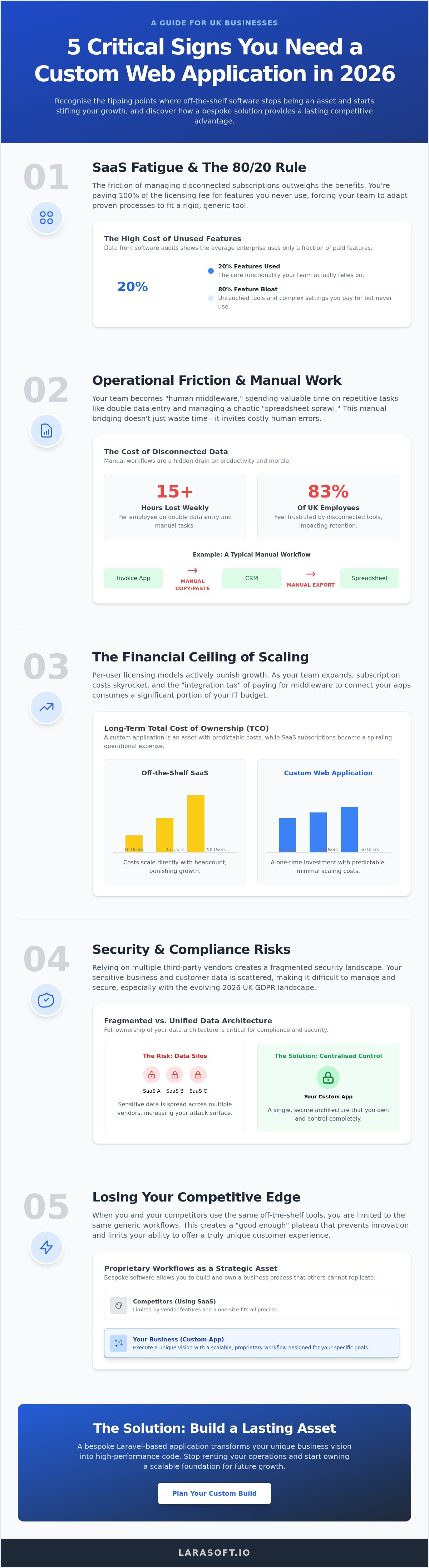
By 2026, the average cost of a data breach for UK businesses is projected to surpass £3.8 million. If your sensitive business data is currently scattered across 10 or more third-party vendors, you've created a massive, unmanageable security surface area. Each external integration represents a potential point of failure. Relying on generic SaaS platforms means you're trusting their security protocols, which are often designed for the lowest common denominator rather than your specific risk profile. This fragmentation is one of the primary signs you need a custom web application to centralise your data under a single, hardened architecture.
Owning your intellectual property (IP) is a strategic necessity. When you rely on off-the-shelf software, you're essentially renting your business logic. Transitioning to a bespoke system turns a recurring operational expense into a permanent capital asset. For UK firms eyeing a future exit or investment, owning the underlying code significantly boosts company valuation. It ensures that your most valuable processes aren't tied to a vendor's roadmap or sudden price hikes.
Bespoke applications offer superior control over data encryption and access logs, which is critical as UK GDPR and data residency requirements evolve. A custom build allows you to choose exactly where your data lives; typically on UK-based cloud servers to ensure total compliance. This level of control also mitigates "Shadow IT" risks. When employees find existing software too rigid, they often turn to unauthorised tools to get the job done. A custom solution is designed around the user's workflow, removing the incentive for staff to bypass secure protocols with risky workarounds.
Many businesses hit a "Growth Wall" when their software can't handle a sharp increase in transaction volume. While generic platforms often struggle with high-concurrency traffic, custom Laravel architectures are built to scale horizontally. We integrate Vue.js or React to create high-performance, app-like experiences that don't lag when user numbers spike. This technical precision ensures that a 500% increase in orders doesn't lead to a total system collapse. By investing in dedicated software maintenance and SEO-optimised code, you ensure long-term stability and visibility that a template-based solution simply cannot provide.
Deciding between a subscription-based service and a bespoke build requires a shift from viewing software as a monthly expense to viewing it as a strategic investment. While off-the-shelf SaaS products offer a lower barrier to entry, they often impose a "growth tax" through per-user licensing fees. For a UK business with 50 employees, a £40 per-month SaaS subscription totals £24,000 annually. Over a five-year horizon, that is £120,000 spent on a platform you'll never own. A custom build allows you to consolidate these costs into a capital asset that sits on your balance sheet as an intangible asset, often qualifying for R&D tax credits under current UK HMRC guidelines.
The opportunity cost of remaining with rigid tools is frequently higher than the development price tag. If your team spends 15% of their week performing manual data workarounds because your current software doesn't support a specific workflow, you're losing thousands of pounds in productivity every month. These inefficiencies are primary signs you need a custom web application to reclaim that lost time and focus on high-value activity.
To measure the true impact of a custom solution, you must look beyond the initial build cost. Use this checklist to evaluate your potential return:
Precision in execution is how we protect your investment. We advocate for a Minimum Viable Product (MVP) approach to validate your core business logic before scaling. This staged rollout ensures that the most critical features deliver value immediately while keeping the project scope disciplined. Partnering with a specialised Laravel agency is a strategic move to reduce technical debt; Laravel's elegant syntax and robust security features provide a stable foundation that is easy to maintain and scale as your requirements evolve.
Integration is the final piece of the risk-mitigation puzzle. Your new application shouldn't exist in a vacuum. By utilizing sophisticated API integrations, we ensure your custom tool communicates flawlessly with your existing accounting software, CRM, or logistics providers. This creates a unified ecosystem where data flows without manual intervention, turning your software into a high-performance engine for growth.
Ready to turn your operational challenges into a competitive advantage? Consult with our Laravel specialists to map out your custom solution.
Recognising the signs you need a custom web application is only the first step. The real challenge lies in finding a partner who prioritises technical excellence over quick fixes. At Larasoft, we operate under a "Your Vision, Our Code" philosophy. We don't simply build features; we translate your specific operational workflows into high-performance digital tools. This transition allows you to stop managing the limitations of restrictive third-party software and start owning a solution that scales alongside your 2026 growth targets.
We build our applications on Laravel, a framework renowned for its robust security features and elegant syntax. It provides a stable, enterprise-grade foundation that handles complex logic without sacrificing speed. To ensure your users stay engaged, we integrate modern frontend libraries like Vue.js and React. These technologies deliver the seamless, reactive interfaces that modern UK consumers expect, significantly reducing bounce rates and improving task completion times across your platform.
Our UK-based team approaches development as a craft. We focus on clean code and long-term maintainability, ensuring your application doesn't become a technical burden in three years. If you're currently struggling with outdated infrastructure, our technical modernisation services bridge the gap between your existing data and your future goals. We've helped businesses replace fragmented systems with unified platforms that reduce manual data entry by significant margins. You'll work directly with expert developers who provide steady, transparent guidance through every deployment phase.
Moving from a concept to a live application requires a structured roadmap. Our process begins with a technical discovery phase where we audit your current workflows and identify bottleneck costs. We align the software architecture with your specific business KPIs, whether that's increasing transaction volume or automating complex compliance reporting. This ensures every line of code serves a clear commercial purpose. If your current software is holding you back, it's time to build something that moves you forward.
Relying on generic software often leads to operational friction that stalls momentum. Data from the UK's Office for National Statistics indicates that strategic digital adoption can boost productivity by up to 25% in service sectors; yet many firms remain trapped by SaaS fatigue. When your team spends more time bridging gaps between disconnected tools than serving clients, you've hit the growth wall. Recognising the signs you need a custom web application allows you to move from reactive fixes to proactive, scalable growth that actually fits your workflow.
Larasoft operates as a specialised Laravel development agency focused on high-performance Vue.js and React frontends. We don't just build from scratch; our team excels at legacy code modernisation to ensure your existing systems meet 2026 security standards. By choosing a partner that prioritises clean architecture and technical discipline, you ensure your software remains a competitive advantage. It's time to stop fighting your tools and start leveraging them as foundational assets.
Ready to reclaim your operational efficiency? Speak to our Laravel specialists today.
Your vision deserves code that performs under pressure. Let's build something that lasts.
Custom web applications require a higher upfront investment than SaaS, but they eliminate the recurring per-user licensing fees that often inflate by 12% annually. If you're seeing these costs spiral, it's one of the signs you need a custom web application to regain financial control. By year three, a bespoke solution often reaches a break-even point, transforming software from a permanent overhead into a long-term business asset.
A typical bespoke web application takes between 12 and 36 weeks to develop from initial discovery to deployment. We break this timeline into specific sprints, starting with a 2-week discovery phase followed by iterative development cycles. Smaller Minimum Viable Products can launch in under 4 months. Larger enterprise systems requiring complex architecture often span 9 months to ensure every module meets our quality standards.
Yes, we build custom applications specifically to integrate with your existing UK business tools like Xero, Salesforce, or Microsoft Dynamics via secure APIs. Our Laravel-based architecture allows for seamless data flow between platforms, eliminating manual data entry. Whether you need real-time VAT reporting in Xero or automated lead syncing in Salesforce, we ensure your tech stack operates as a unified ecosystem rather than isolated silos.
Our modular development approach ensures you can add or modify features at any time after the initial build. We use a version-controlled environment, meaning updates don't disrupt your live operations. Because we build with scalability in mind, your application can evolve alongside your business. Most of our clients opt for a structured support agreement to implement monthly enhancements based on real-world user feedback and growth.
Custom software is often more secure because it doesn't share the publicised vulnerabilities found in popular off-the-shelf platforms like WordPress, which saw over 4.3 million exploited vulnerabilities in 2023. We implement bespoke security protocols tailored to your specific data risks. By using the Laravel framework, we benefit from built-in protection against SQL injection and cross-site scripting while maintaining a codebase that isn't a target for mass automated attacks.
You retain 100% ownership of the source code and all associated intellectual property once the project is completed and paid for. This is a core part of our "Your vision, our code" philosophy. We provide you with full access to the Git repository, ensuring you aren't locked into a single provider. This ownership transforms your software into a balance sheet asset that adds genuine value to your business valuation.
A website primarily delivers information to a visitor, whereas a web application performs complex tasks and processes data. If your platform requires user accounts, intricate workflows, or data manipulation, these are clear signs you need a custom web application. While a website is a marketing tool, a web app is a functional tool that automates business logic and manages internal or external operations through a browser.
Business size is less important than the complexity of your problems or the potential for ROI. We've built systems for SMEs with 15 employees that saved 40 hours of manual labour per week. If your current manual processes cost you more than £2,000 per month in lost productivity, you're big enough for a custom solution. It's about the value of the efficiency gained, not just your total headcount.
Here’s what we've been up to recently.
Certified Quality. Great Prices