Bespoke Frontend Development Services: A UK Business Guide


What if the best bespoke frontend isn’t the one with the most features, but the one that helps users complete their key tasks within the systems you already run? Bespoke frontend development services should be shaped around that fit, not just a visual brief.
It’s reasonable to ask where frontend design ends, where development begins and how much custom work your business needs. A tailored interface can better support users and business goals, but unclear scope or weak technical decisions can make it harder to maintain. It also needs to work across devices and connect reliably with your backend and existing APIs.
This guide explains how to turn user needs and business priorities into a practical scope, assess a provider and plan for ongoing maintenance. It also covers how frontend choices work alongside technologies such as Vue.js, React and Laravel. You’ll find a practical way to commission a frontend around real user tasks and your existing technical environment.
Bespoke frontend development creates a user-facing interface around a product’s specific requirements. It shapes how people navigate, interact with content and access application features. In the broader discipline of Front-end web development, those visible elements connect users with the functionality behind the screen. A custom frontend goes beyond a new look: it makes the interface reflect the product’s workflows and rules.
A standard template can be a sound starting point. Bespoke work becomes relevant when its layouts or interactions don’t support users’ tasks, or when connecting it to your systems creates friction. Base the decision on a defined constraint, such as a workflow users cannot complete easily or an integration the current interface does not support, rather than a preference for custom code.
Consider a service where staff review a case, check information from several systems, record a decision and update its status. A generic layout may split those steps across disconnected screens. A tailored interface could bring the relevant information and actions into a clearer workflow, while the existing backend continues to manage the underlying data and rules.
This can also suit an established product whose interface no longer reflects users’ needs. A redesign may change navigation, screen structure or interactions without replacing the backend. Before setting scope, identify which changes belong in the frontend and which depend on updates to APIs or server-side behaviour.
A configurable platform may be practical when its existing features already support your users’ journeys, integrations and operational requirements. If the changes are mainly cosmetic, a full bespoke build may add engineering and future maintenance work without solving a meaningful problem.
Before commissioning bespoke frontend development services, describe what users need to do and where the current experience falls short. Then weigh the benefit of a better-fitting interface against the additional design, engineering and maintenance effort.
Start with a specific user or business constraint the custom interface will address. If you can’t name one, refine the requirements first. If you can, define the smallest tailored solution that resolves it and can be maintained within your existing technology.
A useful frontend starts with user needs, then turns interface designs into working components such as navigation, forms, status views and reusable controls. Those components manage presentation and interaction, while application state tracks what happens as a user moves through a task. The frontend exchanges data with backend services, often through APIs. The role of a frontend developer includes bridging design and technical implementation, with accessibility and performance in view.
The frontend presents information and captures user actions; the backend applies business rules, checks permissions and manages persistent data. Keeping that distinction clear helps teams decide what belongs in the interface and what must be enforced by the server.
Take an order form. The frontend collects the selected items and delivery details, then sends them in an API request. The backend checks availability, applies pricing and account rules, and returns a response for the interface to display, such as a confirmation or a clear error.
Checking whether a required field is empty in the browser can make a form easier to use. However, browser-side checks are not a substitute for server validation because users can bypass the interface. Confirm how authentication and permissions work, how errors are returned, and how the system handles a request that is repeated or interrupted, so data remains consistent.
An integrated application keeps the frontend closely connected to the backend. This can simplify deployment and coordination when one team owns both. A decoupled frontend communicates with backend services through APIs. That separation can give teams more flexibility, but it also makes API design, deployment coordination and error handling central to the architecture.
Choose based on the product, not fashion. Consider your team’s experience, how each part will be released, and whether future changes are likely to affect the interface, backend or both. Vue.js and React can each support interactive interfaces. The right fit depends on product requirements, existing technology and the team’s ability to maintain the code. For more on one option, see The Strategic Guide to Vue.js Frontend Development for Modern Businesses.
Good bespoke frontend development services make these boundaries explicit before implementation, so interface decisions align with APIs and server-side rules. When assessing that fit, review Larasoft’s Vue.js and React frontend development alongside its Laravel and API integration capabilities.
Compare providers on how they reduce delivery risk, not just how polished their portfolio looks. Look for an example with a challenge similar to yours, such as coordinating a multi-step user journey or connecting an interface to existing systems. Ask what the team built, how it worked with the backend and how success was assessed. Visual quality matters, but it doesn’t show whether a solution fits your operational needs.
Use the same criteria for each provider to make proposals easier to compare and reveal differences in responsibilities or assumptions.
| Area | What to assess |
|---|---|
| Discovery | How user needs become defined journeys, requirements and acceptance criteria. |
| Frontend skills | Relevant experience with the proposed framework and comparable interface complexity. |
| Integration | How the frontend will connect to APIs, backend services and existing systems. |
| Testing | How the team will test key journeys, errors, responsive behaviour and integration points. |
| Ownership | Who owns the source code, and what documentation and handover are included. |
| Ongoing support | Who handles maintenance, updates and issues after release. |
Bespoke doesn’t have to mean unnecessarily complex or locked to one provider. Clear component boundaries, useful documentation and agreed source-code ownership can make future changes easier for your team or another development partner. Ask how decisions will be recorded and how changes to scope, dependencies or risks will be handled.
Ask how the provider turns business requirements into user flows and testable acceptance criteria. Find out how frontend work will be coordinated with design, backend development and your in-house team, and who approves decisions. Request a clear explanation of assumptions, dependencies, delivery risks and the process for managing changes. The answers should make responsibilities clear.
Assess framework fit against your product requirements, existing systems, team capability and maintenance plans. Don’t select a technology solely because it’s popular, familiar or preferred by a provider. Ask what trade-offs the recommendation involves and how the codebase can be supported over time. For broader partner-selection criteria, see The Strategic Guide to Choosing a Laravel Development Agency in 2026.
The right choice is one your team can operate and evolve within the wider application architecture. A provider should explain how it fits your requirements, rather than treating a framework as the answer before understanding the problem.
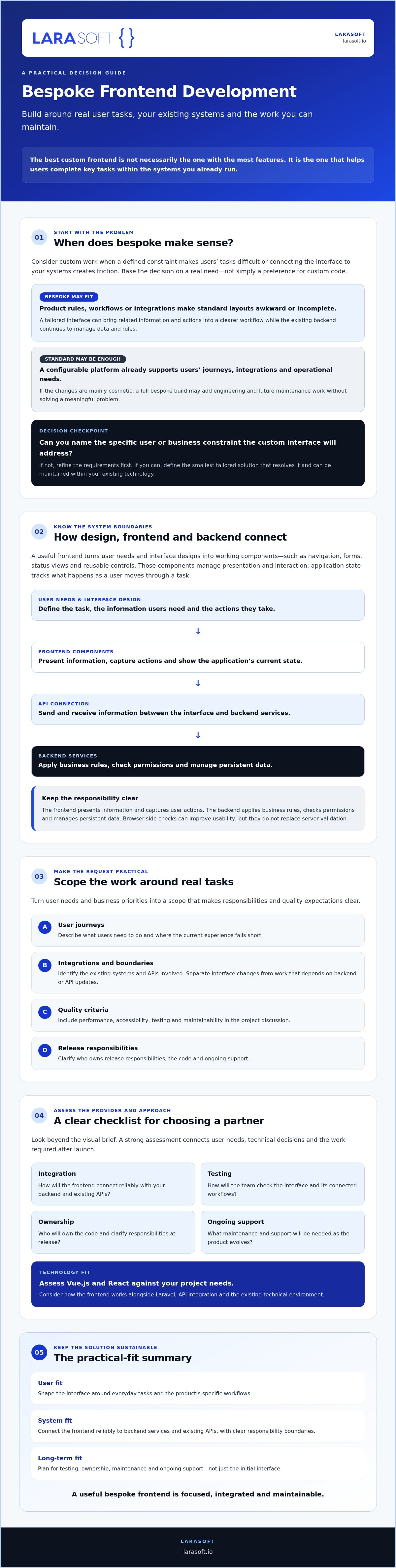
Turn quality expectations into checks that can be reviewed, rather than broad promises such as “fast” or “accessible”. A clear scope for bespoke frontend development services gives the team shared acceptance criteria and makes it easier to identify gaps before release.
Work through these decisions in order:
Performance targets should reflect how the product is used. A content-heavy page, for example, may need different priorities from an interactive dashboard. Core Web Vitals can provide useful reference measures, but they don’t replace testing the tasks users need to complete.
Specify supported screen sizes and browsers, then test responsive layouts, loading and error states, and key interactions. Include keyboard-only operation and an accessibility review against the product’s agreed WCAG criteria. Define the review method and who will address issues. A stated standard is useful only if the team can check it against the implemented interface.
Maintainability depends on documented components, meaningful tests and clear ownership. Include these deliverables in the scope so future developers can understand how the interface is structured and how to validate changes.
Discovery, prototyping, implementation, integration testing and staged release are useful phases, but the sequence should reflect the system and delivery risks. Set review points, name decision owners and record dependencies before development begins. If legacy systems shape the work, the guide Legacy Code Modernisation: A Strategic Guide for UK Business Leaders offers relevant context.
At each review, check progress against agreed user journeys and quality criteria, not just visual approval. For a project involving a Laravel application or existing APIs, discuss how the frontend scope connects with Larasoft’s frontend development and API integration capabilities.
Larasoft develops bespoke frontends with Vue.js and React, and custom web applications with Laravel. These capabilities can be considered together when a project needs a tailored interface connected to a Laravel application or existing APIs. API integration and software maintenance can also help shape how the frontend fits the wider system and can be supported over time.
The right scope depends on your product, users and technical environment. Before discussing bespoke frontend development services, gather the details that will clarify the problem and its constraints.
You don’t need a complete technical specification before an initial discussion. A clear description of the current challenge, the systems involved and the outcome you want is a practical starting point.
The next step is to clarify requirements and define scope. This may include reviewing user journeys, discussing how the frontend should connect to existing technology, and identifying assumptions or dependencies that need investigation. That groundwork can inform a technical proposal outlining an approach, responsibilities and possible next steps.
The appropriate process depends on the project. Agree discovery, scope and delivery decisions collaboratively, and address open questions before making commitments. If the existing application needs modernisation or ongoing maintenance, discuss those needs alongside the frontend so they can be considered within the wider architecture.
If you’re considering a new interface or a frontend update, discuss your bespoke frontend requirements with Larasoft. Explain what users need to do, what technology is already in place and where the current experience falls short. This gives you a practical starting point for exploring the technical direction together.
A successful bespoke frontend starts with a clear user or business need, then connects interface decisions to the systems that support them. Define key journeys, integrations and quality criteria before agreeing the scope. When assessing providers, look beyond visual polish and ask how they handle testing, code ownership, documentation and ongoing maintenance.
These decisions help keep a tailored interface focused and give it a practical foundation for future change. Larasoft provides bespoke frontend development using Vue.js and React, alongside Laravel web application development, API integration and software maintenance. Considering these capabilities together can help you assess how a new frontend may fit your existing application architecture.
To clarify the technical scope or discuss an approach for your product, discuss your bespoke frontend requirements with Larasoft. Share your users’ needs and the technology already in place to start shaping the work.
Bespoke frontend development services create a user-facing interface around a product’s specific requirements, rather than relying solely on a generic layout. The work shapes how users navigate, interact with content and access features, as well as how the interface exchanges information with backend systems. For example, a tailored dashboard might bring several role-specific tasks into one workflow. The frontend presents the experience; server-side systems handle data and business rules.
Choose a bespoke frontend when standard layouts or configurable features can’t support important user journeys, product rules or integrations clearly. It may also suit an existing product that needs a new interface without replacing its backend. First identify the specific user or operational problem to solve. If a stable platform already meets those needs, custom design and engineering may add effort without enough practical value.
The cost depends on the project scope, so there isn’t a reliable price that applies to every bespoke frontend. The number and complexity of user journeys, design requirements, integrations, testing and existing-system constraints all affect the work involved. Ask providers to define what their proposal includes, what assumptions it relies on and how changes are handled. A clear scope makes estimates more meaningful and easier to compare.
Project duration depends on what needs to be built and how ready the requirements and supporting systems are. A frontend with several user journeys, complex integrations or unresolved technical dependencies needs a different plan from a focused interface update. Ask for delivery phases, review points and the decisions your team must make. Discovery can clarify dependencies and provide a more useful timeline than an early guess.
Yes. A bespoke frontend can connect to an existing Laravel application if the architecture and available interfaces support the required data exchange. The frontend can handle presentation and user interaction while Laravel continues to manage server-side logic and data. An early technical review should confirm API capabilities, authentication, permissions and error handling. Larasoft works with Laravel web applications, frontend development and API integration, which can be considered together.
Neither Vue.js nor React is automatically better. The right choice depends on product needs, existing technology and the skills available to maintain the code. Compare how each option fits the required interactions, integrations and wider application architecture. Ask a provider to explain its recommendation and trade-offs rather than selecting a framework solely because it’s popular or familiar. Larasoft provides bespoke frontend development using both Vue.js and React.
Set accessibility and performance expectations during scoping, then verify them through design and implementation reviews. Define keyboard operation, responsive behaviour and appropriate accessibility checks for the product. Test key journeys across the agreed devices and browsers, including loading, error and interaction states. Set measurable performance goals and use relevant measures such as Core Web Vitals as one reference, alongside tests of real user tasks. Address issues before release.
Here’s what we've been up to recently.
Certified Quality. Great Prices