Bespoke Web Application Development in the UK: A Business Guide


What if your team doesn’t need another software tool, but an application shaped around the way your business actually works? When off-the-shelf platforms force staff to adapt essential workflows or leave systems disconnected, bespoke web application development uk can provide a closer fit.
Custom development isn’t automatically the right choice. It makes sense when specific operational needs, integrations or growth plans can’t be served effectively by standard tools. The challenge is turning those needs into clear requirements and sound technical decisions, while planning for security, scalability and ongoing maintenance from the outset.
This guide explains how to assess whether a bespoke application is a sound business decision, scope its essential workflows and integrations, and choose architecture that can support it over time. You’ll also see how Laravel, Vue.js or React can fit a requirements-led approach, and why delivery doesn’t end at launch. A well-built application should reflect your operations today and remain manageable as your business evolves.
A bespoke web application is software built around a business’s specific users, workflows and rules, so people can complete operational tasks through an interactive interface. Unlike a content-led website, which primarily presents information, an application lets users submit requests, manage records or track progress. It may be built from scratch rather than configured from a standard software product. For a general overview of how web applications work, see What is a Web Application?
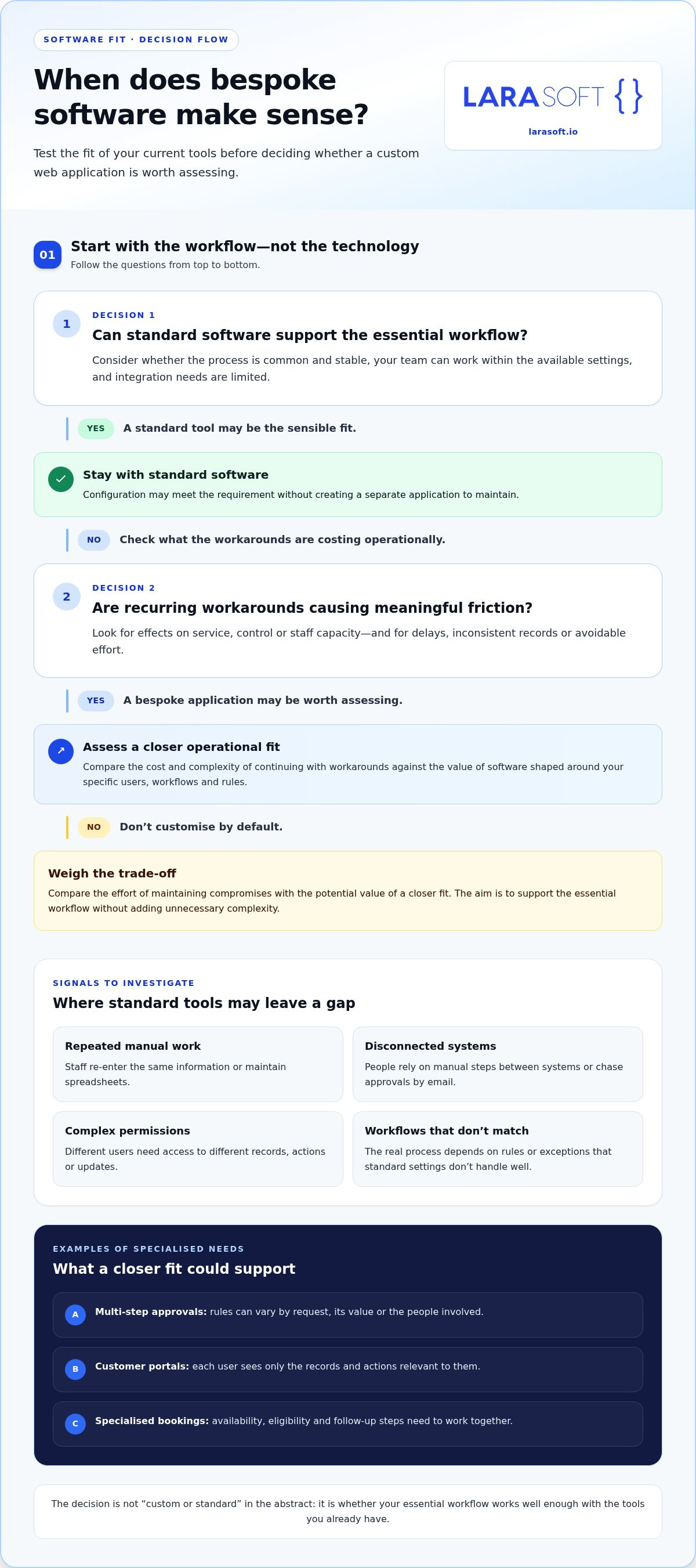
The decision isn’t about choosing custom software because it sounds more flexible. It’s about whether your processes, users and existing systems work well enough with the tools you already have. Repeated manual tasks, disconnected data, complex permissions or workflows that don’t match standard software can signal a gap worth investigating.
Start with the operational consequence, not the technology. Are staff re-entering the same information, chasing approvals by email or maintaining spreadsheets because a system can’t handle the real process? These workarounds can cause delays, inconsistent records and avoidable effort.
For example, a multi-step approval process may need different rules depending on the request, its value or the people involved. A customer portal might need to show each user only the records and actions relevant to them. A specialised booking workflow could need to coordinate availability, eligibility and follow-up steps in a way that a basic calendar can’t support.
Identify who uses the process, where it stalls and what a better outcome would look like. If the need is recurring and affects service, control or staff capacity, bespoke web application development uk may be worth assessing against the cost and complexity of continuing with workarounds.
Standard tools can be a sensible choice when your process is common and stable, your team can work within the available settings, and integration needs are limited. Configuration may meet the requirement without creating a separate application to maintain.
The balance changes when configuration depends on fragile workarounds, duplicate data entry or manual steps between systems. Compare the effort of maintaining those compromises with the value of a closer operational fit. The aim isn’t to customise everything. It’s to support the essential workflow without adding unnecessary complexity. A fuller comparison of custom applications and off-the-shelf software can help clarify that trade-off.
A clear scope starts with the work people need to do, not a list of screens or features. A good application scope defines its users, the actions they need to complete and the measurable outcomes the business expects. This gives business and technical teams a shared basis for deciding what to build, what to defer and how to judge whether the result works.
For bespoke web application development uk, use this sequence to turn operational knowledge into requirements:
Follow a real task through the business. Note who enters information, who reviews it, who makes a decision and what happens when details are missing or a request falls outside the usual path. Record permissions too: a staff member may need to update a case, while a customer can only view its progress.
Then capture the information each role needs to enter, review or retrieve. Turn recurring friction into ranked requirements, such as reducing duplicate entry or making approval status visible. This keeps the scope tied to user needs and business rules, rather than assumptions about screens or technology.
Separate launch-critical capabilities from improvements that can follow once people have used the application. A first release should support the complete essential process, not a partial feature set that leaves staff relying on the same workarounds. This controls scope without weakening the intended outcome.
Write requirements as user stories, then make each one testable. For example: “As a manager, I can approve a submitted request.” Acceptance criteria might specify that an authorised manager can view the request, approve or reject it, and see the resulting status recorded. “Add approvals” alone is too vague to guide implementation or testing.
Clear priorities and acceptance criteria also make technical decisions easier to assess. For a deeper view of the stages from discovery through release, see a guide to the web application development process. If you’re shaping requirements for a bespoke Laravel application, explore Larasoft’s web application development.
Architecture determines how an application’s parts work together and how easily it can change as the business evolves. For bespoke web application development uk, the right choice depends on the requirements, not on which approach is most fashionable. A monolithic application keeps much of its functionality in one system, which can be simpler to build and operate when the product has a clear, unified purpose. An API-oriented approach separates functions behind defined interfaces, which can help when multiple applications need to share data or develop independently. It also creates more boundaries to manage and test.
Laravel is a PHP framework used to build the application’s backend: the logic that applies business rules, manages data and handles requests. Vue.js or React can provide a responsive, interactive frontend when users need a richer interface. These are options, not a default pairing. Complexity, integration needs, team capability and the likelihood of future change should guide the stack. For more on evaluating technical expertise and fit, read this strategic guide to choosing a Laravel development agency.
An integration is more than a connection between systems. Define what information moves, which system owns the authoritative record, how often data is exchanged and what happens if a request fails. For example, if an application sends a record to an existing business system, plan for failed transfers and duplicate submissions, and decide how users can see whether the update succeeded. Clear boundaries help limit errors and make responsibility for data understandable.
Security decisions also shape architecture. Plan authentication to verify who is signing in, then apply least-privilege access so each role can view or change only what it needs. Protect sensitive data as it moves between systems and wherever it is stored. Testing should cover permissions, expected behaviour and failure cases. Operational monitoring can help teams spot errors or interruptions after release.
Assess UK GDPR requirements in the context of the personal data the application handles, its purpose and its data flows. This is a design consideration, not a claim that a particular stack guarantees compliance. Accessibility belongs in the same early planning. Use WCAG 2.2 as a reference for interface requirements and testing, including keyboard operation, clear labels and sufficient contrast. Addressing these needs during design and quality checks is more effective than leaving them until launch.
Architecture, integrations and ongoing maintenance are connected decisions. A requirements-led approach helps keep the application secure, understandable and practical to change as business needs develop.
A successful release is more than software that runs. It should meet the agreed scope, support the intended workflow and leave your organisation able to understand and maintain what’s been built. Assess delivery and ownership together, not as separate decisions made before and after launch.
Use this checklist to review release readiness:
A structured technical assessment can identify gaps in delivery evidence, documentation, access or support arrangements before they become harder to address. Explore Larasoft’s custom web application development to understand how its services support bespoke applications.
Before development, where practical, record a baseline tied to the problem the application is meant to solve. Choose a small set of operational measures, such as time spent on manual handling, the proportion of tasks completed successfully or delays between process stages. Keep each measure connected to an intended outcome, rather than collecting data simply because it’s available.
After launch, compare results with the baseline and gather feedback from the people using the application. If a step remains slow or confusing, investigate why before adding features. This grounds improvements in real use and gives the business a clearer basis for prioritising changes.
Ownership needs defined responsibilities for code, deployments, dependency updates, monitoring and ongoing improvements. Regular software maintenance helps keep an application supportable as its technical components and business requirements change. Clear documentation and maintainable code also make it easier to assess changes without relying on undocumented knowledge.
If an existing application is difficult to update, this legacy code modernisation strategic guide explores how to approach improvement. Treat the application as a long-term business asset: review its health, address technical issues and use operational evidence to shape what comes next.
Larasoft provides bespoke Laravel web application development for UK businesses with defined operational requirements. The focus is a custom build shaped around the application’s users, rules and integrations, rather than a generic product that forces the workflow to fit. For businesses considering bespoke web application development uk, the aim is to bring the key technical decisions together around what the application needs to do now and how it may need to change.
Laravel provides the backend foundation for application logic, data handling and business rules. The frontend should suit the people using the application and the tasks they need to complete. Vue.js or React can support interactive interfaces, with the choice guided by product requirements rather than treated as a fixed prescription.
Existing systems matter too. API integration can connect relevant services and data flows, helping an application fit into the wider business environment. Planning the backend, interface and integrations together makes it easier to define where information comes from, how it moves and what users need to see or do.
For teams weighing frontend options, Larasoft’s strategic guide to Vue.js frontend development explores how the framework can support modern business interfaces.
A custom application needs more than completed features. Testing should check that essential workflows behave as expected, while deployment readiness and clear technical documentation help prepare the application for release and future work. Maintainable code makes it easier to respond as requirements evolve.
Ownership continues after launch. Larasoft’s software maintenance can support application stability, security updates and planned changes over time. The right maintenance approach depends on the application and its ongoing needs, but it should be considered as part of the solution rather than an afterthought.
When planning a bespoke application, define the operational challenge, the users affected and any key systems it needs to connect. These details help keep technical decisions grounded in the work the application needs to support.
A bespoke application is a sound investment when it fits the way your business works and solves a clearly defined operational problem. Start by mapping users, workflows and priorities, then set measurable acceptance criteria to keep the scope focused. Architecture, integrations and security should support those requirements, while testing and maintenance help the application remain useful beyond launch.
For businesses considering bespoke web application development uk, Larasoft’s primary service is Laravel web application development. Vue.js or React can support an interface shaped around user needs, while API integration can connect the application with relevant existing systems. Software maintenance helps support ongoing stability and planned changes as requirements evolve.
Bring your workflow challenge, the users affected and any systems the application needs to connect. Discuss your bespoke application requirements with Larasoft and explore practical next steps for a custom solution. With a clear scope and the right technical partnership, your application can become a dependable foundation for what comes next.
Bespoke web application development is the design and construction of interactive software around a business’s specific users, workflows and rules. Unlike a content-led website, an application enables people to complete tasks, such as submitting requests, reviewing records or managing bookings. A bespoke build can also connect with existing business systems, so the application supports operational needs rather than requiring the business to reshape its processes around a standard product.
Choose a bespoke application when important workflows, permissions or system connections don’t fit standard tools and workarounds are causing repeated effort or delays. First define the business problem, the people affected and the outcome you need to measure. A custom build isn’t automatically the best choice: configurable software may suit common, stable processes. Bespoke web application development uk is most relevant when a tailored workflow or integration offers clear operational value.
The cost depends on the application’s scope, complexity, integrations, security needs and ongoing support requirements. A focused tool with a small number of workflows has different demands from a multi-role application connecting several business systems. There’s no reliable single figure without understanding those requirements. Define the essential first release, user roles, data flows and acceptance criteria before assessing investment. Also account for testing, deployment preparation and maintenance, not only initial development.
Delivery time depends on the scope and complexity of the application, including how many workflows, user roles and integrations it needs. Clear requirements and decisions about the first release help the team plan work and reduce avoidable uncertainty. Testing, feedback and deployment preparation also take time. Rather than relying on a generic timeframe, break the work into agreed stages and assess the schedule against the application’s actual requirements.
Technology choices should follow the application’s requirements, integration needs and plans for future change. Laravel is a backend framework used to implement application logic and business rules. Vue.js or React can support interactive frontend interfaces, depending on the product and user experience requirements. APIs can connect the application with other systems. Larasoft’s primary web application development service uses Laravel, with Vue.js and React frontend development available as part of a tailored solution.
Plan security around the application’s data, users and integrations. Use authentication to verify users, restrict access according to role, protect sensitive information and test permissions and error scenarios. Assess relevant UK GDPR requirements in context, based on the personal data processed and how it is used. Accessibility should also be designed and tested throughout development, using WCAG 2.2 as a reference where appropriate. No framework alone guarantees security or compliance.
Yes, a bespoke application can connect with existing business systems through API integration where the systems and requirements support it. Planning should identify what data is exchanged, which system owns each record, how updates are handled and what happens if a transfer fails. These details help prevent inconsistent information and make system responsibilities clearer. Larasoft provides API integration alongside custom Laravel web application development, helping connect an application with relevant business processes.
Here’s what we've been up to recently.
Certified Quality. Great Prices