Custom Food Delivery App Development: A 2026 Buying Guide

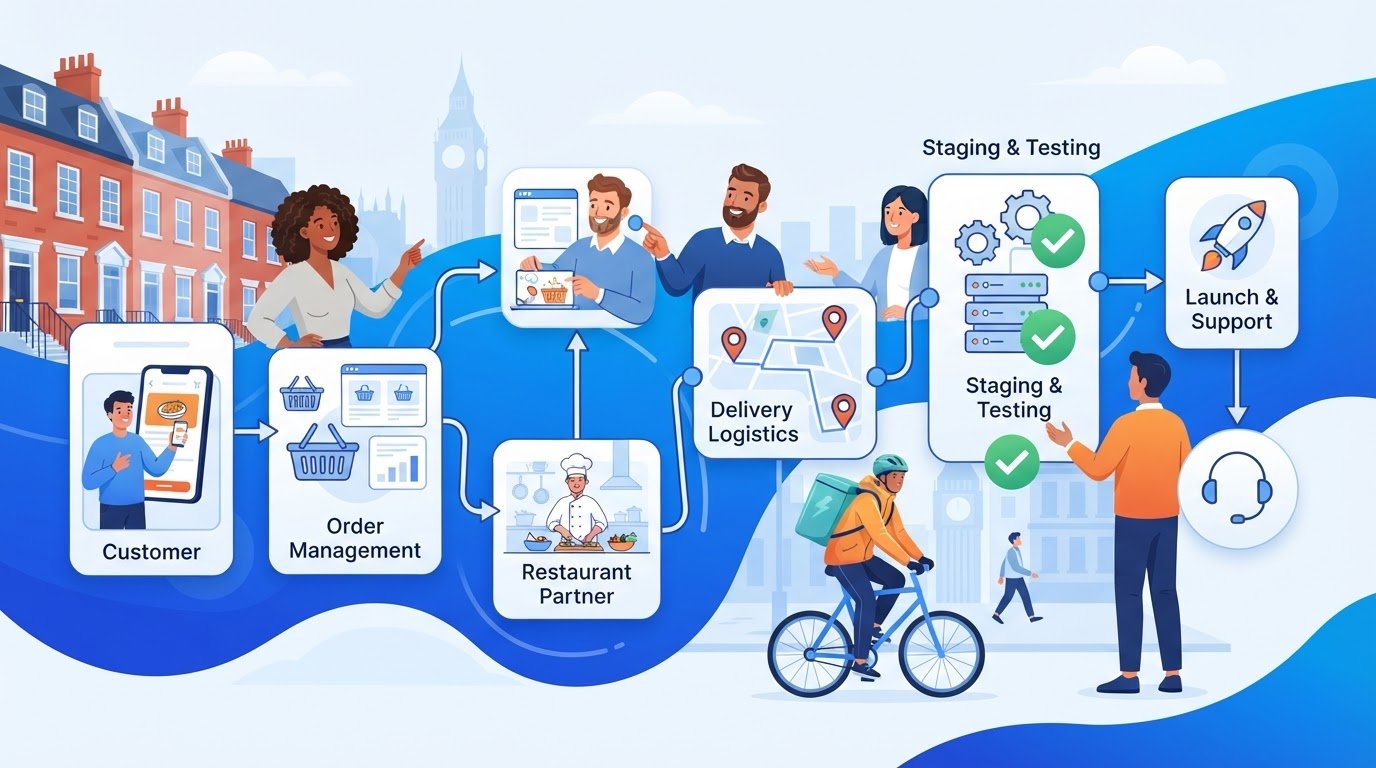
The right food delivery app isn’t the one with the longest feature list. It’s the one built around how your business takes, prepares and fulfils orders. That’s why custom food delivery app development should start with your operating model, not a set of assumed features.
Choosing between a single-brand app and a multi-vendor marketplace shapes everything that follows, from customer ordering to restaurant and courier workflows. Integrations, testing arrangements and post-launch support also need attention if the platform is to work reliably in practice.
This guide will help you choose a delivery model that fits your business and customer experience, then turn it into a prioritised, testable project scope. You’ll see which workflows to define, how to plan integrations and what to establish around ownership and ongoing support. Larasoft provides a staging server for client testing during development. Under the standard service agreement, code ownership is fully transferred to the client, and long-term support is available through service level agreements (SLAs).
Custom food delivery app development is the creation of software tailored to a business’s ordering, preparation and fulfilment operations. The aim isn’t simply to put a menu on a screen. It’s to shape a working system around who places orders, who prepares them and who is responsible for getting them to the customer.
Set those decisions before design begins. A restaurant taking its own orders has different needs from a marketplace coordinating independent vendors. A collection-only service has different hand-offs from a delivery operation. The service area also affects practical requirements, such as where orders can be placed and which fulfilment options customers can select. For general context on the range of models involved, see Online food ordering.
Keep customer experience goals distinct from internal operational needs. Customers may need to find suitable dishes, place an order and understand what happens next. Staff may need to receive, confirm and manage orders without re-entering information across systems. Define and assess both sides separately.
Start by naming the participants: who orders, who fulfils each order and who manages the platform? A single restaurant may handle its own menu and preparation, while a marketplace may involve several vendors and a separate party coordinating delivery. These responsibilities determine the hand-offs the app must support.
Then identify where the current process creates friction. Is it difficult for customers to find the right menu, complete checkout or understand order progress? Do staff receive incomplete details, manually re-enter orders or struggle to coordinate preparation and collection? Describe the problem before proposing a feature.
Connect each proposed capability to an outcome that can be assessed, without assuming the software will guarantee it. For example, a business might track checkout completion, order corrections, time to accept an order or fulfilment delays. These measures help the team judge whether a workflow addresses the original issue.
A useful brief gives the development team an operating picture, not just a feature wishlist. Record the intended users, order types, fulfilment approach, service area and launch objectives. Clarify who manages menus, handles incoming orders and resolves exceptions, such as an unavailable item or a requested order change.
Separate launch-critical workflows from later enhancements. The first group should describe the minimum complete journey needed to accept and fulfil an order. Consider enhancements against user value and operational impact once the core process is clear.
Quotable principle: The business model determines app scope because it defines who participates, which workflows must connect and who is accountable for fulfilment.
A delivery platform is one connected order lifecycle, not three separate feature sets. A customer’s choice must become an actionable restaurant order, then pass to whoever handles fulfilment. Each role needs the information and controls required at its point in the process, while the platform keeps the order’s state consistent.
Map the journey from discovery to completion before deciding how screens should look. A customer might browse restaurants, compare menu items, review a basket and submit an order. The restaurant then needs to receive and respond to it. Depending on the operating model, a courier or another fulfilment role may take responsibility for the next hand-off.
Make the path to a complete order clear. Customers need to find relevant restaurants, understand menu information, select items and review quantities, options and the final basket before checkout. Keep the steps and decisions visible so customers can spot errors before placing an order.
Define what happens after checkout, too. Decide which order updates customers should receive, where they can view progress and how they can return to order history. Include accessibility, privacy and payment experience in the design brief: consider readable content, straightforward navigation, appropriate handling of personal information and a payment flow that fits the business’s chosen setup.
Restaurant staff need a clear incoming-order process: receive the order, accept or decline it, prepare it and update its status at agreed points. Specify who can edit an order and how exceptions are handled, such as an item becoming unavailable. A status should reflect an operational event, not simply change because a screen has been opened.
Next, define dispatch responsibility. The restaurant may manage fulfilment, the platform may coordinate a courier, or responsibilities may be shared. Decide what each role can see and update, and which delivery milestones customers need to understand. For example, “accepted”, “being prepared” and “ready for collection” are useful only if they match the actual process and have a clear owner.
Quotable principle: An order lifecycle connects customer intent to restaurant action and fulfilment, with each status change owned by the role responsible for the next step.
Admin tools provide oversight across these journeys. Depending on the agreed scope, administrators may need to manage catalogue information, user access and operational exceptions. Decide what needs central control and what should remain with a restaurant or fulfilment role.
Define integrations rather than assuming they are included. Payment processing, mapping and customer notifications each have their own requirements, data flows and operational implications. Specify the intended provider or system, the information that needs to pass between systems and what should happen when a connection fails. This gives custom food delivery app development a testable foundation and keeps integration decisions from being left until build work is under way.
Larasoft provides a staging server for client testing during development. Code ownership is fully transferred to the client under the standard service agreement, and long-term support is available through service level agreements (SLAs). Explore custom web and mobile development to shape connected workflows around your operating model.
The best-fit model depends on who owns the customer relationship, who supplies the food and who is accountable for fulfilment. A single-brand app gives one business control over its ordering experience. A marketplace brings multiple vendors into a shared platform. A hybrid combines an owned offer with participating vendors. Each model creates different requirements for catalogue management, access and order coordination.
Use the comparison to clarify responsibilities, not predict performance. A marketplace isn’t automatically the more complex choice, and a single-brand app still needs careful workflow design. Scope only the roles and processes your model needs.
| Decision factor | Single-brand | Marketplace | Hybrid |
|---|---|---|---|
| Control | One business controls its menu and customer experience. | The platform coordinates a shared customer experience across vendors. | The platform manages its own offer alongside participating vendors. |
| Vendor participation | Typically limited to the business’s own operation. | Multiple vendors need ways to manage their catalogue and orders. | Owned offerings and external vendor listings coexist. |
| Fulfilment | The business defines who prepares and fulfils orders. | Responsibilities must be clear across platform, vendor and delivery roles. | Responsibilities may differ between owned and vendor orders. |
| Operational focus | Support the business’s own ordering process. | Coordinate vendor onboarding, catalogue oversight and shared processes. | Handle the distinct rules for owned and participating offers. |
This model fits a business that controls its own menu, ordering process and customer experience. It can be a focused option when one operation sets the catalogue and decides how orders are handled. The app’s fulfilment capabilities should reflect existing arrangements: if the business manages delivery, the workflow differs from one where customers collect orders or another party fulfils them.
Consider a marketplace when multiple vendors need to present their offerings through one platform. The brief should define how vendors join, maintain catalogue information, receive orders and participate in operational decisions. A hybrid suits a business that wants to combine its own offer with participating vendors, but it must account for differences in catalogue ownership and fulfilment responsibility.
In either model, avoid adding functionality simply because it might be useful later. Define the minimum administration each role requires, such as managing vendor access or reviewing catalogue changes. Keep other workflows out of the initial scope unless they serve a clear need.
Custom food delivery app development doesn’t have to mean building every possible feature. It means shaping the software to the selected operating model, with room to extend it as needs evolve. Larasoft provides a staging server for client testing during development. Code ownership is fully transferred to the client under the standard service agreement, and long-term support is available through service level agreements (SLAs).
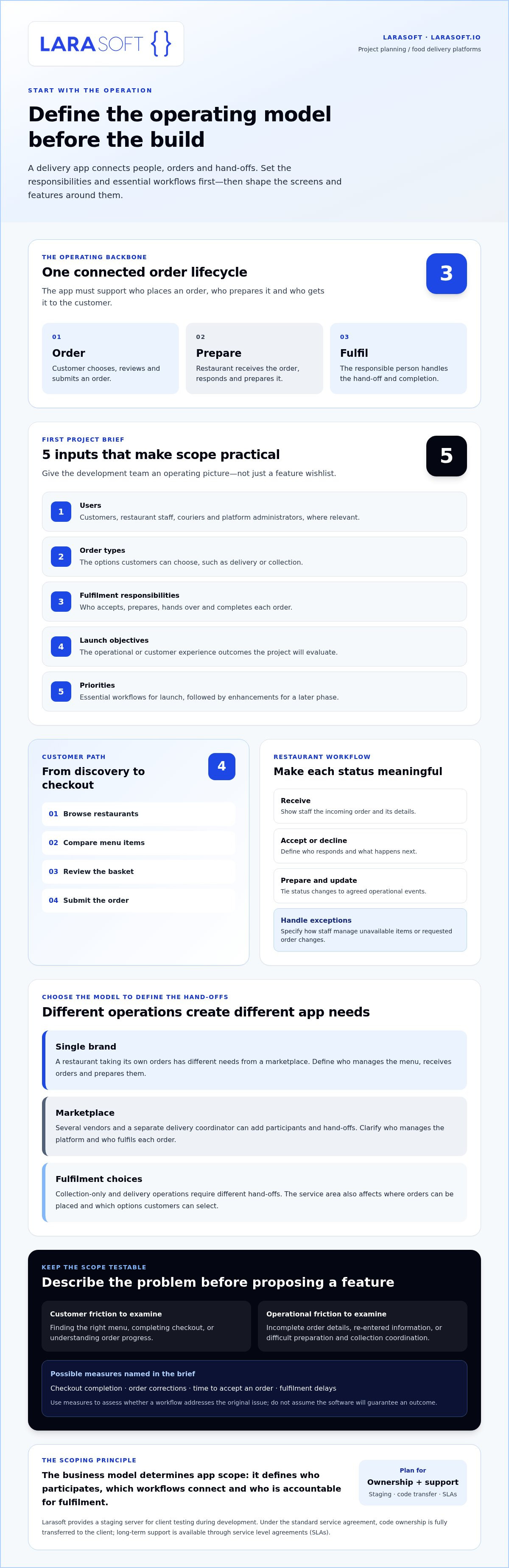
A useful scope turns business priorities into decisions the team can build and test. For custom food delivery app development, define operating requirements first, then use them to distinguish essential launch workflows from useful future enhancements. This keeps the project focused without overlooking security, performance, accessibility or maintainability.
Work through these steps in order:
Include non-functional requirements in the same brief. Describe expectations for security, performance, accessibility and maintainability rather than leaving them as broad aspirations. Review the scope against real order scenarios before sign-off, including a normal order and an exception such as an unavailable menu item. This can expose missing responsibilities and dependencies early.
Rank each feature by whether it enables ordering, fulfilment, administration or essential reporting. Then identify dependencies: checkout may rely on a payment integration, while order status updates depend on agreed workflow rules. Keep later enhancements visible in a separate list, but don’t make them launch conditions unless the core service relies on them.
A clear proposal defines deliverables, responsibilities, testing arrangements and acceptance criteria. It should separate agreed scope from assumptions and future options, so neither the build team nor the business has to infer what “complete” means. Larasoft provides a staging server for client testing during development, giving the client a place to review the work against agreed scenarios before release.
Validate the proposed workflows with the people who manage orders, menus and fulfilment. Their day-to-day knowledge can reveal hand-offs or exceptions a high-level brief misses. Document integration requirements and the access needed to existing systems, then confirm that each key scenario has an owner and a testable outcome.
For a clear ownership plan, code ownership is fully transferred to the client under the standard service agreement, and long-term support is available through service level agreements (SLAs). Discuss your food delivery app requirements and shape the project scope around the workflows your business needs.
A food delivery platform needs to reflect the business behind it: its ordering rules, participants and fulfilment process. Larasoft develops custom web and mobile applications around these operational needs, helping turn an agreed project scope into software that can evolve with the business. A clear working partnership includes defined testing and ownership arrangements alongside the build plan.
Plan for the product beyond launch, too. A custom app is a long-term business asset, so the project should establish how the client can test the work, retain control of the code and access support after development. These arrangements make the transition from build to ongoing ownership more structured.
Larasoft is an Official Laravel Certified Company, with Laravel developers since 2012 and experience across almost a hundred web and mobile apps. Its stated proof points include 99 % Satisfaction and 24 / 7 Support. These details provide context for its technical background and support approach as you plan custom food delivery app development.
Experience is most useful when it connects to delivery practices. Larasoft provides a staging server for client testing during development, so the client can review work against agreed requirements before it moves forward. This provides an opportunity to test workflows and give feedback during the project, rather than leaving review until after launch.
Set expectations for continuity and ownership in the project agreement. Under Larasoft’s standard service agreement, code ownership is fully transferred to the client. Long-term support is available through service level agreements (SLAs), giving the project a defined route for support beyond the initial development phase.
Larasoft can also inherit partially completed projects at any development stage. This can help businesses continue work on an existing application rather than treating a previous build as an automatic dead end. A handover can begin with understanding the current codebase, the work completed and the remaining requirements, then aligning the next steps with the intended product scope.
Larasoft’s stated recognition includes Most Reliable Web Development Agency in the UK Enterprise category for the SME Awards 2021, alongside the figure £100 k + Sales. Consider these alongside the project-specific details that matter to your business: scope, testing, responsibilities, ownership and ongoing support. Clear answers across these areas help establish a sound basis for commissioning and maintaining a custom platform.
To discuss a tailored build or a project already in progress, Discuss a custom food delivery app project.
The next step is to make your decisions actionable. Bring the people who will use the platform and the constraints of your current processes into one working brief. Record what must be ready at launch, what can wait and how proposed changes will be assessed. A strong custom food delivery app development plan gives stakeholders a shared reference as design and development progress, rather than leaving important decisions to assumptions.
Keep that plan connected to your business priorities. As your service evolves, new vendors, order types or fulfilment arrangements may change what the platform needs to support. A clear starting point helps your team assess those changes deliberately and extend the product without losing sight of its purpose.
Larasoft works with businesses to turn operational requirements into tailored software. Discuss your custom food delivery app and take the next step towards a platform shaped around your business.
The total depends on the project’s requirements, operating model, user journeys, integrations and delivery scope. A single-brand ordering app and a multi-vendor platform can require different work. Define the essential workflows and expected outcomes first, then request a scoped proposal. Avoid comparing proposals by headline alone; compare deliverables, assumptions, testing arrangements and ongoing support. Whether consulting an established agency like 4mation or drafting specifications internally, a written feature boundary makes estimates easier to compare.
There is no single timeline that fits every project. The schedule depends on the number of user roles, workflow complexity, integrations, design decisions and how quickly stakeholders review and approve work. A clearly defined first release can help teams plan more effectively. Ask for milestones, dependencies and client review points to be documented in the project plan. For example, identify who approves menu and checkout screens before development begins.
It may be possible to connect an app to existing business systems through APIs or other integration approaches, depending on the systems and their capabilities. Identify the tools involved, the data that needs to move and when it must update. Treat each integration as a scoped requirement rather than assuming it is included automatically, and document how the connected workflows should behave. For example, a menu system may need to share item availability, while an order system may need status changes.
Not necessarily. The right interface structure depends on who uses the platform, what each role needs to do and how frequently they use it. Some projects may benefit from distinct mobile experiences; others may use a mix of apps and web-based tools. Map each role’s essential tasks first, then decide which interface best supports those workflows. A restaurant team at a counter may value a larger-screen order queue, while couriers may need a focused mobile interface.
It can be, if the app solves a clearly defined business need and its initial scope is proportionate. Start by identifying the ordering and fulfilment workflows that matter most, then distinguish launch essentials from future enhancements. A custom build is not automatically the right answer for every business; compare the control and flexibility needed with the work required to operate the platform. For instance, a business could begin with its own ordering channel and defer multi-vendor administration.
A project does not necessarily need to start over. Larasoft can inherit partially completed projects at any development stage. Begin by documenting the existing codebase, current functionality, outstanding work and technical dependencies. A structured review can establish what is working and what remains, creating a clearer basis for planning the next development steps and testing the resulting changes. Keep a record of access, known defects and decisions so the next phase starts from shared facts.
Under Larasoft’s standard service agreement, full ownership of the code transfers to the client. Make sure project documentation describes the agreed deliverables and how handover is handled. Ownership is an important part of the long-term plan because it supports a clear understanding of the client’s rights and responsibilities as the application evolves after the initial development work. Also agree how credentials, deployment materials and technical documentation are handed over.
Here’s what we've been up to recently.
Certified Quality. Great Prices