Custom Loyalty Program Software: A 2026 Buyer’s Guide

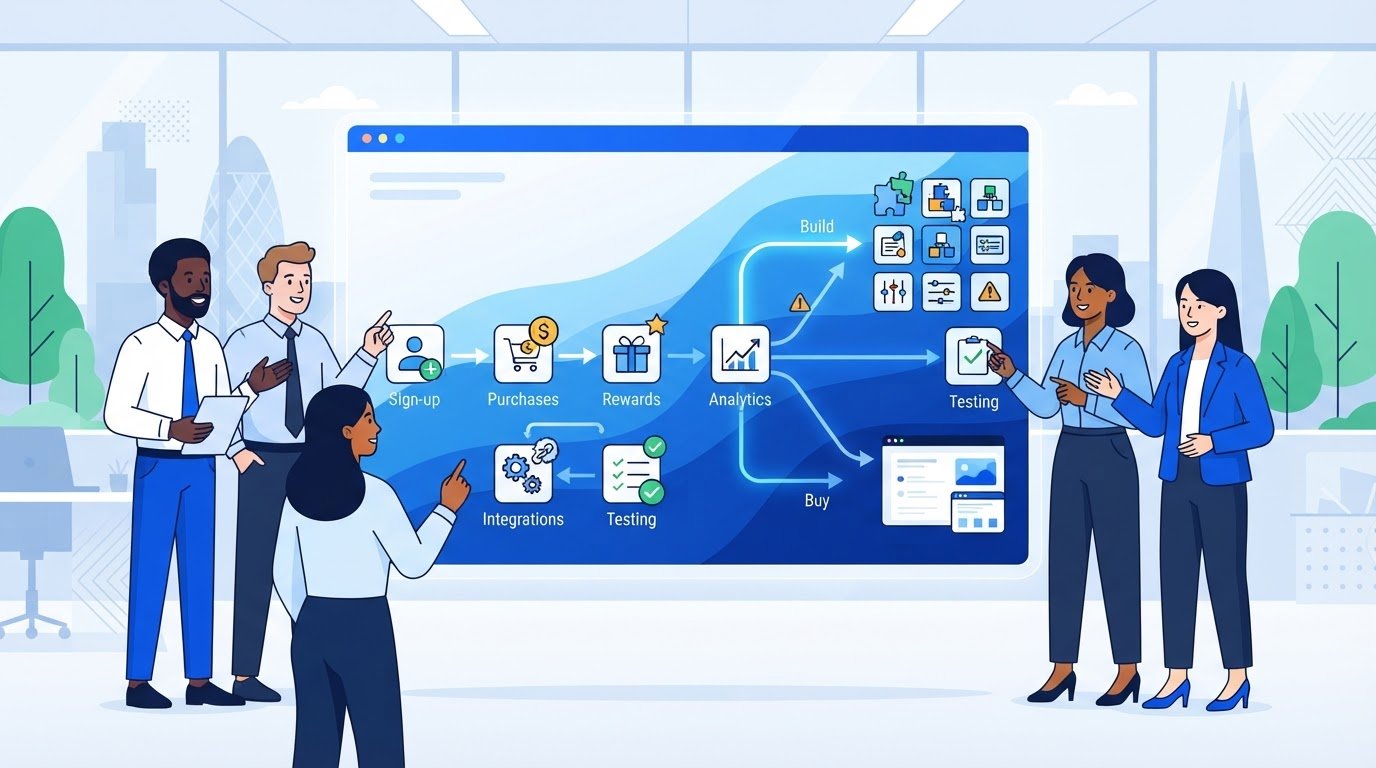
The most flexible loyalty platform may be the one you don’t build. If a ready-made product supports your customer journey and connects cleanly with your existing systems, it may be the more practical choice. Custom loyalty program software makes more sense when your programme rules, workflows or integrations need a closer fit than standard tools can provide.
That trade-off is easy to underestimate. Choosing features before agreeing what success means can leave you with a complex platform that doesn’t encourage the behaviours your business wants. This guide gives you a practical framework for comparing build and buy, defining capabilities and integrations, and planning a loyalty experience around how customers discover, purchase and return.
You’ll also learn how to assess total ownership beyond the initial build, including testing and ongoing support. For a custom project, Larasoft provides a staging server for client testing during development. Under the standard service agreement, code ownership is fully transferred to the client, and long-term support is available through service level agreements (SLAs). The aim is a clear brief and a platform designed around business goals, not a feature checklist.
Custom loyalty program software is an application designed around a business’s rewards, customer journeys and existing systems. It applies programme rules, presents rewards to customers and connects loyalty activity with relevant services. The software is the mechanism, not the objective. The objective might be to encourage repeat purchases, improve retention, increase engagement or support another measurable business priority.
Loyalty programmes can take different forms, from points and tiered rewards to vouchers and referral incentives. The broader Loyalty program concept spans a range of ways businesses recognise and encourage customer participation. The right format depends on the value you want customers to receive and the actions that matter to your business.
Custom-built software applies rules and workflows to agreed business requirements, rather than relying solely on the settings available in a configurable product. For example, a programme might award different rewards to online and in-store customers, or offer a milestone reward after a defined sequence of purchases. These are possibilities, not universal requirements. If standard workflows already fit, custom development may add unnecessary complexity.
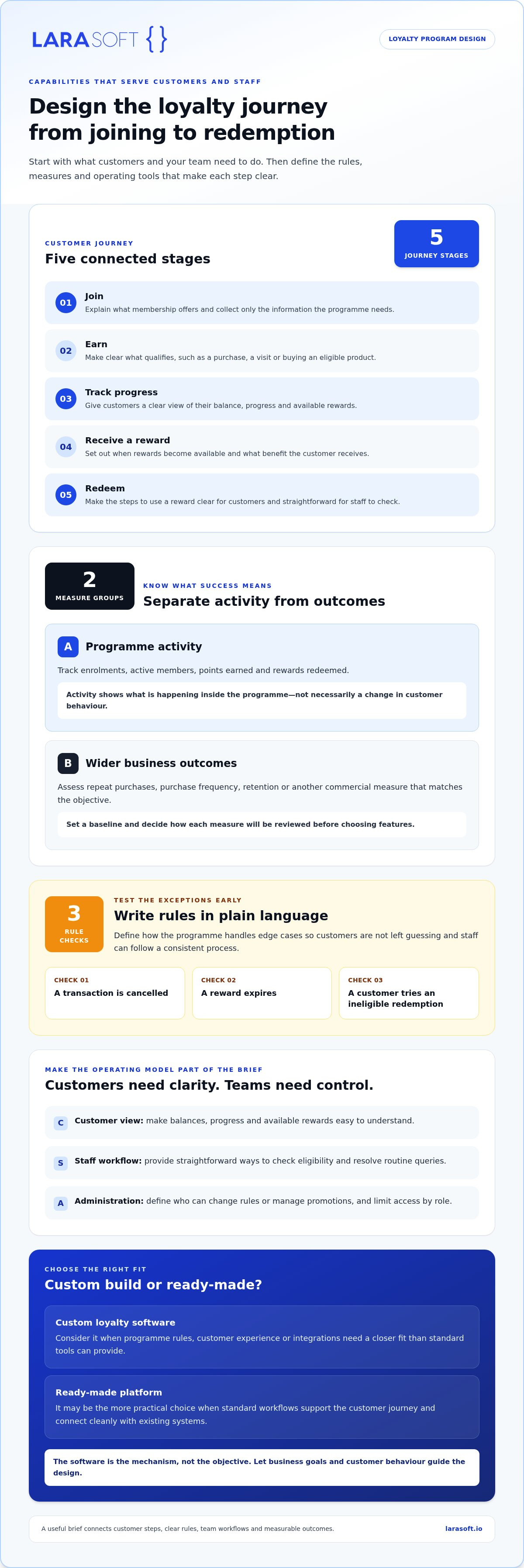
Start with the business outcome, then identify measures that can show whether the programme is contributing. A retention goal could be assessed through repeat-purchase patterns, while a reward-use goal could be tracked through redemption activity. These measures are related but not interchangeable: a high number of points issued shows programme activity, not necessarily a change in customer behaviour or commercial performance.
Separate measures into two groups:
Set a baseline and decide how each measure will be reviewed before selecting features. If the aim is to increase repeat visits, for example, define what counts as a return visit and the period over which you’ll assess it. This makes it easier to distinguish a useful feature from one that simply adds another screen, rule or report. Software can support programme delivery, but results also depend on the reward offer, the customer experience and consistent execution. No platform can guarantee that customers will respond as intended.
These decisions also shape the technical brief. A bespoke application can bring customer-facing journeys and business rules together with the systems needed to support them. Larasoft develops custom Laravel web and mobile applications, with API integration and Vue.js or React frontend work to support defined project requirements. The delivery relationship includes a staging server for client testing during development. Under the standard service agreement, code ownership is fully transferred to the client, and long-term support is available through service level agreements (SLAs).
Larasoft is an Official Laravel Certified Company, with Laravel developers since 2012 and experience building almost a hundred web and mobile apps. Its stated credentials include 99 % Satisfaction, 24 / 7 Support and £100 k + Sales. These details provide context for the development partner behind the platform; the programme itself still needs clear goals and measures to guide its design.
Build the capability brief around what customers and staff need to do, rather than starting with a list of fashionable features. A useful journey runs from joining the programme through earning and checking progress to receiving and redeeming a reward. Each step should be clear to the customer and manageable for the team operating it.
Specify what qualifies for earning, how rewards become available and what a customer must do to use them. Possible triggers include a purchase, a visit or buying an eligible product. Rewards might take the form of a discount, voucher or another agreed benefit. These are programme choices, not defaults every business needs.
Write the rules in plain language, then test exceptions: what happens if a transaction is cancelled, a reward expires or a customer tries to redeem an offer that doesn't apply? Defining these cases early reduces confusion at checkout and gives staff a consistent process to follow.
Joining should explain what membership offers and capture only the information the programme needs. Customers may need a clear view of their balance, progress and available rewards, while staff need straightforward ways to check eligibility and resolve routine queries. Set out who can change rules or manage promotions, and use permissions to limit access to appropriate roles.
Administration and measurement matter too. A team may need to schedule promotions, adjust earning rules and review performance without asking a developer to make routine changes. Reports should distinguish enrolments and rewards issued from redemptions and other measures tied to the programme's objectives. Choose reporting that supports decisions, not simply a larger volume of data.
Map integrations to the systems your business actually uses. A point-of-sale (POS) system may be relevant for in-store earning, while ecommerce or CRM connections may support online orders and customer records. For practical analyses of how specialised retail sectors align digital store architecture with operational workflows, industry resources such as jewelryecommerce.com examine digital commerce platforms and customer retention strategies. Payment integration is relevant only where the loyalty workflow requires it. Define which events need to move between systems, such as a completed purchase, points earned, a reward issued or a redemption.
Then choose a customer-facing channel to match how people engage with your business. That could be a responsive website, a mobile app or another scoped experience; don't assume every programme needs all three. A tailored interface can make balances and redemption steps easier to understand. For a web experience, Vue.js frontend development can support a customer interface shaped around the agreed journey.
Protect customer data through design, not as a late-stage addition. Define what information is collected, who can view or amend it, and how access should differ between customer, staff and administrator roles. Include these requirements alongside your integration map so data flows and permissions are considered together. This keeps the architecture focused on real workflows instead of a speculative feature wishlist.
Use that map to prioritise custom loyalty program software: first the capabilities required for the core journey, then enhancements supported by a clear business need. A focused integration and interface brief gives development work a practical boundary. If you’re shaping a bespoke loyalty experience, Larasoft’s application development can translate agreed requirements into a web or mobile solution.
There isn’t a universally better route. A ready-made platform can be the sensible choice when its standard mechanics and existing integrations cover your needs. A bespoke application may be worth evaluating when distinctive workflows, connected systems or a specific customer experience don’t fit those options. Compare how each option works in practice, not just its feature count.
Decision area | Ready-made platform | Bespoke application
Fit | Works well when standard programme journeys match your requirements. | Can be shaped around specific rules and workflows.
Configuration | Uses the settings and options provided by the platform. | Requirements define how programme rules and administration work.
Integrations | Existing connectors can simplify adoption when they support your systems. | API integration can be designed around the systems and events in scope.
Customer experience | Uses the platform’s available interfaces and journey patterns. | The experience can be designed around your customer journey.
Ownership | Access and control are governed by the platform’s terms. | Under Larasoft’s standard service agreement, code ownership is fully transferred to the client.
Ongoing change | Changes depend on available configuration and the platform’s development. | Changes can be planned against the application’s architecture and agreed scope.
If familiar mechanics meet your programme goals and the platform connects with the systems you already use, buying can keep the project focused. You won’t need to define every interaction from scratch. For example, Loopy Loyalty centres on digital stamp cards, while Square presents loyalty within a broader POS and commerce ecosystem. These illustrate different product approaches, not a universal template.
Assess the whole workflow, from customer enrolment to redemption and the reporting your team needs. A platform that covers the essential journey with workable integrations may be a better fit than commissioning custom loyalty program software to reproduce standard functions.
Consider custom development when your programme depends on non-standard rules, several connected systems or administration that doesn’t align with a ready-made workflow. It can also suit a business that needs greater control over future changes and the customer-facing experience. The decision should account for the application’s ongoing ownership and support, not only its initial design.
For a custom build, Larasoft provides a staging server for client testing during development, and long-term support is available through service level agreements (SLAs). If you’re assessing this route, a strategic guide to choosing a Laravel development agency can help structure the technical and working-relationship criteria.
Before deciding, list requirements that are essential at launch, then separate desirable enhancements. Compare each option against that short list, including integration fit, operational effort and how change will be handled. This makes the trade-off concrete: choose ready-made when it meets the need, and evaluate a bespoke application when the gaps affect the customer journey or day-to-day operation.
A clear scope turns business goals into decisions about journeys, rules, integrations and release priorities. Before selecting technical components, document what the programme must achieve and how customers and staff will use it. This gives a development team a practical brief for custom loyalty program software, while helping prevent useful later ideas from becoming unplanned launch requirements.
Work through these steps in order. Keep each decision specific enough to guide design, development and testing.
Use a short checklist to make the brief easy to review:
Scope area | Decision to record
Launch requirement | What must work before the programme goes live?
Later enhancement | What can be deferred without blocking the core journey?
Data and access | What data moves, and which roles can view or change it?
Ownership | Who manages rules, member queries, promotions and operational decisions?
Acceptance | What user action and system response demonstrate that each requirement works?
For each connection, state the source system, the data or event exchanged, and what the loyalty application should do with it. This clarifies whether the project needs an API integration, data migration or both. If the loyalty journey must work with existing software, assess its current interfaces and constraints early; legacy code modernisation may form part of the technical plan.
Plan testing around real customer and staff scenarios. Larasoft provides a staging server for client testing during development, giving stakeholders a place to review workflows before release. Agree who supplies test cases, who approves results, who prepares the rollout and how feedback will be assessed. Include permissions and migrated data in those tests, not just the ideal customer journey.
Document how future rule changes will be handled, who owns day-to-day administration and what support is required after launch. Under Larasoft’s standard service agreement, code ownership is fully transferred to the client, and long-term support is available through service level agreements (SLAs). Plan your loyalty application scope with Larasoft.
A loyalty platform needs to reflect the business rules, customer experience and connected systems defined in the project scope. Larasoft builds custom Laravel web and mobile applications around those requirements, with frontend and API integration work supporting the agreed architecture. The result is a tailored application project, not a ready-made loyalty product.
That starts with a clear working brief. The agreed scope provides a basis for shaping the application, reviewing its user journeys and planning how it will operate alongside your existing systems. Decisions stay connected to the business need, so the software is designed as a durable asset rather than a collection of disconnected features. Fixed-price projects are priced on application after Larasoft receives the project scope.
Larasoft is an Official Laravel Certified Company, with Laravel developers since 2012 and experience building almost a hundred web and mobile apps. These credentials provide context for the technical team contributing to a custom project. The stated proof points also include 99 % Satisfaction, 24 / 7 Support and £100 k + Sales.
Larasoft was recognised as the Most Reliable Web Development Agency in the UK Enterprise category for the SME Awards 2021. For a loyalty platform, the relevant focus is translating your agreed requirements into a coherent web or mobile application, with the architecture and integrations shaped around its intended role.
Client testing is part of development, not an afterthought. Larasoft provides a staging server for client testing during development. This gives your team a place to review the application as it takes shape, exercise relevant workflows and provide feedback against the agreed requirements. Structured testing can help surface mismatches between the intended experience and the implementation before release.
Define who will review the staged application, gather feedback and approve that requirements have been met. This keeps testing purposeful: feedback can be assessed against the agreed scope rather than turning each review into an open-ended redesign. It also creates a shared view of what is ready and what may belong in a later phase.
Ownership and ongoing care matter after development. Under Larasoft’s standard service agreement, code ownership is fully transferred to the client. Long-term support is available through service level agreements (SLAs), providing a defined route for continued support after the project. These arrangements make the development relationship clearer without blurring the distinction between building the application and supporting it over time.
If you’re planning custom loyalty program software, bring your goals, customer journeys and integration requirements into the initial conversation. Discuss your loyalty platform scope with Larasoft to explore how a tailored Laravel web or mobile application could support the agreed project requirements.
The strongest loyalty platform isn’t defined by how many features it contains. It’s defined by how well its rules, customer experience and operations work together to support the behaviour your business wants to encourage. Before development begins, bring the key decision-makers around one clear brief: what the programme should achieve, what customers need to do, and what your team must be able to manage.
That clarity gives technical decisions a purpose. It also creates a practical basis for shaping custom loyalty program software that can evolve with your customer journey, rather than locking the programme into features chosen too early.
Larasoft is an Official Laravel Certified Company. Its stated credentials include 99 % Satisfaction and 24 / 7 Support. Under the standard service agreement, code ownership is fully transferred to the client.
Ready to turn your requirements into a considered project brief? Discuss your custom loyalty software project with Larasoft, and take the next step towards a platform shaped around your business.
It can be a fit when the business has requirements that standard tools do not address, but custom development is not automatically the right choice for every small business. Start with the customer journey, operating needs, integrations, and intended outcomes. Compare those requirements with ready-made options. If standard workflows cover the need, a packaged platform may be the more proportionate route. For custom loyalty program software, consider whether staff can manage rewards within existing checkout routines.
There is no single useful figure without a defined project scope. Cost depends on factors such as the customer-facing experience, programme rules, integrations, data migration, administration tools, and testing requirements. First prioritise the essential launch capabilities and separate later enhancements. A clear brief helps a development team assess the work and prepare a project-specific proposal. For example, note whether existing member records need importing and what information must be retained.
Delivery time depends on the agreed features, integrations, data requirements, testing, and decision-making process. A focused first release may have a different scope from a platform spanning several customer channels and business systems. Define priorities and acceptance criteria early, then agree a delivery plan against that scope. Avoid relying on a generic timeline before requirements are understood. Access to existing systems and timely review of work can also affect the schedule.
Not necessarily. The right customer experience depends on how customers interact with the business and what they need to do, such as join, check progress, or redeem a reward. A web experience or an existing channel may be sufficient for some programmes. Include a dedicated app in the scope only when its role supports a clear customer or operational need. For example, an app should serve a defined use case, not simply duplicate a website.
It can be designed around the integrations identified in the project scope. Begin by listing the systems involved, the information each needs, and the events that should trigger an exchange. The development team can then assess those requirements as part of the application design. Avoid assuming every system connects in the same way; integration details depend on the systems and project. For instance, a completed transaction may need to update a member’s reward balance.
Choose measures that relate to the programme’s stated goals. Depending on the business model, useful measures may include enrolment, repeat purchasing, reward redemption, or engagement with specific offers. Establish how each measure will be calculated and where its data will come from before launch. Treat the figures as evidence for improving the programme, not as proof of guaranteed financial outcomes. Reviewing results against the original objective helps identify which mechanics may need adjustment.
Full ownership of the code transfers to the client under the standard service agreement. Confirm the project scope and delivery expectations as part of the development engagement, and make sure the agreement remains the reference point for ownership terms. Larasoft also provides a staging server for client testing during development, with long-term support available through service level agreements (SLAs). This provides a defined place to review the application during development and a support route for ongoing needs.
Here’s what we've been up to recently.
Certified Quality. Great Prices