How to Scale a Laravel Application: A Strategic Guide for 2026


Scaling a Laravel application isn't about throwing more RAM at a single server; it's about dismantling the monolithic mindset that limits your growth. You've likely felt the frustration of slow page loads during peak traffic or the anxiety of a database deadlock stalling your production environment. These aren't just technical glitches. They're signals that your current architecture has reached its natural ceiling, making new feature deployment feel increasingly risky. When technical debt begins to dictate your roadmap, it's time for a structural intervention.
This strategic guide provides a definitive roadmap on how to scale a Laravel application into a high-performance, enterprise-grade system. By moving beyond basic optimizations, you can transform your existing codebase into a foundation for fluid expansion. We'll explore the transition to stateless architecture, the significant throughput gains available via Laravel Octane, and how to decouple your database to handle massive traffic spikes. You'll learn to build a stable, future-proof environment that reduces infrastructure costs while maintaining the structural integrity your business demands in 2026.
Every Laravel application eventually reaches a performance crossroads. As traffic grows, the initial response is often to increase the resources of a single server. This approach, known as vertical scaling, provides a temporary buffer but lacks the structural integrity required for long-term expansion. To truly understand how to scale a laravel application, you must first identify whether your current bottlenecks are hardware-bound or architectural. Understanding the nuance of Vertical vs. Horizontal Scaling is essential for making informed infrastructure decisions.
Modern monitoring tools are your first line of defense. Utilizing APM solutions like New Relic, Sentry, or the first-party Laravel Pulse allows you to pinpoint exactly where the friction lies. You might find a high CPU load caused by complex calculations, or perhaps the database is stalling due to unoptimized queries. These tools provide the data necessary to move from guesswork to strategic intervention, ensuring your development efforts focus on the areas that yield the highest return on investment.
Increasing your server's CPU and RAM is the path of least resistance, but it's a strategy of diminishing returns. There's a physical and financial limit to how much a single machine can handle. More importantly, throwing hardware at the problem often masks underlying technical debt. If your application code is inefficient, a faster processor only processes bad code more quickly. A clear cost-benefit analysis often reveals that once you reach high-tier cloud instances, the price per performance unit skyrockets. At this juncture, the focus must shift from purchasing bigger servers to refining the application's structural efficiency. Vertical scaling is a stopgap; horizontal scaling is a strategy.
Transitioning to horizontal scaling, where you distribute traffic across multiple server instances, requires a fundamental shift in how your application manages state. For a load balancer to effectively route requests to any available node, the application must be stateless. This means no data can be stored locally on the web server's filesystem. If a user uploads a profile picture to Node A, it must be available when they visit Node B.
To achieve this, you must implement several key technical changes:
By decoupling the application from the underlying hardware, you create a system that can grow fluidly alongside your user base. This architectural discipline ensures that adding a second, third, or tenth server is a matter of simple configuration rather than a high-risk manual deployment.
The database is frequently the primary friction point in any growth trajectory. In a standard Laravel environment, the application performs both reads and writes against a single database node, which eventually leads to resource exhaustion as traffic climbs. Scaling the data layer requires a shift from simple storage to a distributed architectural model. By implementing sophisticated query management and caching strategies, you can ensure your application remains responsive even under heavy concurrent loads. These are essential pillars in understanding how to scale a laravel application for enterprise-grade performance.
Eloquent, while exceptionally developer-friendly, can become a silent performance killer if not managed meticulously. The N+1 query problem, where the application executes separate queries for every related record, causes hundreds of unnecessary database round-trips in high-traffic scenarios. Eager loading relationships and conducting regular query audits are non-negotiable steps for Optimizing Laravel Applications. If your data layer is struggling to keep pace, our specialists in Laravel Web Development can provide a comprehensive audit to eliminate these hidden inefficiencies.
Distributing your database load is critical for maintaining high-availability. Database replication acts as a tool for
Decoupling the application logic from the user request cycle is a fundamental requirement for high-concurrency systems. When a user submits a form or triggers an action, the web server should acknowledge the request almost instantly. Any task that doesn't need to happen in real time, such as sending notifications, generating reports, or syncing with third-party APIs, must be offloaded to a background queue. Mastering the transition from synchronous to asynchronous processing is a non-negotiable step in learning how to scale a laravel application.
Separating these duties ensures that your web-facing servers remain lean and responsive. It prevents a single slow API call from an external service from tying up a PHP process and causing a bottleneck for other users. This architectural principle is a core component in any academic overview of web application scalability, as it allows each layer of the stack to scale based on its specific resource demands. While competitors often suggest simple process monitors, true enterprise scaling involves dedicated worker clusters that operate independently of your web nodes.
Laravel Horizon provides the visibility needed to manage background processes at scale. It's not enough to simply use queues; you need a strategy for job prioritization. By implementing multiple queue tiers, such as high, default, and low, you ensure that critical tasks like password resets aren't stuck behind a massive batch of monthly reports. Horizon allows you to monitor throughput and wait times in real time, providing the data necessary to adjust your worker count before performance degrades. This level of granularity is essential when handling thousands of jobs per minute.
The rise of Laravel AI integration introduces unique resource challenges that traditional web servers aren't designed to handle. AI-driven features, such as generating vector embeddings or processing large datasets for machine learning models, are often CPU-intensive and high-latency. These tasks shouldn't compete for resources with your primary web traffic.
To scale these features effectively, you must utilize dedicated worker pools on separate server instances. This allows you to scale your AI processing power independently of your web traffic. If a sudden surge in AI requests occurs, your worker cluster can expand to meet the demand without impacting the page load speeds for your general users. This fault-tolerant approach ensures that even if a background integration slows down, the core user experience remains unaffected. Building these isolated processing layers is what transforms a standard app into a resilient, enterprise-grade platform.
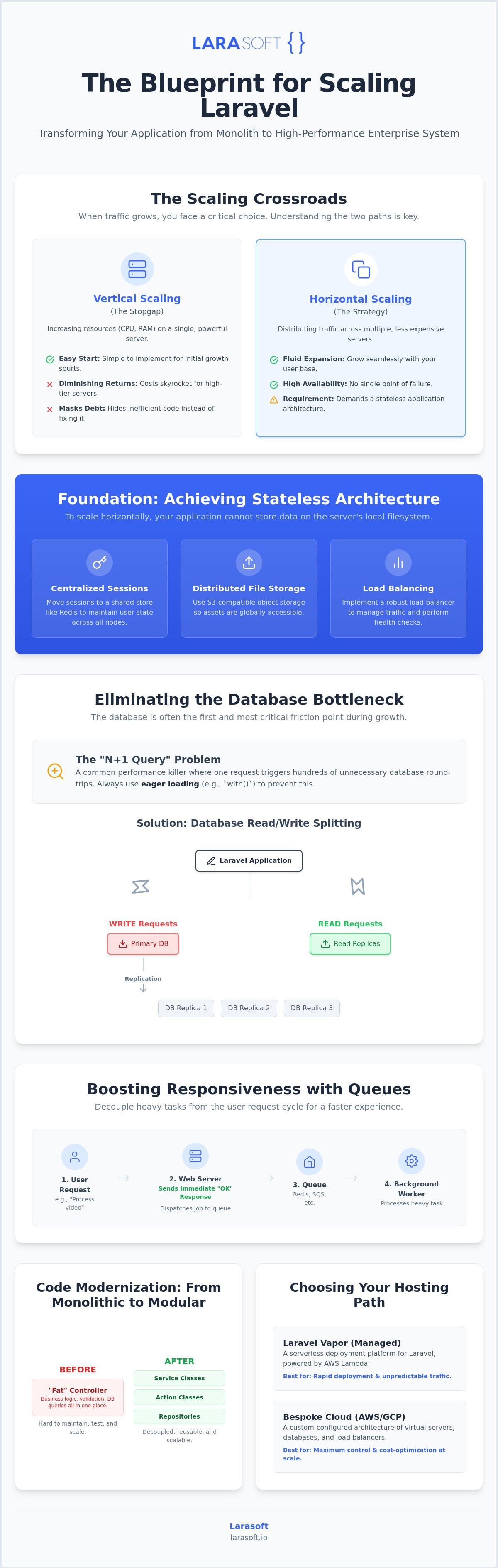
Scaling infrastructure without addressing the underlying codebase is like adding more engines to a sinking ship. Technical debt acts as a constant friction point, consuming valuable CPU cycles and memory that should be reserved for user traffic. When considering how to scale a laravel application, the focus often shifts immediately to load balancers and database replicas. However, structural integrity at the code level is the true prerequisite for any high-performance system. A comprehensive legacy code modernisation strategy ensures that your application is efficient enough to justify the cost of horizontal expansion.
Modernising your application also means keeping pace with the framework's evolution. As of July 2026, Laravel 13 is the stable standard, requiring a minimum of PHP 8.3. Applications stuck on legacy versions of PHP or Laravel cannot leverage the significant performance optimisations and security patches found in newer releases. This technical stagnation creates a ceiling that no amount of hardware can penetrate. Addressing these foundational issues is the first step toward building a resilient, enterprise-grade platform.
Monolithic controllers often become dumping grounds for business logic, validation, and data persistence. This creates a bloated boot cycle that slows down every request. By refactoring these into Service Classes and dedicated Actions, you isolate responsibilities and make the application easier to profile and optimise. Implementing the Repository pattern further decouples Eloquent from your business logic, allowing for more efficient data fetching strategies. Modern PHP JIT compilation significantly reduces execution time for complex calculations, but its benefits are only fully realised when the application structure is clean and predictable.
A thorough audit identifies the deprecated packages and outdated dependencies that hinder framework upgrades. Standardising API responses is equally vital for interoperability and future growth. Transitioning to a Vue.js frontend development approach offloads rendering tasks to the client's browser, significantly reducing the load on your web servers. This shift allows your backend to function as a high-speed API, which is a critical step in understanding how to scale a laravel application effectively. If technical debt is stalling your growth, our team offers expert Legacy Code Modernisation to prepare your system for the demands of 2026.
Selecting the final production environment is a strategic decision that balances operational overhead against technical control. While previous sections focused on code and data, the infrastructure layer is where those optimisations meet the reality of user traffic. When determining how to scale a laravel application in 2026, you must decide between managed serverless environments and bespoke cloud clusters. Each path offers distinct advantages depending on your traffic patterns and internal team capacity.
Modern hosting isn't just about where the code lives; it's about how the system responds to pressure. Laravel Cloud, following its 2025 pricing restructure, has become a formidable option for teams seeking a balance of scalability and ease of use. However, enterprise-grade systems often require more granular control over their environment. This is why choosing the right Laravel development agency is critical. They act as a technical ally, helping you navigate these complex infrastructure choices to ensure long-term stability and business returns.
Laravel Vapor provides a serverless approach that's ideal for applications with unpredictable traffic spikes. It removes the need for manual server provisioning by scaling automatically to handle thousands of concurrent requests. This is particularly effective for marketing-heavy platforms or apps with seasonal peaks. Conversely, bespoke AWS or Azure clusters are better suited for predictable, high-volume workloads where custom networking or specific security compliance is required.
Evaluating the total cost of ownership (TCO) is essential here. While some industry professionals suggest manual VPS management to save on subscription fees, this approach often ignores the human cost of maintenance. Manual intervention in a high-traffic environment introduces risk and technical debt that can stall your growth. A managed or professionally architected solution ensures your team spends time on feature innovation rather than server troubleshooting.
Scale is meaningless if your application is unavailable during updates. High-traffic systems in 2026 require zero-downtime deployment workflows to maintain structural integrity. Using CI/CD pipelines to automate testing and deployment is a foundational requirement for any modern digital platform. We recommend the following strategies to mitigate risk:
Maintaining these complex systems requires dedicated software maintenance. As you learn how to scale a laravel application, remember that the journey doesn't end at deployment. Ongoing monitoring and incremental refactoring are what keep an enterprise system performing perfectly under pressure. This disciplined approach ensures your application remains a robust, foundational asset for your business's future.
Scaling a Laravel application is a deliberate journey from a monolithic structure to a high-performance, distributed architecture. It requires moving beyond simple hardware upgrades to embrace statelessness, optimized data layers, and decoupled background workers. By addressing technical debt and modernizing legacy code, you create a system capable of handling the high-concurrency demands of 2026. This transition ensures your platform remains a foundational asset rather than a liability as your user base expands.
Navigating the complexities of how to scale a laravel application requires a partner with deep technical authority and a focus on business returns. Our UK-based bespoke development team specializes in legacy code modernisation and high-performance Vue.js and React frontends, ensuring your transition is structured and secure. Partner with Larasoft for expert Laravel scalability and modernisation to transform your growing application into a resilient, enterprise-grade system. With the right architectural discipline, your platform is ready to perform perfectly under pressure.
The database is the most frequent bottleneck in a growing system. As traffic increases, unoptimised queries and the lack of proper indexing cause CPU spikes and slow response times. Identifying these bottlenecks via tools like Laravel Pulse allows you to implement read/write splitting or aggressive caching before the system fails under load. This proactive approach ensures the data layer doesn't become a single point of failure.
Yes, Laravel is capable of handling millions of requests daily when built with the right architecture. High-traffic platforms achieve this by using Laravel Octane with FrankenPHP or RoadRunner to keep the application in memory between requests. This setup, combined with horizontal scaling across multiple web nodes, ensures the framework performs efficiently at an enterprise level without sacrificing developer experience.
You should move to a load-balanced cluster when your single server's resource usage consistently exceeds 70% during peak times. This transition is also necessary if your business requires high availability and zero-downtime deployments. A single point of failure is a significant risk for any growing digital platform; distributing traffic across multiple instances provides the redundancy needed for enterprise stability.
Neither is objectively better as they serve different traffic profiles. Laravel Vapor is a serverless platform ideal for unpredictable, "spiky" traffic that needs automatic, rapid scaling without manual intervention. Laravel Forge is better for applications with steady, predictable workloads where you want full control over your server configuration and more predictable monthly infrastructure costs.
Database indexing improves performance by allowing the database engine to find records without scanning every row in a table. In a high-concurrency environment, proper indexes prevent full table scans that would otherwise lock resources and cause deadlocks. This is a critical step in how to scale a laravel application effectively, particularly as your datasets grow into the millions of records.
Redis acts as the central nervous system for a scalable architecture. It handles distributed session management, high-speed caching, and acts as the primary broker for background queues via Laravel Horizon. Using Redis ensures that stateful data is accessible to all web nodes in a horizontally scaled environment, allowing your application to remain stateless and fluidly expandable.
Infrastructure costs in the UK depend entirely on your chosen cloud provider and traffic volume. While serverless options like Laravel Vapor have a predictable monthly fee, usage-based AWS costs can fluctuate based on Lambda or RDS consumption. Strategic architectural shifts often reduce long-term costs by improving resource efficiency and reducing the need for expensive, oversized server instances that remain underutilised.
You don't usually need a full rewrite, but strategic refactoring is essential. Monolithic codebases often contain "hidden" bottlenecks that prevent horizontal expansion and increase deployment risk. Modernising your business logic into service classes and actions is a core part of how to scale a laravel application without incurring massive technical debt or operational friction as you add more server instances.
Here’s what we've been up to recently.
Certified Quality. Great Prices