Laravel Backend for Mobile App: The Strategic Architect’s Guide for 2026


What if the framework you once viewed as a web development tool is actually the most sophisticated headless orchestration engine for mobile architecture in 2026? While many still associate it with traditional sites, the reality is that a laravel backend for mobile app development now offers a level of structural integrity and performance that rivals any specialized mobile middleware. You're likely feeling the pressure of maintaining sub-millisecond API response times while securing complex data relationships across iOS and Android. It's a valid concern; a single security breach or a laggy interface can devastate your brand's reputation—especially in high-stakes sectors like the high-profile live entertainment experiences produced by Lar&Co, where instant, secure interactions are essential.
In this guide, we'll demonstrate why Laravel is the premier choice for powering high-performance mobile applications and how to architect a backend that's both secure and scalable. We'll cover the strategic advantages of the Laravel 13 ecosystem, including the 5 to 10x throughput improvements offered by Laravel Octane. You'll learn how to build a future-proof tech stack that integrates seamlessly with your mobile frontend while adhering to the latest security standards. From managing stateless architectures to leveraging the stable Laravel AI SDK, we're outlining the roadmap to a robust digital foundation.
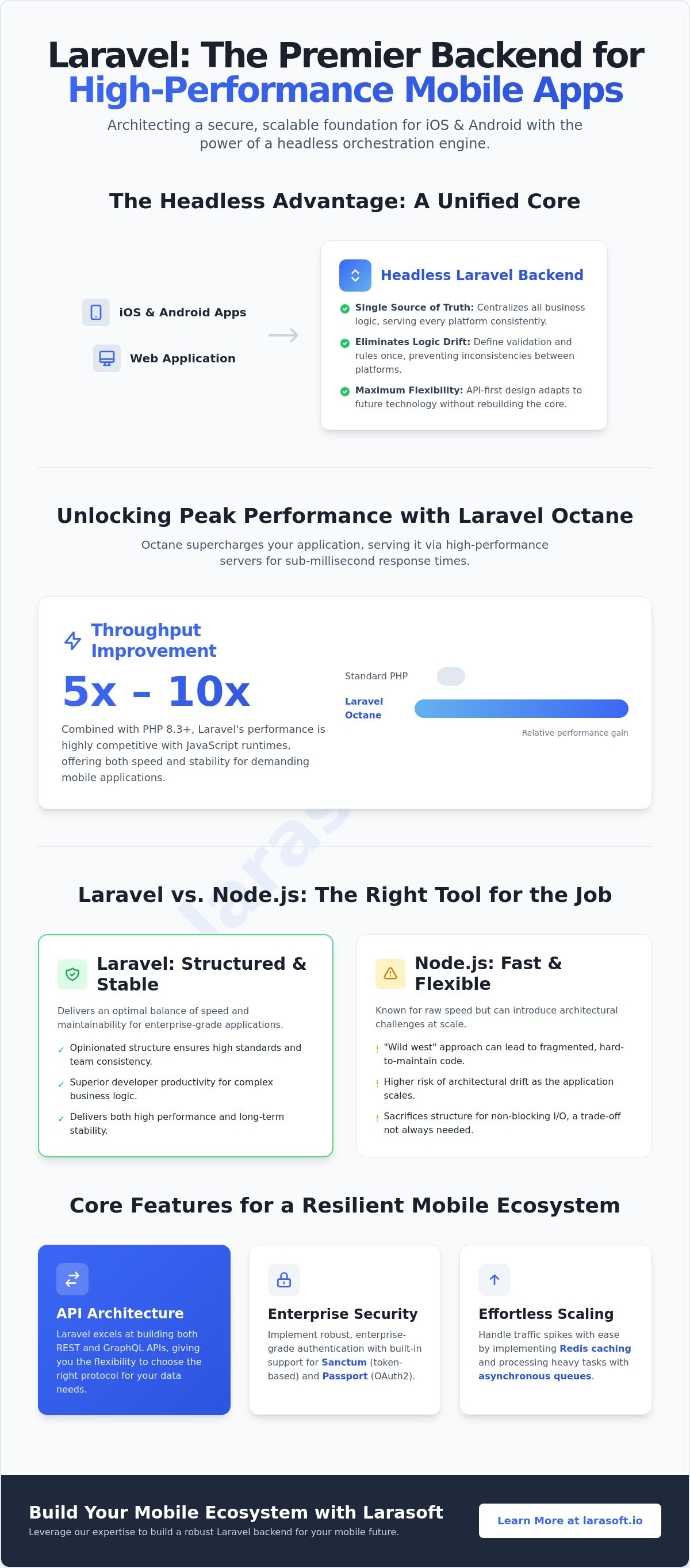
The architecture of successful digital products has shifted. In 2026, the most resilient brands have abandoned monolithic structures in favor of a headless approach. Choosing a laravel backend for mobile app development allows you to centralize your business logic, serving web, iOS, and Android platforms from a single, high-performance source of truth. The Laravel framework has evolved from a web-centric tool into a sophisticated orchestration engine, capable of handling the intense data demands of modern mobile users without compromising on security or developer speed.
Maintaining a unified codebase for business logic across all platforms is a strategic masterstroke. Instead of duplicating validation rules or calculation logic in both Swift and Kotlin, you define them once in Laravel. This approach doesn't just save time; it eliminates the risk of logic drift, where different platforms behave inconsistently under the same conditions. By anchoring your ecosystem in Laravel, you create a stable foundation that supports rapid iteration and consistent user experiences.
Decoupling the frontend from the backend provides your organization with maximum flexibility. By treating your Laravel application as a headless API, you ensure that data remains consistent across every touchpoint, from a customer’s iPhone to your internal web dashboard. This structural integrity is vital for long-term growth. It significantly reduces the need for legacy code modernisation by enforcing a clean, API-first design from day one. You're not just building for today; you're creating an asset that can adapt as mobile technology continues to evolve.
Laravel’s Eloquent ORM is a core differentiator in this headless setup. It simplifies complex mobile data structures, allowing developers to map relationships between users, orders, and products with minimal boilerplate. Beyond data management, Laravel provides native support for modern mobile requirements:
The debate between Laravel and Node.js often centers on speed. While Node.js is known for its non-blocking I/O, Laravel’s structured approach provides superior developer productivity for enterprise applications. Node.js can often feel like the "wild west," leading to fragmented architectures that are difficult to maintain as they scale. In contrast, Laravel’s opinionated structure ensures every team member follows the same high standards. Performance benchmarks in 2026 show that PHP 8.3 and higher, combined with Laravel Octane, are highly competitive with JavaScript runtimes. You don't have to sacrifice speed for the sake of stability; a laravel backend for mobile app delivers both.
Selecting the communication protocol is a foundational decision for any laravel backend for mobile app. While the industry often debates which is "better," the choice depends entirely on your specific data requirements and project scale. A balanced understanding of REST vs. GraphQL ensures your architecture remains efficient as your user base grows. Laravel's flexibility allows it to excel in both paradigms, providing developers with the tools to build tailored solutions that prioritize performance and maintainability.
Laravel's built-in Resource Controllers provide a standardized way to handle CRUD operations, making the backend predictable for mobile developers. By using Laravel API Resources, you can transform your database models into a clean, consistent output. This layer allows you to hide sensitive fields and rename attributes without breaking the mobile frontend. JSON serves as the universal, lightweight bridge that ensures seamless communication between your Laravel server and mobile clients. Proper error handling is equally critical. Utilizing standard HTTP status codes, like 401 for unauthorized access or 422 for validation errors, allows mobile apps to respond intelligently to server-side events. This leads to a more polished user experience where errors are handled gracefully rather than resulting in generic crashes.
For data-heavy mobile applications, GraphQL offers a compelling alternative to traditional REST. It solves the "over-fetching" problem, where a mobile app receives more data than it actually needs, consuming unnecessary bandwidth and battery life. By using a tool like Laravel Lighthouse, you can implement a GraphQL server that allows mobile developers to request exactly the fields they require. This flexibility is particularly useful when managing complex nested relationships. Instead of making three separate API calls to fetch a user, their recent orders, and the tracking status of those orders, a single GraphQL query can retrieve everything in one trip. This reduction in latency is vital for maintaining a responsive feel in high-traffic environments.
Regardless of the protocol, API versioning is a non-negotiable requirement for long-term success. Mobile apps aren't updated like websites; you'll always have users running older versions of your software. Implementing versioned routes, such as /api/v1/, ensures that new backend features don't break the experience for legacy users. It's about creating a stable environment where innovation doesn't come at the cost of current stability. If you're struggling to determine the best path for your specific project, our team specializes in custom API integration to bridge these technical gaps and ensure your architecture is built to last.
Security is the silent pillar of any high-performance digital product. When architecting a laravel backend for mobile app, you aren't just managing data; you're safeguarding user trust and ensuring regulatory compliance. In 2026, the financial and reputational cost of a data breach is too high to rely on basic API keys or outdated security patterns. Laravel offers a robust suite of authentication tools specifically designed to handle the unique challenges of mobile connectivity, where sessions are long-lived and network conditions are often unpredictable.
Choosing between Laravel Sanctum and Laravel Passport is a critical architectural decision that impacts both security and development speed. Sanctum provides a lightweight, token-based authentication system that's ideal for most bespoke mobile applications. It issues simple API tokens that the mobile client stores securely and includes in the header of every request. For many projects, this is the superior choice because it avoids the complexity of a full OAuth2 server while maintaining high security standards. It's built for simplicity, making it perfect for apps where the mobile client is the primary consumer of the API.
Passport, by contrast, is the definitive choice if your mobile app needs to act as an OAuth2 provider or if you require advanced features like authorization codes and refresh tokens. While more complex to implement, it provides the structural integrity needed for enterprise-grade ecosystems where third-party integrations are a priority. Most modern mobile apps thrive on the simplicity of Sanctum, which allows for stateful authentication and seamless user sessions without the overhead of heavy protocol management. Your choice should align with your long-term scaling strategy and the complexity of your user permission structures.
Authentication is only the first layer of a secure architecture. To protect against brute-force attacks, we implement strict rate limiting on all API endpoints. This ensures that even if a malicious actor attempts to guess credentials, the system automatically throttles or blocks their access. Protecting sensitive information also requires robust encryption. Data must be encrypted both at rest in your database and in transit via TLS to align with Mobile security best practices. This dual-layered approach ensures that even if data is intercepted, it remains unreadable.
For UK-based businesses, GDPR compliance is a non-negotiable requirement. This involves more than just data encryption; it requires a strategic approach to data residency, user consent, and the right to be forgotten. A well-architected Laravel backend simplifies these obligations through built-in encryption helpers and structured data management. However, security isn't a one-time setup. Consistent software maintenance is an absolute imperative to patch emerging vulnerabilities and keep your tech stack resilient against modern threats. By treating security as a continuous process, you ensure your mobile platform remains a foundational asset for your business future.
Performance isn't a luxury. It's a retention strategy. A laggy laravel backend for mobile app will drive users toward competitors within seconds of a slow interaction. In 2026, scaling means moving beyond the basics of PHP-FPM and embracing high-concurrency environments that can handle thousands of simultaneous requests without breaking a sweat. This requires a shift from traditional request-response cycles toward a more optimized, memory-resident architecture.
Reducing server load is essential for applications with high user density. By implementing API response caching, you bypass expensive database queries for static or semi-static data, significantly lowering latency. Redis acts as a high-speed data buffer for mobile backends, ensuring that frequently accessed resources are delivered in milliseconds. For even greater performance, Laravel Octane keeps your application bootstrapped in memory. This eliminates the overhead of reloading the framework on every request, delivering up to 10x throughput improvements for high-traffic endpoints.
Database efficiency often hinges on how you handle data relationships. Eager loading is the standard for mobile APIs to prevent the "N+1" query problem, which can throttle performance during complex data fetches. For resource-intensive tasks like image processing or batch push notifications, Laravel Queues are indispensable. They allow the backend to return an immediate success response to the mobile client while the server handles the heavy lifting in the background, keeping the user interface fluid and responsive.
Integrating AI directly into your architecture is a competitive necessity. By leveraging the stable Laravel AI SDK, you can implement predictive data fetching. This allows the backend to analyze user behavior and pre-load data before a user even taps a button, creating a "zero-latency" feel. It transforms the backend from a passive data store into an active participant in the user experience.
The synergy between high-performance caching and intelligent data management creates a foundation that doesn't just survive traffic spikes; it thrives under them. If you're looking to integrate these advanced capabilities into your own tech stack, explore our specialized Laravel AI integration services to build a smarter, faster mobile ecosystem.
Building a high-performance digital product requires more than just clean code; it demands a unified architectural vision. At Larasoft, we specialize in bridging the gap between sophisticated server-side logic and the intuitive interfaces users expect on their devices. Deploying a laravel backend for mobile app is a strategic decision, but its success depends on the structural integrity of the integration layer. We act as your technical artisans, ensuring that every API endpoint and data relationship serves the ultimate goal of business growth and user satisfaction. Our role is to be your deeply invested technical ally, transforming complex development processes into a manageable, structured journey toward scaling.
Choosing to partner with a specialized laravel development agency ensures that your project benefits from deep domain expertise. We don't just build APIs; we architect foundations. Our team understands how to navigate the complexities of legacy systems, providing expert API integration services that breathe new life into older infrastructure by connecting it to modern mobile frontends. This approach minimizes technical debt and ensures that your mobile ecosystem is built to last, rather than being a one-off product that requires constant patching.
Our approach centers on creating fluid transitions between platforms. Whether we're building high-performance applications with React Native or developing Vue-based frontends for cross-platform utility, our focus remains on speed and reliability. We ensure seamless synchronization between your web dashboards and mobile apps, so your data is always accurate, regardless of the device. From initial discovery to final deployment, we provide dedicated support across the entire mobile app development lifecycle. This comprehensive oversight ensures that the performance gains from Laravel Octane and Redis, discussed earlier, are fully realized in the palm of your user's hand.
The digital landscape of 2026 moves fast, and static software quickly becomes a liability. We prioritize proactive software maintenance and security updates to keep your ecosystem resilient against emerging threats. Our strategic technical consulting helps you plan for horizontal scaling and feature expansion, ensuring your tech stack remains at the cutting edge. Reliability is our steady promise. We find genuine satisfaction in building systems that perform perfectly under pressure, allowing you to focus on your core business objectives while we handle the technical complexity. Contact us to discuss your bespoke mobile app development requirements and discover how we can help you build a future-proof mobile ecosystem.
Architecting a robust digital ecosystem requires a shift from short-term fixes to long-term structural integrity. By leveraging a laravel backend for mobile app development, you're not just choosing a framework; you're investing in a headless orchestration engine that unifies your business logic across all platforms. We've explored how advanced security protocols, lightning-fast caching with Redis, and intelligent AI integrations create a foundation that survives the intense demands of a 2026 user base. This strategic approach ensures your application remains responsive, secure, and ready for rapid scaling as your market grows.
At Larasoft, we provide the specialized expertise needed to turn these architectural concepts into high-performance realities. As UK-based Laravel experts, we specialize in seamless API integration and legacy modernisation, ensuring your mobile product connects perfectly with existing systems. Our team also brings deep expertise in building fluid Vue.js and React frontends to match your backend's power. It's time to transform your technical vision into a scalable business asset. Partner with Larasoft for your bespoke Laravel mobile backend and build a system that performs perfectly under pressure.
Yes, Laravel is an exceptional choice for a mobile backend due to its mature ecosystem and the performance gains found in Laravel 13. It provides a structured, secure environment that allows developers to build a laravel backend for mobile app that is both scalable and easy to maintain. With tools like Octane and Reverb, it handles high-concurrency demands with the same efficiency as specialized mobile middleware.
Laravel Sanctum is usually the superior choice for bespoke mobile applications because it is lightweight and specifically designed for simple token-based authentication. It provides the security you need without the overhead of a full OAuth2 server. You should only consider Laravel Passport if your mobile app needs to act as an authentication provider for third-party services or requires complex OAuth2 grant types.
The communication happens through an API layer where data is exchanged using JSON, the universal language for modern digital platforms. The mobile app sends HTTP requests to specific endpoints on the Laravel server, which then processes the logic and returns a structured response. This decoupled architecture ensures that your backend remains a single source of truth for both iOS and Android clients.
It can certainly handle enterprise-level traffic when configured with high-performance tools like Laravel Octane and Redis. By keeping the application bootstrapped in memory, Octane significantly increases throughput compared to traditional setups. When combined with horizontal scaling and efficient database indexing, a laravel backend for mobile app can support thousands of simultaneous users without compromising on response times or stability.
REST is the industry standard and is often the best choice for its simplicity, cacheability, and ease of implementation. However, if your mobile application requires complex, deeply nested data structures, GraphQL might be more efficient. GraphQL allows the mobile client to request exactly the data it needs, which can reduce bandwidth consumption and improve performance on slower mobile networks.
The cost varies significantly based on the complexity of your business logic, the number of third-party integrations, and your specific security requirements. A simple MVP will require a different level of investment than a high-traffic enterprise platform with integrated AI features. We focus on building foundational assets that provide long-term value, so the scope is always tailored to your strategic business goals.
Laravel is highly secure and is frequently used for applications requiring high levels of data integrity, provided it is architected correctly. It includes built-in protections against common vulnerabilities like SQL injection and cross-site request forgery. When combined with strict adherence to OWASP standards and robust encryption, Laravel provides a secure foundation that meets the rigorous demands of the banking and healthcare sectors.
Yes, Laravel's native notification system makes it simple to trigger push notifications across multiple platforms. By using drivers for services like Firebase Cloud Messaging (FCM) or Apple Push Notification service (APNs), you can send real-time alerts to your users. This allows you to manage all your communication logic in one place, ensuring a consistent experience for both iOS and Android users.
Here’s what we've been up to recently.
Certified Quality. Great Prices