Strategic Laravel API Integration Services: Building the Connected Enterprise in 2026


By 2026, a business's competitive edge isn't defined by the data it owns, but by how effectively that data moves between systems. If your enterprise is still battling fragmented data silos or high latency in third-party syncing, you aren't just losing time; you're losing market share. Many UK firms find themselves trapped by legacy code and security vulnerabilities in custom connectors that weren't built for the modern era. Strategic laravel api integration services provide the architectural backbone needed to turn these disconnected tools into a unified, high-performance ecosystem.
We understand that software interoperability can feel like a moving target, especially with the release of Laravel 13.31.0 and the shift toward AI-first architectures. This guide offers a professional roadmap to mastering these complexities. You'll learn how to achieve sub-second API response times and build a secure, future-proof framework ready for autonomous AI agents. We'll break down the transition from fragile legacy connectors to robust, scalable integrations that protect your business intelligence and support long-term growth.
An Application Programming Interface (API) serves as the digital connective tissue of a modern organisation. However, in 2026, the scope of laravel api integration services has expanded beyond basic data syncing. It's now about achieving true system interoperability, where disparate platforms don't just talk, but understand and act upon shared data in real time. For the 'Connected Enterprise', this fluidity is essential. Data silos remain the primary barrier to growth, trapping valuable business intelligence in isolated systems and preventing a holistic view of operations.
Laravel has emerged as the preferred framework for complex UK business integrations due to its expressive syntax and robust security features. As of late 2026, with the stability of Laravel 13, the framework provides a 'batteries-included' approach that simplifies the creation of secure, scalable endpoints. We see a definitive shift from monolithic architectures toward API-first, headless models. This allows businesses to decouple their backend logic from the frontend, ensuring that data can be served to web apps, mobile platforms, and AI agents through a single, unified source of truth.
Many established UK firms rely on ageing infrastructure that lacks modern connectivity. Strategic APIs facilitate legacy code modernisation by acting as a sophisticated middleware layer. Instead of a risky, full-scale rebuild, we wrap legacy PHP applications in a modern Laravel API. A common scenario involves connecting a decades-old ERP system to a contemporary React frontend. This approach breathes new life into existing assets, allowing for rapid innovation without disrupting core business logic.
The transition to a fully integrated ecosystem delivers immediate returns by reducing operational overhead. When data flows automatically between CRM, inventory, and accounting platforms, manual entry errors vanish. This efficiency allows teams to focus on high-value tasks rather than data reconciliation.
API integration is a strategic asset that transforms technical agility into a sustainable competitive advantage.
High-performance APIs require more than just clean code; they need a structural blueprint that balances speed with absolute reliability. Laravel provides this through Eloquent Resources. These act as a sophisticated transformation layer between your database and the API consumer, ensuring that data is delivered in a clean, predictable JSON format. This predictability is vital when working with internal teams who require high-performance frontend development to match your backend capabilities.
Security is the non-negotiable foundation of any laravel api integration services project. We typically choose between Laravel Sanctum for lightweight, token-based authentication and Laravel Passport for full OAuth2 compliance. Sanctum is ideal for single-page applications and simple mobile builds, while Passport handles complex, multi-tenant systems requiring scoped permissions. Scoped permissions ensure that an integrated third-party tool only accesses the specific data it needs, significantly reducing the security risk of any potential credential compromise.
To protect your infrastructure from external threats, we implement granular rate limiting and throttling. This prevents API abuse and ensures that a surge in traffic from one integration doesn't crash the entire system. When handling heavy tasks, such as bulk data imports or generating complex reports, we use Laravel Queues. By processing these tasks asynchronously, the API can return a success response immediately, while the heavy lifting happens in the background without impacting the user experience.
Speed is a critical metric for modern enterprise systems. We utilise Redis for API caching, which allows frequently requested data to be served with sub-100ms response times. This bypasses repetitive database queries and lowers server load during peak periods. Coupled with precise database indexing strategies, Laravel handles large-scale data retrieval with ease. For ongoing reliability, we use modern observability tools like Laravel Pulse to monitor API health and identify bottlenecks before they impact your business operations. This proactive approach ensures that your connected ecosystem remains stable as your data volume grows.
Choosing between a middleware platform and bespoke laravel api integration services often comes down to a choice between immediate convenience and long-term structural integrity. While iPaaS solutions like Zapier or Make offer rapid deployment for simple tasks, they frequently struggle with the complex business logic required by a scaling enterprise. A custom-built Laravel API provides a level of flexibility that off-the-shelf connectors can't match, allowing for precise control over every data transformation and exchange.
SaaS integration platforms often lure businesses with low entry costs, but as transaction volumes grow, so do the recurring fees. Platform-imposed "task limits" can become a significant bottleneck for enterprises handling millions of monthly requests. In contrast, custom laravel api integration services offer a fixed-cost architectural asset. Once built, the system scales with your server capacity rather than your monthly subscription tier. This shift from an OpEx-heavy model to a CapEx investment provides better financial predictability for UK business leaders who prioritise sustainable growth.
Custom builds are essential when integrating proprietary systems that lack standard connectors. If your business operates in a high-security environment, bespoke development ensures your data stays within your controlled infrastructure. This satisfies strict UK GDPR requirements and data residency concerns. Data residency isn't just a legal checkbox; it's a matter of structural integrity. By keeping data within your own VPC, you eliminate the risk of third-party cloud breaches affecting your core business intelligence. This approach is particularly vital for applications requiring deep, bi-directional syncing where complex business rules must be applied during the data transformation process.
Low-code tools often present a "Black Box" problem. When an integration fails, debugging the exact point of failure within a third-party middleware platform is notoriously difficult. This lack of visibility can lead to extended downtime and lost revenue. Additionally, vendor lock-in remains a constant threat; migrating away from a platform that holds your entire integration logic is both costly and complex.
Partnering with a specialized Laravel development agency avoids these pitfalls by building a foundation you own entirely. This ownership allows for unlimited scalability and the freedom to evolve your system without platform-imposed constraints. It ensures that your software architecture remains an asset rather than a recurring liability, providing the clean, efficient performance that modern business demands.
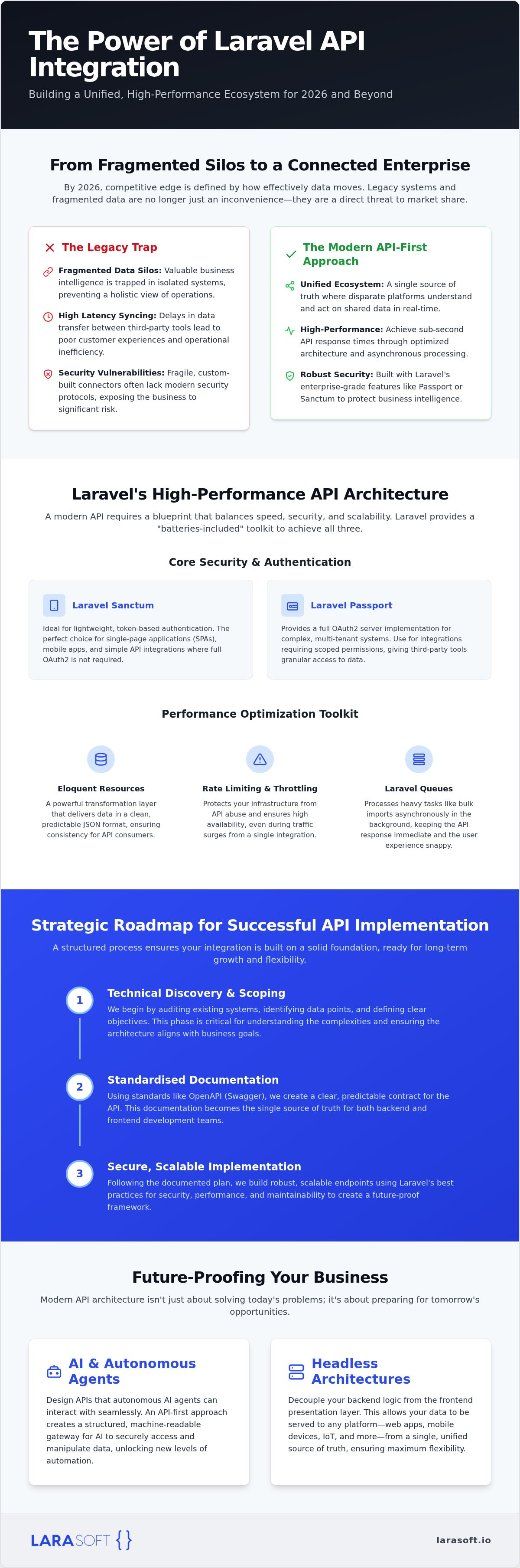
Building a connected enterprise requires a disciplined approach that moves beyond ad-hoc scripting. A successful deployment of laravel api integration services follows a multi-phase roadmap designed to mitigate risk and ensure structural integrity. We begin with technical discovery, where we map the data flow architecture to identify potential bottlenecks or security gaps. This phase is critical for UK businesses operating under strict data regulations; we ensure all data pathways align with GDPR and UK Cyber Essentials standards from day one.
Phase two focuses on design and documentation using OpenAPI or Swagger standards. This provides a clear, machine-readable contract that both internal and external teams can rely on. Development follows in phase three, where we employ test-driven integration to ensure every endpoint performs as expected under load. Finally, phase four involves deployment and ongoing software maintenance. This continuous oversight is vital for adapting to third-party API changes and maintaining the longevity of your digital assets.
High-quality APIs are built for humans as much as they are for machines. Clear, versioned documentation prevents the "documentation rot" that often plagues long-term projects. By following RESTful or GraphQL standards, we create intuitive endpoints that reduce the learning curve for your internal developers. We also provide sandbox environments, allowing teams to test integrations safely without touching live production data. This focus on DX ensures that your API remains a usable, scalable asset rather than a technical burden.
Reliability in a connected system hinges on how gracefully it handles failure. We implement automated integration tests that run with every update to prevent regression. Since third-party services are inherently unpredictable, we use "Mocking" to simulate service outages and error responses. This allows us to verify that your system remains stable even when an external partner goes offline. Robust error logging and notification systems provide instant troubleshooting data, ensuring your team can resolve issues before they impact the end user.
If you're ready to secure your infrastructure with a professional roadmap, explore our full range of laravel api integration services to see how we can unify your data ecosystem.
By late 2026, the standard for laravel api integration services has shifted from simple data exchange to supporting autonomous AI agents. These Large Language Models (LLMs) don't just read data; they interact with your systems to perform complex tasks on behalf of users. Designing APIs that are "AI-ready" involves creating structured, semantic endpoints that models from OpenAI or Anthropic can navigate with high precision. This evolution transforms your API from a passive bridge into an active participant in your business automation strategy.
Adopting a headless architecture is the most effective way to ensure this versatility. By decoupling the backend, a single Laravel API can simultaneously power Vue.js and React frontends, mobile applications, and third-party AI tools. This unified approach reduces redundancy and ensures that business logic is updated in one place, instantly reflecting across every digital touchpoint. It's a strategy that prioritises flexibility, allowing you to swap frontend technologies or add new channels without rebuilding your core infrastructure.
Modern laravel api integration services now frequently include the orchestration of AI-driven data pipelines. Whether you're connecting to Claude for intelligent customer classification or using OpenAI for predictive inventory logic, Laravel provides the structural integrity needed to handle these heavy computational tasks. We build custom AI endpoints that allow your internal data to be analysed in real time, providing insights that were previously trapped in static databases. To fully leverage these systems, firms often look to Navo Inc. for specialized coaching on synthetic workforce development and agent deployment. This isn't just about adding a chatbot; it's about embedding intelligence into your automated workflows to drive measurable efficiency.
A high-performance system is only as good as its last update. Continuous modernisation is essential to keep your integration layer running on the latest PHP and Laravel versions, such as Laravel 13.31.0. This proactive maintenance prevents the accumulation of technical debt and ensures that security patches are applied before vulnerabilities can be exploited. There's also a significant synergy between high-performance code and technical SEO for custom applications. Systems that load data via sub-second APIs provide the speed signals that search engines reward with higher rankings.
Larasoft serves as a strategic partner for UK enterprises looking to build these sophisticated, national-scale systems. Our focus on clean, artisanal code and disciplined execution ensures that your integrations aren't just functional today, but ready for the demands of tomorrow. Partner with Larasoft for your next API integration project and build a foundation that scales with your ambition.
Transitioning from fragmented data silos to a connected enterprise is a strategic necessity for businesses aiming to lead in 2026. By prioritising bespoke laravel api integration services, you move beyond the rigid limitations of off-the-shelf middleware and gain a secure, scalable asset that your organisation owns entirely. This architectural foundation doesn't just solve current latency issues; it prepares your systems for the next generation of autonomous AI agents and headless delivery models.
Larasoft acts as your dedicated technical ally in this journey. Our UK-based team of Laravel Certified developers specialises in high-performance custom web and mobile applications, bringing a proven track record in structural modernisation and complex system connectivity. We take pride in building clean, efficient systems that perform perfectly under pressure, ensuring your data ecosystem remains a driver of growth rather than a source of technical debt. Consult Our Experts on Your Laravel API Integration Strategy to begin your transition toward a more agile and interoperable future.
REST is the standard architectural style for most web services, using fixed endpoints and standard HTTP methods. GraphQL offers a more flexible approach, allowing clients to request exactly the data they need in a single call. Laravel supports both; we typically implement REST for standard integrations and GraphQL for complex data relationships. The choice depends on your specific performance requirements and the complexity of your frontend consumers.
A custom Laravel API integration typically takes between 4 and 12 weeks to complete. Simple connections to established third-party services are often faster, while deep synchronisation with bespoke legacy software requires a longer discovery and mapping phase. We follow a structured roadmap that includes technical discovery, design, development, and rigorous testing. This ensures the final build is performant and ready to handle your enterprise data volumes without lag.
Laravel provides a highly secure framework for financial and healthcare data integrations when implemented correctly. It includes native protection against SQL injection, cross-site scripting, and request forgery. For high-security environments, we implement Laravel Passport for full OAuth2 compliance and scoped permissions. Our UK-based team ensures that all data handling protocols meet the rigorous security standards required for sensitive information while maintaining compliance with national regulatory frameworks.
Yes, Laravel can integrate with legacy systems built on older PHP versions. We often use laravel api integration services to build a modern middleware layer that wraps around your ageing software assets. This allows you to modernise your infrastructure incrementally without the risk of a total system rebuild. By creating secure endpoints for legacy data, we enable your older systems to communicate effectively with modern React frontends or AI platforms.
Ongoing maintenance for a custom API involves security patching, performance monitoring, and updates to accommodate third-party service changes. Since external providers frequently update their own APIs, your integration layer needs periodic adjustments to prevent downtime. We also monitor for documentation rot and ensure that endpoints remain performant as your data volume increases. Dedicated software maintenance prevents technical debt and ensures the long-term stability of your connected enterprise architecture.
API integration significantly impacts SEO by improving site speed and data accuracy. Fast, sub-second APIs ensure that your custom web application meets the Core Web Vitals targets that search engines use for ranking. When content is served efficiently via a backend API, it provides a seamless user experience that reduces bounce rates. Additionally, real-time data syncing prevents search engines from indexing outdated or incorrect information, protecting your brand's digital authority.
You don't always need to upgrade infrastructure immediately, as Laravel includes tools to optimise existing resources. We utilise Redis for API caching and Laravel Horizon to manage heavy background tasks efficiently. If your traffic volume grows significantly, we recommend scalable solutions like Laravel Vapor or dedicated UK cloud environments. These options allow your API to handle millions of requests while maintaining the sub-second response times your users and integrated systems expect.
We ensure your laravel api integration services remain UK GDPR compliant by implementing strict data residency protocols and end-to-end encryption. Our approach focuses on keeping sensitive data within your controlled infrastructure, reducing the risk associated with third-party cloud exposure. We also implement granular logging and scoped permissions, ensuring that only the necessary information is processed. Working with a UK-based team provides the assurance that your data handling aligns with national legal requirements.
Here’s what we've been up to recently.
Certified Quality. Great Prices