WordPress Development vs Bespoke Laravel: A Business Comparison for 2026


The quickest route to a digital presence is often the most expensive way to scale a business. While 43.5% of global sites utilise standard wordpress development, many UK firms find themselves tethered to plugin bloat and 2.5-second load times that drive away impatient customers. You probably recognise the growing frustration of a rigid system that struggles to integrate with your internal APIs or buckles under the weight of necessary security patches. This friction often results in a 32% increase in bounce rates as performance lags behind user expectations.
We'll help you clarify these technical crossroads to ensure you build a high-performance asset that actually scales with your vision. You'll learn whether a template-based CMS or the surgical precision of a bespoke Laravel application fits your 2026 commercial objectives. We examine the transition from high-maintenance legacy systems to seamless, integrated architectures that reduce long-term costs and secure your company's digital future. Our analysis focuses on providing a structured journey toward growth, replacing technical debt with clean, efficient code.
WordPress development has moved far beyond its origins as a blogging engine. In 2026, it serves as a sophisticated enterprise Content Management System (CMS) capable of handling complex data structures and high-traffic environments. Current data from W3Techs shows that WordPress still powers 43.5% of all websites globally. This dominance isn't due to momentum alone; it's the result of a massive ecosystem of 59,000+ plugins and a global developer base that ensures long-term viability for UK businesses. For many organisations, the platform represents a safe, scalable choice for managing digital content without the overhead of building a backend from scratch.
The industry has seen a clear divergence in technical roles. We now see a sharp split between "site builders" who assemble solutions using pre-made themes and "core engineers" who write custom PHP, JavaScript, and React components. High-growth companies typically require the latter. These engineers treat the CMS as a foundation for bespoke functionality rather than a rigid template. This shift ensures that wordpress development can meet specific business requirements, such as integrating with UK-specific payment gateways or local ERP systems, while maintaining the user-friendly interface that marketing teams expect.
The introduction of the Block Editor (Gutenberg) and Full Site Editing (FSE) fundamentally changed the development workflow. Developers now build modular "blocks" that allow non-technical staff to manage complex layouts safely. This system enables rapid prototyping, reducing the time to market for new landing pages by up to 40% compared to legacy PHP templates. WordPress currently functions as a hybrid platform that bridges the gap between traditional visual site building and modern, decoupled application architecture.
Many UK enterprises now adopt a "headless" approach, using WordPress as a backend API while building the frontend with React or Vue.js. This decoupled architecture improves security by hiding the CMS from the public web and boosts performance through static site generation. However, this path introduces significant complexity. While it offers superior frontend flexibility, it often requires double the development hours for maintenance compared to a standard build. When your project reaches this level of technical overhead, the benefits of a bespoke Laravel solution often begin to outweigh the convenience of a CMS-first approach.
WordPress remains the primary choice for rapid market entry. For a startup testing a concept in 2026, the ability to deploy a functional site within days is a clear advantage. WordPress development allows businesses to leverage a massive library of pre-built themes and functional blocks, which drastically reduces the initial engineering workload. This ecosystem supports 43.5% of the web for a reason: it's accessible and allows for immediate momentum.
Speed often comes with a performance tax. Many businesses fall into the "plugin trap," where they stack third-party tools to achieve specific features. A typical corporate site might run 25 active plugins. This creates technical debt. Every additional script increases server response times, often leading to a 1.2-second delay in Largest Contentful Paint (LCP). This lag directly impacts SEO rankings and user retention, turning a convenient solution into a performance bottleneck.
The dashboard is the platform's greatest asset for non-technical staff. Most marketing teams already understand the interface, making WordPress development a low-friction choice for content-heavy projects. This familiarity reduces training costs and allows for immediate content agility. You don't need a developer to change a headline or swap an image, which is vital for fast-moving UK SMEs that require total control over their daily messaging.
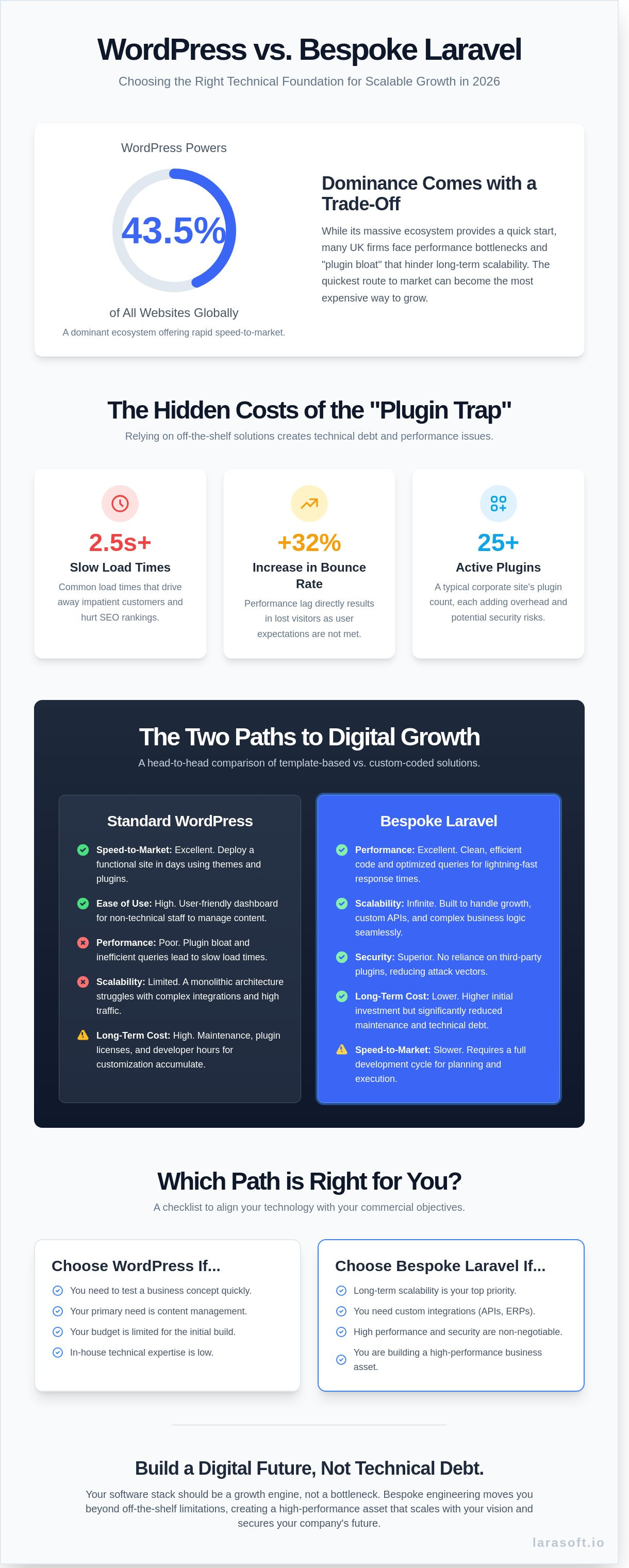
Standard WordPress development serves many UK businesses well for initial content needs, but it often creates a performance ceiling as operations expand. The core difference lies in the architecture. WordPress is a monolithic CMS where the core software, themes, and plugins are tightly coupled. This means every page load carries the weight of the entire system. Laravel operates as a clean-slate MVC (Model-View-Controller) framework. We build only what your business requires, ensuring the code remains lean and the performance remains sharp.
Performance gains with bespoke code are immediate and measurable. A typical WordPress site might execute 80 to 120 database queries to render a single complex page. A bespoke Laravel application can often achieve the same result with fewer than 15 optimised queries. This efficiency is crucial for legacy code modernisation and complex API integrations. Laravel excels at connecting disparate systems; it treats external data from your CRM or ERP as a first-class citizen rather than a secondary plugin addition. This flexibility allows us to build features around your specific business processes, ensuring the software adapts to you, not the other way around.
The wp_options table is a common bottleneck in WordPress development. It stores a vast array of configuration and plugin data in a single, unindexed list that becomes sluggish as it grows. Laravel utilises custom relational database schemas with strict data types and indexing. This structure is essential for handling high-concurrency traffic during peak periods, such as Black Friday or major product launches. Bespoke architecture prevents database bloat over time by ensuring that every data point has a defined, logical home and a clear retrieval path.
There is a fundamental difference between hacking a theme and engineering a professional solution. WordPress relies on a system of hooks and filters that can lead to "spaghetti code" if not managed perfectly. Laravel encourages modern engineering standards, including automated testing and comprehensive documentation. According to the 2023 Stack Overflow Developer Survey, Laravel is one of the most desired frameworks because its expressive syntax allows for cleaner, more maintainable code. This discipline reduces the cost of future feature pivots by approximately 25% compared to refactoring a cluttered CMS. We view your software as a long-term foundational asset, built to work perfectly under pressure.
WordPress development accounts for 43% of the internet's infrastructure as of 2024, yet it isn't a universal solution for every commercial challenge. Many UK businesses encounter "feature friction" when their operational needs begin to outpace the structural limits of a template-based system. This friction manifests as a reliance on dozens of third-party plugins that eventually conflict, leading to performance bottlenecks and security vulnerabilities. Identifying this threshold early prevents the costly mistake of over-engineering a platform that wasn't designed for high-logic applications.
A decision-maker's checklist for evaluating your current stack should include the following criteria:
Security is often the primary driver for moving to a bespoke Laravel framework. While WordPress is secure in its core form, the vast ecosystem of unverified plugins creates entry points for automated attacks. By choosing a custom build, you reduce the attack surface by approximately 85% because the codebase is unique to your business and lacks the public-facing vulnerabilities common in mass-market software.
There is a clear line between a marketing site and a functional business tool. If your project involves complex workflows, such as multi-stage approval processes or automated financial calculations, a CMS becomes a hindrance. The ROI of a bespoke build is realised through operational efficiency. You're no longer fighting the software; the software is actively automating your specific business logic. This transition typically becomes necessary when a company reaches a certain level of maturity and needs its digital assets to reflect its unique competitive advantage.
Platform lock-in is a significant risk for growing enterprises. Relying on a rigid ecosystem means your business growth is dictated by what the CMS allows. We design software for a 5-year lifecycle, ensuring the architecture remains maintainable as your requirements evolve. Software maintenance is an investment in your company's foundational assets, not just an overhead cost. By owning the code, you ensure that your technical stack remains an agile tool rather than a legacy burden. If your current system feels like it's holding you back, speak with our Laravel specialists to plan a scalable transition.
While wordpress development provides a functional starting point for many content-led sites, Larasoft views software as a core business asset rather than a commodity. Our philosophy, "Your vision, our code," dictates every stage of our engineering process. We don't rely on restrictive third-party templates that bloat your infrastructure. Instead, we specialise in Laravel to build high-performance, secure applications tailored to your specific commercial requirements. This focus ensures your platform remains agile and competitive as we approach 2026.
Our team directly addresses the friction between technical debt and business growth. We specialise in legacy code modernisation and seamless API integration, turning disjointed systems into unified powerhouses. Recent data from the UK tech sector indicates that inefficient legacy systems can cost businesses up to 20% in lost operational productivity. We bridge the gap between technical excellence and business ROI by delivering systems that work perfectly under pressure, ensuring every line of code serves a strategic purpose.
We build with a commitment to clean, scalable architecture. By pairing Laravel backends with reactive Vue.js frontends, we deliver fluid user experiences that feel instantaneous. Maintenance isn't an afterthought at Larasoft; it's a proactive service that ensures your bespoke application never becomes legacy. Our current projects involve integrating AI and advanced automation into custom Laravel environments. These implementations allow our UK clients to automate complex data workflows, often reducing manual processing time by over 30%. This level of precision and performance is rarely achievable within the standard constraints of wordpress development.
Larasoft transcends the traditional vendor-client model to become a dedicated technical ally. We understand that software isn't a one-off purchase but a living foundation for your company's future. We support UK businesses in scaling their digital infrastructure by providing the technical discipline required for high-stakes environments. Whether you're managing complex logistics or high-volume financial transactions, our code is built to endure and evolve. We provide the stability you need to innovate without fear of system failure.
Ready to move beyond generic solutions and build a platform that truly scales? Book a technical consultation with our specialist team to discuss your roadmap for 2026 and beyond.
Deciding between standard wordpress development and a bespoke Laravel build defines your technical trajectory for the next five years. While WordPress powers over 43% of the web as of 2024, the scalability gap becomes clear when you require complex API integrations or high-performance React frontends. Businesses aiming for long-term ROI often find that bespoke engineering eliminates the technical debt found in plugin-heavy ecosystems. By 2026, the demand for seamless legacy code modernisation will increase as organisations move away from restrictive templates to gain a competitive edge.
LaraSoft operates as your dedicated UK-based team of software craftsmen. We specialise in Laravel and high-performance Vue.js frontends, ensuring your architecture handles growth without compromise. Our expertise in complex API integrations means your systems will communicate flawlessly across your entire stack. We don't just provide a service; we act as a technical ally for your growth. Don't let a generic platform limit your vision; instead, build a foundational asset that performs perfectly under pressure. Discuss your bespoke project with our Laravel specialists today and start building a system designed for your specific business logic. We're ready to turn your complex requirements into a streamlined reality.
WordPress development is usually more cost-effective for initial launches, with basic builds often starting around £2,000. Bespoke Laravel applications require a larger upfront investment, typically exceeding £10,000, due to the custom architecture involved. You'll find that WordPress maintenance costs can increase by 20% each year as plugins become obsolete. Laravel offers a more stable long-term ROI by eliminating the need for constant third-party patches.
You can migrate your data and SEO value from WordPress to Laravel through a structured database mapping process. We use custom scripts to export your posts, users, and meta-data into a clean Laravel schema. This ensures your existing content remains intact while benefiting from a more robust architecture. It's a common transition for UK businesses that require custom logic that standard plugins cannot provide.
Your business has outgrown WordPress when page load times consistently exceed 3 seconds or when you require more than 20 plugins to meet basic requirements. High-traffic UK sites often suffer from plugin bloat which introduces critical security gaps. If your internal team spends over 15 hours a month resolving plugin conflicts, it's a clear signal to move to a bespoke system. This transition ensures your platform scales with your revenue.
The main risk involves the platform's massive footprint, as WordPress sites face 90% of all CMS-targeted cyber attacks globally. Most breaches occur through unpatched third-party plugins rather than the core code itself. For a UK enterprise, a data leak can result in GDPR penalties of up to £17.5 million or 4% of annual turnover. Laravel mitigates these risks by providing a clean environment without the vulnerabilities inherent in public marketplaces.
A bespoke Laravel project generally requires 12 to 24 weeks to complete, compared to 8 to 12 weeks for a complex WordPress site. This extra 4 to 12 weeks of development time is an investment in a foundational asset tailored to your specific workflows. While the initial delivery takes longer, you avoid the common 3-year rebuild cycle associated with off-the-shelf templates. We focus on building for your 2026 goals today.
Laravel offers superior SEO flexibility because it gives developers total control over every line of code and server-side response. While our wordpress development services include heavy optimisation, Laravel allows for 95+ Google Lighthouse scores by stripping away the code bloat found in standard themes. Faster performance and precise metadata control lead to better rankings. We ensure your technical SEO is a competitive advantage, not a bottleneck.
We provide maintenance services for existing WordPress sites after a comprehensive technical audit of the current codebase. Our team reviews your plugin stack and hosting environment to ensure it meets our standards for reliability and speed. We focus on stabilising your platform and improving performance. If the site is beyond economical repair, we'll provide a clear roadmap for a refactor or migration to a more sustainable system.
A WordPress developer typically works within the constraints of the CMS, managing themes and existing plugin configurations. A full-stack developer at LaraSoft builds the entire architecture from the ground up, including complex database schemas and custom APIs. While a specialist might rely on third-party tools, our developers write the original code that powers those functions. This expertise ensures your application is efficient, secure, and perfectly aligned with your business logic.
Here’s what we've been up to recently.
Certified Quality. Great Prices