Migrating from WordPress to Laravel: The Strategic Guide for UK Businesses


Your website shouldn't be a collection of patched-together plugins that dictate how your business operates. For many UK firms, migrating from wordpress to laravel is the moment they stop managing a generic CMS and start owning a bespoke business asset. While WordPress 7.0 powers 43.5% of the web, its reliance on third-party extensions often leads to technical debt and security risks that stall growth. You've likely experienced the frustration of slow performance or the limitations of off-the-shelf software when trying to build complex, custom features.
We understand that moving your digital foundation feels like a high-stakes gamble with your search rankings and daily operations. This guide shows you how to transition to Laravel 13 while maintaining your SEO value and business momentum. We'll outline a structured path toward a high-performance application that meets WCAG 2.2 Level AA standards and complies with the Data (Use and Access) Act 2025. You're about to discover how clean, maintainable code provides the security and scalability your future growth requires.
Many UK businesses eventually hit a plateau where their digital platform feels like a constraint rather than a catalyst. This is the "WordPress Ceiling." While WordPress remains a dominant force powering 43.5% of the web as of March 2026, its core architecture has inherent limitations for scaling enterprises. Even with the launch of version 7.0 in May 2026, the platform isn't designed to handle complex business logic or deeply bespoke workflows. Migrating from wordpress to laravel represents a fundamental shift. You're moving from renting space in a generic ecosystem to owning a tailored digital asset that evolves alongside your company.
This transition is a strategic choice to trade technical debt for technical equity. In a standard CMS environment, you're often fighting the platform's core architecture to implement custom features. This creates a "hacky" codebase that is expensive to maintain and difficult to secure. Migrating from wordpress to laravel allows for comprehensive legacy code modernisation. It replaces fragile workarounds with clean, documented code that adds tangible value to your business's balance sheet and operational efficiency.
UK business leaders increasingly prioritise this move to ensure compliance and performance. With the Data (Use and Access) Act 2025 introducing stricter requirements for data handling by February 5, 2026, the "black box" nature of many WordPress plugins becomes a significant liability. Laravel 13 provides the transparency needed for rigorous data protection and the speed required to meet modern user expectations. It's about moving from a state of constant maintenance to a state of continuous innovation.
Plugin reliance creates a fragile and unpredictable ecosystem. Every third-party extension you install is a potential security vulnerability and a source of performance bloat. By May 2026, the complexity of web standards like WCAG 2.2 Level AA makes it nearly impossible to maintain true accessibility through automated plugins alone. These "off-the-shelf" solutions frequently conflict with one another. This leads to site crashes, slow load times, and a degraded user experience that directly impacts your conversion rates and organic search performance.
Laravel 13 offers a sophisticated framework that prioritises security by design. It includes native, built-in protection against common threats like SQL injection, cross-site request forgery (CSRF), and cross-site scripting (XSS). Because Laravel utilizes a Model-View-Controller (MVC) architecture, your application remains organized and highly maintainable. This clean separation of concerns means your developers can scale specific features or integrate complex APIs without compromising the stability of the entire system. It's a professional foundation built for high-pressure business environments where reliability is non-negotiable.
Transitioning from WordPress involves more than a visual refresh. It's a structural overhaul. WordPress stores almost everything in two primary tables: wp_posts and wp_postmeta. This "Entity-Attribute-Value" model is the primary reason for slow queries as your database grows. When migrating from wordpress to laravel, you gain the ability to define a strict, relational schema. Instead of forcing your business logic into a "post" format, you create dedicated tables for your specific entities, such as Orders, Members, or Inventory.
Mapping your existing Advanced Custom Fields (ACF) data requires a strategic approach. While ACF is flexible, it creates technical debt by scattering data across thousands of meta rows. In Laravel, you can choose between standard relational columns for core data and flexible JSON columns for dynamic attributes. This hybrid approach ensures your database remains performant while allowing for the flexibility your marketing team expects. It's a shift from loosely structured data to a system where every piece of information has a logical, indexed home.
Media management also undergoes a significant upgrade. WordPress stores attachments in a rigid year/month folder structure that is difficult to manage at scale. Laravel’s Storage facade allows you to decouple your file system from your application code. This makes it simple to move your media library to cloud storage like Amazon S3 or DigitalOcean Spaces, ensuring your site remains fast as your asset library grows. We map your WordPress users, posts, and meta directly to Laravel Eloquent models, ensuring that your historical data remains intact and accessible in the new environment.
Normalising your database is a priority during this move. By stripping away the redundant meta rows inherent to WordPress, we often see a significant reduction in database size and query complexity. For high-traffic UK businesses, we frequently implement Laravel Scout or Elasticsearch to handle complex search queries that would otherwise cripple a standard MySQL setup. Eloquent ORM acts as the sophisticated bridge between your application code and your database, allowing for expressive and maintainable data handling.
Most WordPress sites rely on a patchwork of plugins for basic functionality. When migrating from wordpress to laravel, these are replaced by custom Service Providers. This allows for seamless API integration with your existing ERP or CRM systems, such as Sage or Salesforce. You aren't limited by what a plugin developer decided was "standard." Instead, you build a tailored admin dashboard designed specifically for your internal workflows, which improves team efficiency and reduces training time.
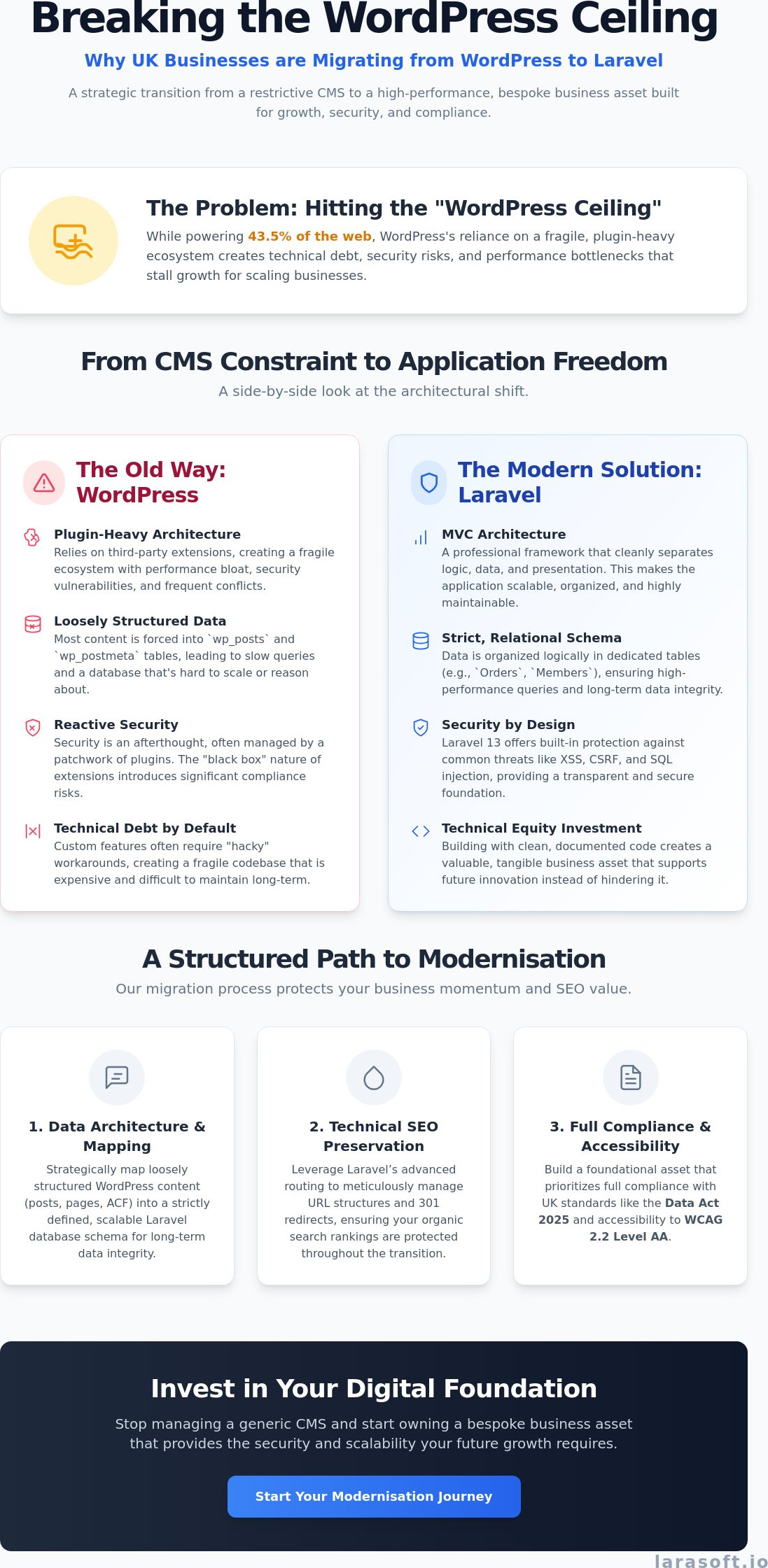
Successful software engineering relies on a predictable process. Migrating from wordpress to laravel is a precision task that requires a clear, phased strategy to avoid operational downtime. We don't recommend a "lift and shift" approach. Instead, we follow a rigorous roadmap that ensures your new application is built on a foundation of clean code and reliable data.
Maintaining data consistency is the most technical part of the journey. We use Laravel's native migration and seeding tools to create a repeatable deployment process. This is particularly vital for user accounts. Since WordPress and Laravel use different hashing algorithms, we implement custom logic to handle password compatibility or manage secure resets. We validate every record post-import to ensure that complex relationships, such as order histories or customer profiles, remain perfectly intact.
Your business cannot afford to stop while we build. We run the development process in parallel, keeping your existing WordPress site fully operational while the Laravel application is constructed in a secure sandbox. This staging environment allows your team to experiment with new bespoke features without risking live traffic. A phased migration is safer than a "big bang" approach because it allows for granular validation of each system component before the final switch. This methodical pace ensures that by the time you reach the cut-over date, the risk of failure is virtually non-existent.
The primary anxiety when migrating from wordpress to laravel is the potential for a sudden drop in organic search rankings. This fear is justified if the transition is handled carelessly. However, Laravel 13 offers a level of technical SEO control that WordPress simply cannot match. By treating your URL structure as a first-class citizen rather than a template-driven afterthought, you can actually improve your visibility post-launch. We prioritise the preservation of your hard-earned authority through meticulous planning and execution.
We map every legacy WordPress URL to its new Laravel equivalent using comprehensive 301 redirect maps. This ensures that the "link equity" you've built over years isn't lost. Unlike WordPress, where plugins often manage these via the database, Laravel handles routing at the application level. This is significantly faster and more reliable. It prevents the redirect loops and 404 errors that frequently plague poorly managed migrations. With over 70% of UK web browsing taking place on mobile devices in 2026, these performance gains are vital for maintaining your competitive edge.
Core Web Vitals remain a critical ranking factor, and Laravel’s high-performance architecture provides a distinct advantage. You're no longer fighting the "bloat" of multiple CSS and JS files loaded by disparate plugins. Instead, you deliver a lean, optimised experience that meets the highest performance standards out of the box. This architectural shift directly correlates to better user engagement and higher search visibility.
Lightning-fast interactions are a baseline expectation for modern users. By utilising Vue.js frontend development with Inertia.js or Nuxt, we implement Server-Side Rendering (SSR). This ensures that search engine crawlers see your content exactly as a human user does, but with the speed of a modern single-page application. We use Vite for asset bundling and modern CDNs to ensure your site loads instantly for users across the UK and beyond.
You don't need a heavy plugin like Yoast to manage your metadata. We use bespoke Laravel SEO packages that automate Schema.org markup, increasing your chances of appearing in Rich Snippets for competitive UK search terms. During the critical first 30 days post-migration, we monitor Search Console daily to resolve any crawl errors or indexing issues immediately. If you want to ensure your organic traffic remains stable during your transition, consider speaking with our team about our specialised SEO services.
Larasoft approaches every project with the mindset of a digital craftsman. When migrating from wordpress to laravel, we don't just move data; we rebuild your technical infrastructure to serve your long-term business goals. This is a rigorous process of legacy code modernisation that transforms a restrictive CMS into a scalable, high-performance engine. We operate on a collaborative philosophy defined by our signature concept: "Your vision, our code." This means we act as your deeply invested technical ally, ensuring that every architectural decision reflects your specific operational requirements.
Our commitment to your growth extends far beyond the initial launch phase. We provide structured software maintenance to ensure your digital asset remains secure and fully compatible with the latest PHP 8.3 standards required by Laravel 13. Security isn't an optional extra; it's a baseline requirement in our development cycle. We integrate technical SEO expertise into every line of code, ensuring that site speed and data integrity are hardcoded into your application. This disciplined execution is what separates a successful migration from a costly technical failure.
Choosing a partner with deep expertise in the UK market is essential for navigating national business standards. As of February 5, 2026, the Data (Use and Access) Act 2025 has introduced rigorous new requirements for data handling that generic WordPress setups often struggle to meet. We have a proven track record of migrating complex legacy systems for UK firms, focusing on long-term scalability and measurable business ROI. By working with specialists, you ensure that your platform is ready for the future of AI integration and headless architecture without the burden of technical debt.
The benefits of migrating from wordpress to laravel are clear: superior speed, robust security, and the freedom of bespoke functionality. You're moving away from the limitations of off-the-shelf licenses and toward a foundational asset that your business truly owns. The first step in this journey is a comprehensive technical audit of your current WordPress site. We'll identify the bottlenecks and security risks that are holding you back from your next stage of growth. Speak with our Laravel experts about your migration project today to start building a system that works perfectly under pressure.
Transitioning away from a restrictive CMS is a strategic move toward building technical equity. By migrating from wordpress to laravel, you replace the vulnerabilities and performance bottlenecks of a plugin-heavy ecosystem with a bespoke application designed for your specific business logic. A structured roadmap protects your hard-earned search rankings while ensuring your data is normalised and secure. This isn't just about a framework change; it's about building a foundation that meets modern standards and scales alongside your vision.
Since 2018, Larasoft has operated as a UK-based technical authority focused on high-performance code and legacy code modernisation. We take pride in our craftsmanship, ensuring every system we build performs perfectly under pressure. Our team acts as your dedicated technical ally, turning complex software challenges into a manageable journey toward growth. Consult with our Laravel specialists on your migration strategy and take the first step toward owning a modern, maintainable business asset. Your vision deserves code that can keep up.
Laravel provides superior SEO performance because it allows for total control over HTML output and server-side rendering. Unlike WordPress 7.0, which can suffer from plugin-induced bloat, Laravel applications meet Google's Core Web Vitals more effectively. This is critical in the UK, where over 70% of browsing occurs on mobile devices as of 2026. You gain the ability to automate Schema.org markup and manage routing without database overhead.
A standard migration typically takes between 8 and 16 weeks, though complex enterprise systems can require more time. This timeline includes the full architectural rebuild, data mapping, and rigorous UAT. Because migrating from wordpress to laravel involves custom coding your existing plugin functionality, the duration depends on the volume of bespoke features and the complexity of your legacy data structures.
You can retain your current visual identity, but the frontend code must be rebuilt from scratch. We typically recreate WordPress themes using modern frameworks like Vue.js or React to ensure better performance and accessibility. This process ensures your site meets the WCAG 2.2 Level AA standards required for UK businesses in 2026 while maintaining your brand's established look and feel.
WordPress plugins do not work in Laravel and must be replaced by bespoke Service Providers or native Laravel packages. This eliminates the security risks associated with third-party extensions. By custom-coding these features, you remove unnecessary code bloat and ensure that every function in your application serves a specific business purpose. It's a shift from off-the-shelf limitations to architectural freedom.
Your historical blog posts, pages, and user accounts are preserved through custom migration scripts. We map your wp_posts and wp_users tables directly to Laravel Eloquent models to ensure data integrity. This process maintains your SEO metadata and internal linking structures, ensuring that migrating from wordpress to laravel doesn't result in a loss of valuable content or customer history.
In 2026, UK migration costs typically range from £1,500 for simple sites to over £75,000 for complex enterprise or e-commerce platforms. A standard business migration usually falls between £5,000 and £25,000 depending on the volume of custom functionality. These figures reflect the specialized engineering required to rebuild a CMS into a bespoke application that provides long-term business ROI.
Laravel is significantly more secure because it has a smaller attack surface and robust built-in protections. It includes native defenses against SQL injection, CSRF, and XSS as part of the Laravel 13 core framework. Since you aren't relying on a vast ecosystem of public plugins, your application is less vulnerable to the automated exploits that target 43.5% of the web's WordPress sites.
Here’s what we've been up to recently.
Certified Quality. Great Prices