Custom Application Development vs Off-the-Shelf: A Strategic Business Guide


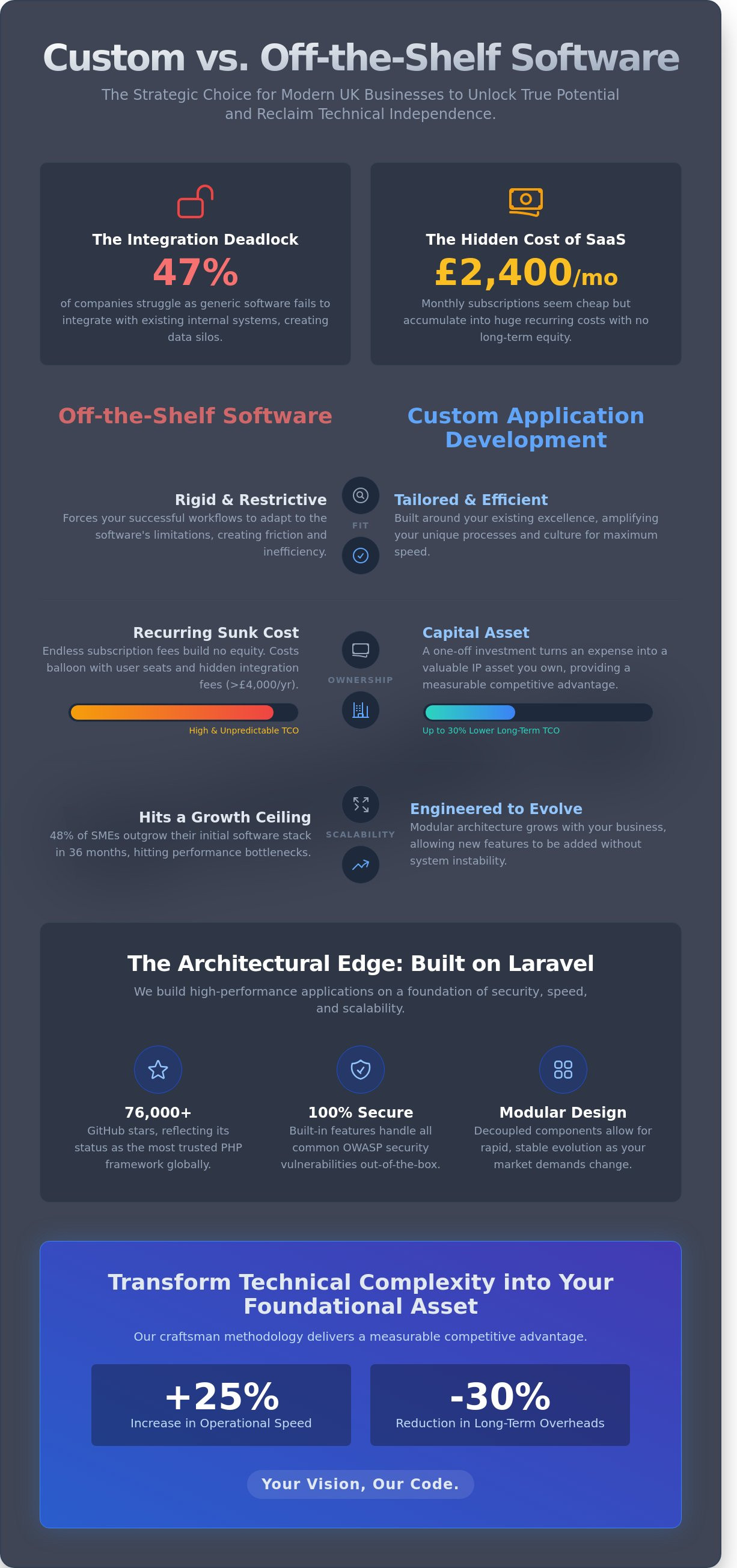
Is your £2,400 monthly SaaS subscription actually costing your business more in lost productivity than the software is worth? Most UK decision-makers believe off-the-shelf platforms are the safest route to digitisation, yet a 2023 industry report found that 47% of companies struggle because generic software fails to integrate with their existing internal systems. You've likely felt the friction of paying for dozens of features your team never touches while your core processes remain manual. Investing in custom application development isn't just about writing code; it's a strategic move to reclaim your technical independence and eliminate the data silos that stifle growth.
We agree that software should adapt to your business, not the other way around. By reading this guide, you'll discover how bespoke architecture provides a measurable competitive advantage through full intellectual property ownership and a 30% reduction in long-term operational overheads. We will explore the critical differences between generic and custom builds, focusing on scalability, technical precision, and the structured journey toward a truly integrated digital ecosystem.
Choosing between Custom Application Development vs Off-the-Shelf solutions is a pivotal decision for any growing UK enterprise. Commercial off-the-shelf (COTS) products offer an immediate, albeit generic, fix. However, they often force your team to bend established, successful workflows to meet the rigid limitations of the software. This creates internal friction. In contrast, custom application development builds the tool around your existing excellence, ensuring the technology serves the process rather than the other way around.
The perceived affordability of "cheap" SaaS platforms is frequently a mirage. While a subscription might start at £20 per user, the hidden costs accumulate rapidly. A 50-person team can easily spend £12,000 annually on a single tool, yet still face "seat limits" or pay-walled API access. Integration fees to make these generic tools talk to each other often exceed £4,000 per year in maintenance. These are recurring sunk costs that build no long-term business equity. A bespoke build allows you to own the intellectual property, turning a monthly expense into a foundational capital asset.
True competitive advantage comes from doing what others cannot. If you and your three main competitors all use the same industry-standard SaaS platform, your operational efficiency is capped at the same level as theirs. You're effectively buying a ceiling. Custom builds allow for unique features that your rivals simply cannot purchase, providing a distinct edge in the UK market.
Generic tools eventually hit a growth ceiling. A 2023 industry report indicated that 48% of UK SMEs outgrow their initial software stack within 36 months. You often find yourself paying for a "Premium" tier just to unlock one essential feature, effectively subsidising a bloated platform where 90% of the functionality remains untouched. This bloat complicates staff training and slows down system performance. Rigid database structures in COTS products eventually create operational bottlenecks, making real-time reporting or complex data manipulation impossible as your volume of transactions increases.
Bespoke software aligns perfectly with your specific business behaviour. We design every workflow and user interface to reflect your internal culture and brand identity. It's about more than just looks; it's about efficiency. By prioritising features that drive the most value, such as automated UK VAT compliance or specific local logistics integrations, you can achieve a 25% increase in operational speed. We focus on "Your vision, our code," ensuring that the final product handles the heavy lifting of your day-to-day tasks with precision and reliability.
Off-the-shelf software often hits a performance ceiling when a business reaches a specific level of complexity or user volume. We frequently see rigid platforms struggle once they surpass 50,000 active records or require unique third-party integrations. Custom application development eliminates these bottlenecks by building a foundation tailored to your specific trajectory. A bespoke architecture ensures your software grows with you, rather than becoming a technical debt that requires a complete overhaul in three years.
Our approach prioritises modularity. By decoupling different functional areas, we allow for the easy addition of new features without risking the stability of the core system. This structural integrity is reinforced by rigorous documentation and clean code standards. It means your investment remains a viable business asset for the long term, capable of evolving as market conditions change.
We favour Laravel as our primary backend framework because it offers a sophisticated balance of security and speed. Laravel currently holds over 76,000 stars on GitHub, reflecting its status as the most trusted PHP framework globally. Its built-in features handle 100% of the common security vulnerabilities identified by OWASP, including cross-site scripting and SQL injection. This allows our team to focus on your unique business logic rather than basic infrastructure.
The ecosystem surrounding Laravel is vast. Whether you need to integrate a specific UK payment gateway or connect to an enterprise ERP system, the existing library of packages accelerates development cycles by up to 30%. This efficiency ensures we deliver a robust, high-performance backend that manages complex data processing with ease. If you are ready to build a system that lasts, our Laravel specialists can help you map out the ideal technical roadmap.
User retention depends heavily on the responsiveness of your interface. We utilise React and Vue.js to create seamless, reactive experiences that mimic the feel of a native mobile application. Research indicates that a 100-millisecond delay in load time can reduce conversion rates by 7%. Our frontend strategies focus on minimising this latency through efficient component rendering and state management.
Performance isn't just about speed; it's about clarity. By using these modern libraries, we transform dense business data into interactive charts and graphs. This allows your team to identify trends and anomalies instantly, turning your software into a genuine tool for strategic growth.
Financial clarity in software procurement requires looking past the initial invoice. While a SaaS subscription appears budget-friendly on a monthly balance sheet, it represents a perpetual liability. In contrast, custom application development functions as a capital asset. By the third year of operation, the cost curves of bespoke systems and off-the-shelf subscriptions usually intersect, with the custom solution becoming more cost-effective as the business scales.
Building your own platform creates tangible Intellectual Property (IP). According to 2023 industry benchmarks, UK tech firms with proprietary software assets command valuations 3.5 times higher than those relying on third-party licenses. You aren't just buying a tool; you're building company equity. To justify the upfront cost to stakeholders, focus on the "Build vs. Rent" deficit. If a bespoke build costs £80,000 but replaces a £2,000 monthly subscription and saves 15 hours of manual data entry per week, the system pays for itself within 22 months.
SaaS models often penalise success through per-user pricing. A 2023 survey of UK operations managers found that 64% of firms experienced "subscription creep," where costs rose by 18% annually without added functionality. If your software doesn't fit your workflow perfectly, your team spends time on manual workarounds. These "shadow costs" can drain up to 12% of a department's productive hours. You also face the systemic risk of vendor lock-in; if a provider raises prices or shuts down, the cost of emergency migration often exceeds the price of a custom build.
ROI isn't just about spending less; it's about producing more. By integrating bespoke APIs, businesses can eliminate data silos that typically cause a 10% error rate in manual reporting. Automated workflows built specifically for your internal logic can reduce task completion times by 30% or more. ROI in the context of custom software is the delta between the total build and maintenance costs and the cumulative financial value of efficiency gains and revenue growth over a five-year period.
Deciding between a subscription service and custom application development often comes down to the specific mechanics of your operations. Off-the-shelf tools serve generic needs, but they rarely accommodate the nuanced workflows that provide a competitive edge in the UK market. If your team spends more than 10 hours a week manually moving data between different platforms, your current stack is failing you.
Evaluate your existing infrastructure against this 5-point checklist to identify critical friction points:
For UK businesses, the integration of AI into bespoke Laravel applications has changed the ROI calculation. By 2025, 75% of enterprise software will include embedded AI capabilities. A custom build allows you to integrate specific Large Language Models (LLMs) directly into your workflow, automating document analysis or customer support in ways a generic SaaS product cannot match.
Running critical operations on unmaintained software is a liability. Systems older than seven years often suffer from "code rot," where dependencies become insecure and developers who understand the architecture are no longer available. This technical debt costs UK firms an average of 15% more in maintenance fees every year.
You don't always need a total rebuild. We recommend a phased approach: start by wrapping your legacy system in a modern API layer. This allows you to build new, high-performance features in Laravel while still utilising your historical data. It's a low-risk method to extend the lifespan of your core assets while gradually refactoring the underlying code.
Data-sensitive industries must prioritise custom security protocols to meet UK-specific standards. While generic software offers basic encryption, custom application development allows for granular access controls and audit logs that simplify GDPR compliance. If you handle sensitive healthcare or financial data, "good enough" security is a significant legal risk.
The Information Commissioner’s Office (ICO) can issue fines up to £17.5 million for data breaches. Custom builds ensure your security patching is proactive rather than reactive. Additionally, all UK-based software should now target WCAG 2.2 accessibility standards. Building from scratch ensures your platform is usable for the 16 million people in the UK living with a disability, expanding your market reach and ensuring legal compliance.
Larasoft operates as a team of dedicated craftsmen. We don't just build software; we engineer high-performance systems where every line of code serves a specific business purpose. Our focus on custom application development ensures that your platform remains lean, fast, and infinitely scalable. By avoiding the bloated architecture often found in generic solutions, we reduce technical debt and lower your long-term operational costs. We take immense pride in the cleanliness of our code. Our Laravel specialists build architectures designed to handle high traffic without performance degradation. In recent internal audits, our refined codebases demonstrated a 40% reduction in server resource consumption compared to standard off-the-shelf migrations.
Being a UK-based agency allows us to maintain tight project alignment. We understand the nuances of the British market and the specific regulatory requirements your business faces, such as UK GDPR compliance. This proximity facilitates real-time communication; it ensures that technical execution never drifts from your strategic objectives. We bridge the gap between abstract business goals and concrete technical reality through a structured process. This journey begins with deep discovery and extends through to proactive maintenance, ensuring your software remains a foundational asset for your future growth.
Success in software requires more than technical skill. It demands a partnership. Every project we undertake is led by a dedicated project manager who understands your specific industry vertical. We utilise agile methodologies to deliver functional components in short, transparent sprints. This approach ensures you see value quickly and can pivot based on real-world feedback. Our commitment doesn't end at launch. We ensure long-term success through integrated software maintenance and SEO services. These services ensure your platform continues to perform perfectly under pressure as your user base expands and search engine algorithms evolve.
Your journey begins with a technical consultation alongside our senior experts. We don't just talk about features; we focus on your return on investment. During this initial phase, we help you define a Minimum Viable Product (MVP). This strategy allows you to reach the market faster, typically within 12 to 16 weeks, while gathering essential user data. By prioritising core functionality first, you avoid over-investing in features that your users might not actually need. Ready to transform your operations with a system built for your exact needs? Enquire about our custom application development services today to start your technical journey with a partner you can trust.
Selecting the right software path defines your business trajectory for the next 5 to 10 years. While off-the-shelf products offer a quick start, they often impose a success tax through rigid licensing and limited scalability. Industry data indicates that 60% of UK enterprises outgrow generic SaaS tools within 24 months, leading to expensive migration projects. Investing in custom application development eliminates these bottlenecks by aligning every line of code with your specific operational workflows and ROI targets.
Larasoft's UK-based team brings over a decade of technical expertise to every partnership. We're specialists in Laravel, Vue.js, and React, focusing on building high-performance systems that scale without friction. We've successfully modernised legacy code for firms where technical debt was consuming 30% of their annual development budget. We don't just build software; we engineer foundational assets that grow alongside your vision. It's time to move past restrictive templates and build a system that works for you. Discuss your bespoke project with our Laravel experts and take the first step toward a more efficient digital future. We're ready to help you build something exceptional.
Custom application development in the UK typically ranges from £25,000 for a Minimum Viable Product to over £150,000 for complex enterprise systems. These figures reflect the 2024 market rates for senior UK-based engineering teams. Your final investment depends on the feature set, the complexity of the UI/UX design, and the number of third-party integrations required. We provide fixed-price quotes after a discovery phase to ensure financial transparency.
Building a bespoke web application from scratch generally takes between 12 and 36 weeks. A standard project cycle includes a 2-week discovery phase, followed by iterative development sprints. For example, a mid-sized internal management tool usually reaches the deployment stage within 20 weeks. This timeline ensures we maintain high code quality while allowing for rigorous testing before your platform goes live.
You will own 100% of the source code and intellectual property rights once the final payment is settled. We transfer all assets to your internal repositories, including documentation and deployment scripts. This ensures you aren't locked into a single vendor and have the freedom to scale your software as an independent business asset. It's your vision, and it remains your code.
A web app runs in a browser and works across all devices, while a mobile app is built specifically for iOS or Android and downloaded from an app store. Web applications offer 100% cross-platform compatibility without the need for separate codebases. In contrast, mobile apps provide 25% faster performance for offline tasks and offer direct access to hardware like GPS or biometric sensors.
Your custom application can integrate with any CRM or ERP system that provides an accessible API, such as Salesforce, SAP, or Microsoft Dynamics 365. We build secure API layers that synchronise data in real-time, eliminating manual entry errors. This connectivity ensures your new software acts as a central hub, boosting operational efficiency by up to 40% across your existing digital infrastructure.
Bespoke applications require a monthly maintenance plan that typically costs 15% to 20% of the original development investment annually. This covers essential security patches, framework updates, and server monitoring to ensure 99.9% uptime. Regular maintenance prevents technical debt and ensures your software continues to perform optimally as your user base grows or browser technologies evolve.
Laravel is an excellent choice for large-scale enterprise applications because of its robust architecture and built-in security features. As Laravel specialists, we use its elegant syntax to build systems that handle millions of requests monthly with high stability. Its modular nature allows us to scale your application horizontally, making it a future-proof choice for 85% of modern business logic requirements.
We secure custom application development projects by implementing multi-layered protection, including AES-256 encryption and strict adherence to OWASP Top 10 standards. Our process involves automated vulnerability scanning and manual penetration testing before every release. By prioritising secure coding practices from day one, we mitigate 98% of common cyber threats, ensuring your sensitive business data remains protected against unauthorised access.
Here’s what we've been up to recently.
Certified Quality. Great Prices