Total Cost of Ownership for Custom Software: A Strategic Guide for 2026


Did you know that 40% of UK businesses are shifting away from generic SaaS in 2026 to regain control through bespoke development? While this transition offers unmatched flexibility, it also means that calculating the total cost of ownership for custom software has become a critical board-level priority. You've likely felt the sting of unpredictable maintenance costs or watched hidden infrastructure fees creep upward as cloud providers forecast price hikes of up to 10% this year. It's frustrating when technical debt slows your growth just as you're ready to scale.
We understand that building a digital platform is a foundational investment, not a one-off expense. This guide provides a clear financial roadmap to justify your development choices and ensure your investment delivers maximum ROI over the next five years. We'll explore how to optimise your architecture to reduce long-term debt and keep your systems high-performing. From leveraging modern frameworks like Laravel and React to proactive software maintenance, you'll learn how to turn technical complexity into a structured journey toward sustained growth.
The price on a development proposal is rarely the final number. To build a sustainable digital asset, decision-makers must look at the Total Cost of Ownership (TCO). This metric provides a comprehensive financial estimate of a software asset over its entire lifecycle, typically measured over a five-year horizon. In 2026, where the UK software development market is valued at £49.5 billion, precision in forecasting is no longer optional for firms that value efficiency.
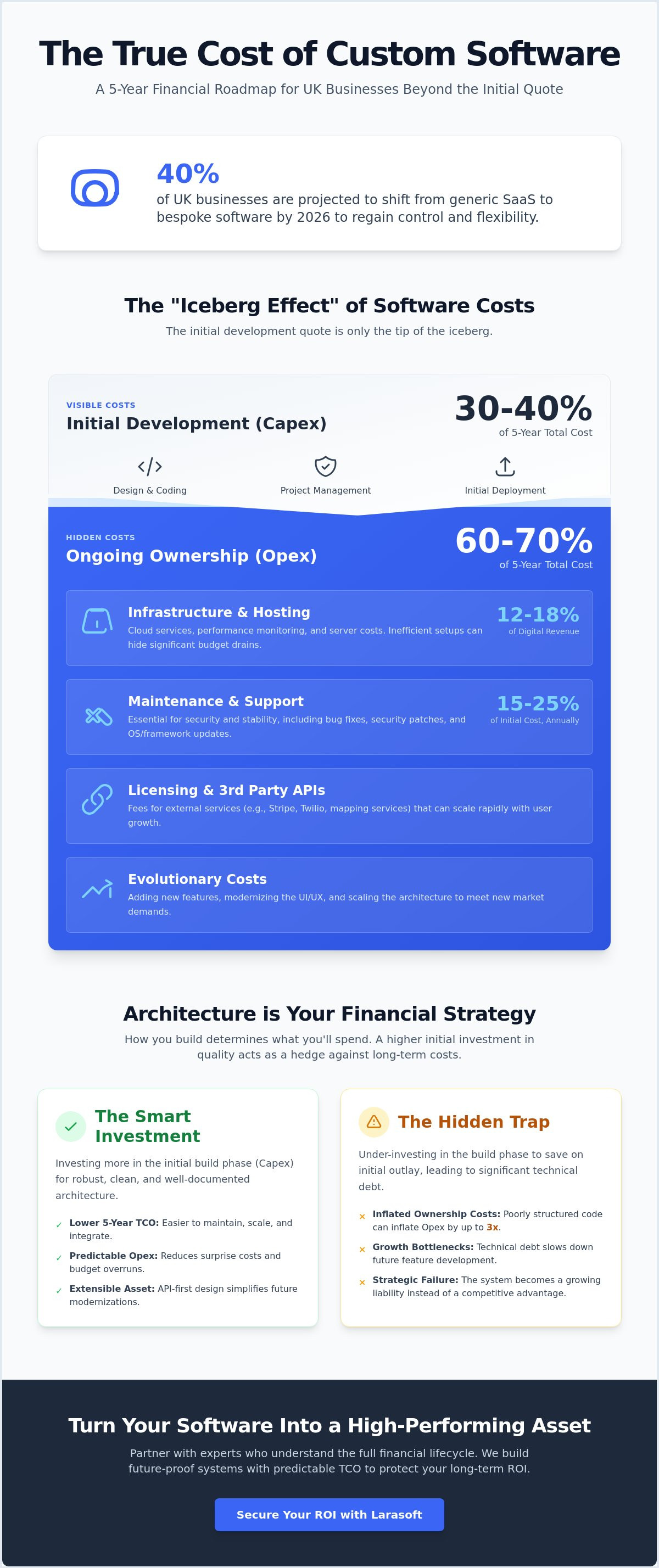
Research indicates that the initial development fee often accounts for only 30-40% of the total 5-year cost. This creates what engineers call the "Iceberg Effect." While the visible peak represents the design and build phase, the massive structure beneath the surface includes hosting, security updates, and feature iterations. Understanding the total cost of ownership for custom software is the only way to ensure your technical investment remains a foundational asset rather than a growing liability.
TCO is the only metric that truly measures the success of bespoke software. A project that finishes on time and under budget during the build phase but requires constant, expensive patching is a strategic failure. Conversely, a higher initial investment in robust architecture often results in a lower TCO over five years because the system is easier to maintain, scale, and integrate with modern tools.
The build phase represents your Capital Expenditure (Capex). It covers the architectural design, coding, and initial deployment. Once the software goes live, you enter the ownership phase, which is Operational Expenditure (Opex). A common trap is under-investing in the Capex phase to save on initial outlay. This usually backfires. Poorly structured code or a lack of documentation creates technical debt, which can inflate ownership costs by up to three times the original estimate. High-quality work in the build phase acts as a hedge against these long-term expenses.
Accurate forecasting prevents mid-project capital exhaustion, a risk that has grown as cloud infrastructure costs fluctuate. For instance, OVH Cloud forecasted price increases of 5-10% between April and September 2026, with other major providers expected to follow. By accounting for these variables, you protect your business's scalability and overall valuation. A software system with a clear, managed total cost of ownership for custom software provides a distinct competitive advantage. It ensures your technical ally is helping you grow rather than draining resources through unforeseen maintenance cycles.
Managing the total cost of ownership for custom software requires a granular understanding of where capital flows after the initial launch. It isn't just about the code. It's about the ecosystem that sustains it. Leading tech consultants suggest that understanding TCO for IT investments involves looking at both direct and indirect expenses. For bespoke systems, these fall into five distinct categories.
By breaking down these components, you can build a more resilient financial roadmap. This transparency allows you to treat your software as a high-performing asset rather than a series of surprise invoices.
Cloud environments often hide inefficiencies that drain budgets. With AWS holding 32% of the market and Azure at 23%, many businesses default to these giants without optimising their environments. This leads to "cloud sprawl," where you pay for unutilised resources. Bespoke builds offer a significant advantage here. Unlike rigid SaaS platforms, a custom system allows for precise infrastructure tuning. You only pay for the compute power your specific workloads require. Given that providers like OVH Cloud and Azure are forecasting 5-10% price increases this year, performance monitoring is vital to keep monthly bills predictable.
Internal staff training and change management represent significant indirect costs. If a system is difficult to use, the time spent onboarding employees eats into your ROI. High-quality UX design is a strategic intervention that reduces these long-term support expenses. There's also the opportunity cost of downtime. Slow release cycles or system instability don't just cost money in repairs; they cost you market share. Investing in clean, maintainable code from the start ensures your total cost of ownership for custom software remains low by enabling faster, more reliable updates.
Your choice of technology stack is more than a technical preference; it's a long-term financial commitment. Architecture dictates how easily your system adapts to market shifts, and it directly influences the framework for TCO you'll manage over the next decade. Choosing a niche or proprietary language might seem innovative today, but it often leads to "developer lock-in" and inflated maintenance fees. To keep your investment agile, you need a stack that offers high developer liquidity.
Developer liquidity refers to how easily you can find, hire, and replace talent to work on your codebase. With 76% of UK employers currently reporting difficulty in filling technology roles, choosing a popular, well-documented framework is a strategic hedge against rising recruitment costs. Sticking to industry standards lowers the total cost of ownership for custom software because you aren't forced to pay a premium for specialists in obscure languages. Standardisation ensures that transition periods are short and knowledge transfer is seamless.
Building with an API-first design further reduces long-term integration TCO. By decoupling your backend logic from the frontend, you ensure your software remains extensible. Whether you decide to launch a mobile app in 2027 or integrate Laravel AI capabilities, an API-centric architecture prevents the need for a complete system rebuild. You simply plug new services into your existing foundation, preserving your original capital investment.
Laravel has become a cornerstone for businesses that value structural integrity and cost-efficiency. It includes built-in security features and automated testing tools that significantly reduce the time spent on manual QA and patching. By leveraging the Laravel ecosystem, specifically tools like Forge or Vapor, we can simplify infrastructure management and reduce the hours required for server maintenance. For a deeper look at how to select the right partner for this stack, see The Strategic Guide to Choosing a Laravel Development Agency in 2026.
Utilising modern frontend libraries like Vue.js (v3.5.34) or React (v19.2.6) allows for a component-based architecture. This approach lets developers create reusable blocks of code, which lowers the cost of building new features and ensures a consistent user experience. Efficient frontends also reduce the load on your servers, helping to keep your monthly cloud bills predictable. You can learn more about these benefits in The Strategic Guide to Vue.js Frontend Development for Modern Businesses.
Many businesses fall into the trap of planning for a three-year software lifecycle. In reality, successful bespoke systems often serve a business for seven years or more. A five-year horizon is the gold standard for calculating the total cost of ownership for custom software, as it captures the shift from initial growth to the necessary modernisation cycles. To build a reliable financial roadmap, you must move beyond guesswork and apply a structured framework.
Ignoring technical debt doesn't just slow down your developers; it makes your TCO grow exponentially. When systems aren't updated, the cost of adding even simple features rises as engineers struggle with outdated dependencies. Refactoring early is almost always more cost-effective than a total emergency rebuild in year five. You can explore our deep dive on this in Legacy Code Modernisation: A Strategic Guide for UK Business Leaders.
Proactive security maintenance is a fraction of the cost of a data breach. With the EU AI Act compliance deadlines for high-risk systems approaching in August 2026, UK firms with international reach must budget for rigorous technical audits. Automated security testing and regular code reviews should be baked into your total cost of ownership for custom software. This disciplined approach ensures you meet evolving UK data protection standards without sudden, unbudgeted spikes in expenditure.
If you're ready to build a system with a transparent financial future, contact our team for a strategic consultation on your next bespoke project.
Larasoft approaches every project as a long-term partnership rather than a transactional delivery. We don't just ship code; we build foundational assets designed to scale. Our commitment to clean, maintainable architecture is a deliberate strategy to lower the total cost of ownership for custom software. By prioritising structural integrity from the first line of code, we ensure your system remains agile and resists the expensive technical debt that often follows rapid, undisciplined builds.
We utilise an API-first methodology across our Laravel, Vue.js, and React projects. This architectural choice ensures your platform is extensible by design. Whether you plan to launch a native mobile app in two years or need to integrate with emerging third-party platforms, the transition is fluid and cost-effective. Our specialised expertise in Laravel AI integration also allows us to build systems that automate high-volume operational tasks. This reduces the manual overhead required to manage your platform, directly lowering your long-term Opex.
Transparency is a core component of our relationship with clients. We provide structured software maintenance plans that offer UK business leaders a predictable financial roadmap. Instead of reacting to system failures, we proactively manage your environment to prevent them. This shift from reactive patching to strategic maintenance is what keeps the total cost of ownership for custom software manageable as your business grows.
High-performing software is the backbone of modern digital visibility. Our maintenance services go beyond security patches; we focus on technical performance that supports your SEO visibility. A fast, secure, and stable system is favoured by search engines, meaning our technical execution directly feeds your long-term growth strategy. By ensuring high uptime and rapid load speeds, we protect your brand's reputation and search rankings. Our deep Laravel expertise makes us a dedicated ally, ensuring your system evolves alongside both search engine algorithms and user expectations.
If you're currently managing an aging system that feels like a financial drain, the best way to regain control is through a comprehensive technical audit. We specialise in legacy code modernisation, helping you identify exactly where technical debt is inflating your lifecycle costs. For those starting a new project, we help you adopt a TCO-first mindset during the initial discovery phase. This ensures every architectural decision is weighed against its five-year financial impact.
Securing your technical future requires a partner who understands the intersection of code and commerce. Contact us today to discuss your bespoke software roadmap and discover how we can optimise your long-term technical investment.
Mastering the total cost of ownership for custom software is a transition from reactive spending to strategic asset management. By prioritising disciplined architecture and a structured five-year financial roadmap, you ensure your platform remains a driver of growth rather than a drain on resources. We've explored how selecting the right stack and committing to proactive modernisation can protect your ROI in an increasingly complex digital economy.
As UK-based Laravel experts since 2018, Larasoft has a proven track record of building high-performance web applications that stand the test of time. We specialise in legacy code modernisation, helping business leaders transform outdated systems into scalable, foundational assets. Our approach balances technical precision with clear business outcomes, ensuring your software performs perfectly under pressure.
Take the first step toward a more predictable and efficient technical future. Request a Technical Audit to Optimise Your Software TCO and let us help you build a resilient roadmap for your bespoke development. Your technical journey is manageable when you have a dedicated ally invested in your long-term success.
Annual maintenance typically ranges between 15% and 25% of the initial development cost. This allocation ensures your system remains secure, stable, and compatible with evolving browser standards and operating system updates. Budgeting for these recurring expenses is a fundamental part of managing the total cost of ownership for custom software over a multi-year horizon.
Bespoke software generally requires a higher initial capital investment but offers lower marginal costs as you scale. While SaaS subscriptions often increase linearly with every new user or transaction, a custom system allows you to control your infrastructure spend. For UK businesses with high volumes or specialized workflows, the total cost of ownership for custom software can be more economical than long-term SaaS licensing fees by year four or five.
Projects frequently exceed estimates because decision-makers focus on the "build price" while overlooking the "ownership price." Hidden factors, such as the 5-10% cloud infrastructure price increases forecasted by providers like OVH and Azure for 2026, can significantly impact budgets. Failing to account for third-party API fee escalations or the cost of internal staff training also leads to unforeseen financial pressure.
Legacy code modernisation lowers TCO by replacing inefficient, high-maintenance code with modern, optimized frameworks like Laravel or React. Older systems often require more developer hours for even simple updates due to fragile dependencies. By refactoring these systems, you reduce the time spent on bug fixes and lower your infrastructure requirements, resulting in a leaner and more predictable operational budget.
Choosing a standard, well-documented tech stack and an API-first architecture provides the best long-term value. This approach ensures high developer liquidity, making it easier and more cost-effective to find talent in the UK's competitive tech market. Additionally, precise cloud resource tuning prevents "cloud sprawl," ensuring you only pay for the compute power your specific workloads require.
A major refactoring or modernisation cycle should be planned every three to four years. While routine maintenance handles security patches, a deeper architectural review ensures the system remains performant and scalable. Proactive refactoring prevents technical debt from compounding, which keeps the ongoing maintenance costs from spiking as the software ages.
Technical debt is a critical, though often invisible, component of TCO. It represents the eventual cost of rework required because a faster, less disciplined solution was chosen during the build phase. If unmanaged, technical debt acts like high-interest financial debt, inflating your maintenance costs and slowing down your ability to release new features, which ultimately reduces your total ROI.
Here’s what we've been up to recently.
Certified Quality. Great Prices