The Real Cost to Modernise a Legacy PHP Application in 2026


Enterprises often spend 60% to 75% of their total IT budgets merely maintaining legacy systems that have ceased to drive innovation. In 2026, the cost to modernise legacy php application infrastructure is no longer just a technical line item; it's a strategic move to stop the compounding interest on your technical debt. With PHP 8.1 already unsupported and the average US data breach cost reaching $10.22 million, the risk of "doing nothing" has finally eclipsed the price of a structured upgrade.
We understand the frustration of seeing your roadmap stalled by spaghetti code and the difficulty of finding specialized talent willing to touch outdated frameworks. This guide provides a comprehensive framework for decision-makers to estimate, justify, and manage the budget for PHP modernisation. You'll gain a clear understanding of the primary cost drivers, from AI-assisted refactoring to full architectural shifts. We'll outline a roadmap that balances your immediate budget constraints with long-term risk mitigation, giving you the data required to secure board approval for a foundational business asset.
Many enterprises find themselves trapped in a cycle where 60% to 75% of their IT budget is consumed by simply maintaining existing systems. This "Legacy Tax" represents a massive drain on capital that should be fueling innovation. When you evaluate the cost to modernise legacy php application infrastructure, you must weigh it against this invisible monthly burn. Maintaining outdated codebases isn't just a technical burden; it's a financial anchor that prevents your organization from pivoting when market conditions change. The math is unforgiving. Older code requires more manual testing; more manual testing leads to slower releases; slower releases mean your competitors reach the market first.
The recruitment landscape adds another layer of financial pressure. As of May 2026, the average hourly rate for a PHP developer in the United States is approximately $49.04, with mid-to-lead Laravel roles typically ranging from $42 to $69. However, these figures don't tell the whole story. Finding high-tier talent willing to work on "spaghetti code" is increasingly difficult. Skilled engineers gravitate toward modern environments like Laravel 13. If your stack is stuck in the past, you'll pay a premium for developers who can navigate the technical debt, or you'll face a total inability to scale your team.
Every month you delay legacy system modernization, you're paying "interest" on your technical debt. This interest manifests as longer development cycles and frequent system downtime. For national brands, even an hour of downtime can damage a reputation built over decades. Beyond the internal friction, legacy systems often hinder SEO and user acquisition. Slow server response times and rigid architectures make it nearly impossible to meet the performance benchmarks required for top-tier search rankings. You're effectively paying more for traffic that converts less because of a sluggish user experience.
Security is the most urgent driver for change in 2026. PHP 8.1 is now unsupported, and versions like 8.2 and 8.3 receive security fixes only. With the average cost of a data breach for US organizations reaching $10.22 million in 2025, the financial risk of running end-of-life infrastructure is staggering. Cyber insurance providers have noticed; many now require proof of a modern, supported stack before issuing or renewing policies. Proactive modernisation is no longer a technical luxury. It's a mandatory requirement for risk management and GDPR compliance. The cost to modernise legacy php application environments is almost always lower than the cost of a single major security incident.
Understanding the financial scope of a transition requires looking beneath the surface of the codebase. It isn't just about the number of files or the age of the server. The U.S. Government Accountability Office has repeatedly highlighted the high cost of maintaining legacy systems, noting how these expenses eventually consume the resources needed for new development. Several variables influence the total cost to modernise legacy php application environments, and identifying these early prevents budget overruns.
The following factors typically dictate the complexity and resource requirements of your project:
Starting with a comprehensive Legacy Code Modernisation audit ensures your roadmap is based on technical reality rather than optimistic assumptions.
A thorough technical audit is the first non-negotiable expense. We don't just look for bugs; we look for structural weaknesses that make future updates impossible. While automated tools can provide a high-level overview of syntax issues, a manual review by a specialist identifies the "why" behind the code. This distinction is critical because structured legacy applications are far cheaper to refactor than those built without a clear architectural pattern. An accurate assessment at this stage is what allows us to provide a reliable cost to modernise legacy php application estimate.
Legacy PHP applications often rely on outdated protocols like SOAP or even direct database connections to share data. Modernising these into REST or GraphQL APIs is essential for scalability but adds to the project's integration density. Decoupling a monolithic system into manageable services requires meticulous planning to ensure data integrity during the transition. The effort spent here pays dividends later, as it allows your system to interact seamlessly with modern frontends and external SaaS platforms.
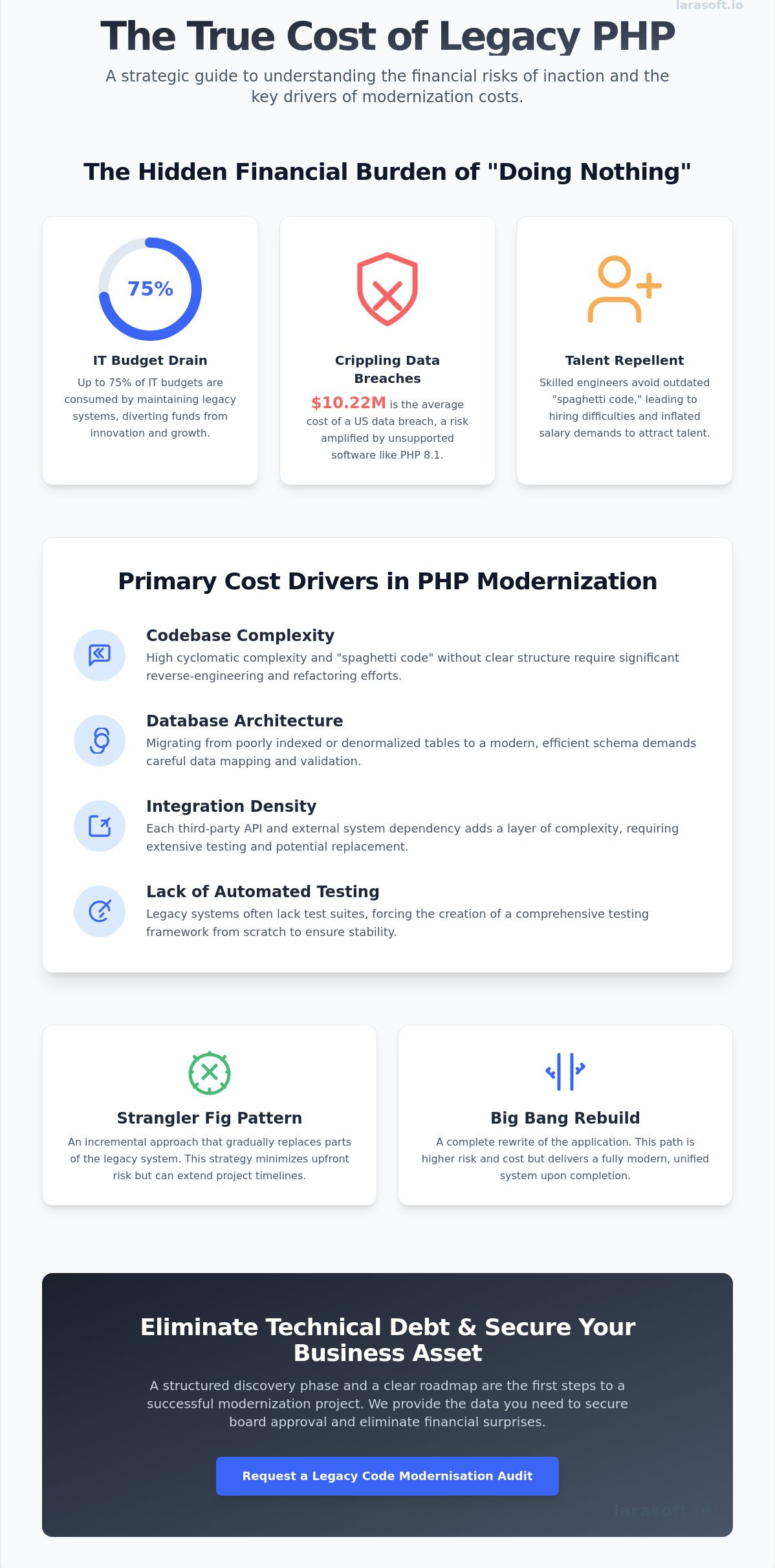
Choosing between refactoring and rebuilding is the most critical financial decision in any software lifecycle. The total cost to modernise legacy php application infrastructure varies wildly based on whether you choose to renovate the existing structure or demolish it to start over. Research into budgeting for modernization suggests that many organizations fail because they don't align their technical strategy with their long-term financial objectives. You must decide if your priority is immediate risk mitigation or a total reset of your technical debt.
Hybrid approaches offer a middle ground for complex platforms. You might modernise a brittle frontend using Vue.js or React while keeping a stable legacy PHP backend via an API bridge. This balances the need for a fresh user experience with the reality of a limited budget. Each path has a distinct impact on your cash flow. Rebuilds demand heavy upfront capital, while refactoring allows you to spread the investment across multiple fiscal periods.
Incremental refactoring often utilizes the "Strangler Fig" pattern. This method involves replacing specific modules of the application one by one while the legacy system continues to run in parallel. It's an ideal strategy for businesses that require continuous uptime and prefer to spread the cost to modernise legacy php application over several quarters. By focusing on high-value modules first, you can achieve immediate ROI. While the total cost over time might be higher due to the need for "bridge" code, the lower initial outlay makes it accessible for many mid-market firms.
A "Big Bang" rebuild represents a clean slate approach. While it requires a higher initial investment, it often results in significantly lower maintenance costs over the next five to ten years. A full rebuild allows you to implement Laravel AI integration from the very beginning, ensuring your new platform is built for the future. This strategy effectively eliminates the architectural bottlenecks that incremental refactoring might leave behind. It's often the cheaper long-term option when the existing code is so degraded that the cost of understanding it exceeds the cost of replacing it.
Timelines for refactoring are typically longer but more flexible, whereas rebuilds are intense, shorter-term projects that demand a dedicated focus. The right choice depends on your specific operational constraints and how much disruption your business can tolerate during the transition. If your current system is a liability that prevents any new feature development, a clean slate is likely your most efficient path forward.
Effective financial planning for a modernisation project begins with a structured Discovery Phase. We typically recommend allocating 10% to 15% of your total project budget to this initial stage. This phase isn't just a preliminary check; it's a deep dive into the architectural reality of your system. It allows us to uncover hidden dependencies and refine the total cost to modernise legacy php application before the main development work begins. Without this foundation, your budget is little more than a guess.
Legacy systems often hide "unknown unknowns" beneath layers of undocumented patches. To manage this risk, a contingency fund is a non-negotiable component of a successful budget. This buffer ensures that unexpected technical hurdles don't stall your progress or force compromises on quality. By adopting a phased rollout strategy, you can spread the financial impact across multiple quarters. This approach also allows you to validate the new system in a production environment earlier, providing immediate feedback and reducing the overall risk profile of the entire project.
ROI shouldn't be a vague concept. You can track concrete metrics such as speed-to-market for new features and a significant reduction in support tickets related to system stability. These improvements directly correlate to a more efficient operation and a better bottom line. When your team spends less time fighting fires, they spend more time building value.
Securing approval for a large-scale project requires translating technical debt into business consequences. Instead of discussing code refactoring, focus on how legacy code modernisation acts as a catalyst for digital transformation. Present KPIs like a 30% faster checkout process or a significant reduction in server overhead costs. When the board sees that the cost to modernise legacy php application is actually an investment in developer efficiency and market agility, the conversation shifts from "unnecessary expense" to "foundational growth asset."
The goal is to stop the cycle of technical decay permanently. Budgeting for ongoing software maintenance ensures that your new application remains at the cutting edge. This shift from reactive fixing to proactive evolution is powered by modern CI/CD pipelines. These automated systems reduce the manual effort required for future updates, significantly lowering the long-term cost of ownership and preventing your new stack from becoming the legacy system of 2030.
If you're ready to define a realistic roadmap for your system, explore our Legacy Code Modernisation services to start your discovery phase today.
Selecting the right framework is the most effective way to control the long-term cost to modernise legacy php application infrastructure. Laravel 13, released in March 2026, has solidified its position as the industry standard for enterprise-grade PHP development. It reduces development hours by providing a robust ecosystem of pre-built packages for authentication, API management, and task scheduling. Instead of paying for hundreds of hours of custom "plumbing" code, your budget is directed toward building features that drive actual business value.
The developer landscape also favors this transition. While mid-to-lead Laravel developers in the US command an average of $59.26 per hour as of May 2026, the real financial benefit is the size of the talent pool. You'll never be held hostage by a single developer who is the only person capable of navigating a bespoke, undocumented system. By moving to a standardized framework, you ensure your application is a foundational asset that any high-tier engineer can maintain and scale.
We utilize an "Audit-First" methodology designed to eliminate waste. This process ensures we don't spend your budget refactoring low-impact areas of the code that aren't critical to your operations. Our team specializes in pairing Laravel with high-performance frontends like Vue.js or React to deliver a modern user experience that matches the improved backend architecture. We have a proven track record of transitioning complex UK business systems from brittle legacy environments into streamlined, high-performance platforms that perform perfectly under pressure.
Modernisation doesn't require a leap of faith. You can request a targeted technical audit to define the exact scope of your technical debt without committing to a full-scale rebuild. During your first consultation, we'll break down your current system into logical components and provide a roadmap that balances your budget with your risk tolerance. This transparency ensures that you understand the strategic purpose behind every technical intervention before any code is written.
Discuss your modernisation project with our expert team to define a clear, cost-effective path toward a more reliable and scalable digital future.
Modernising your infrastructure is about more than just updating code; it's about reclaiming the significant portion of your IT budget currently lost to maintenance. By choosing a structured path toward Laravel 13, you replace brittle "spaghetti code" with a scalable, secure, and developer-friendly environment. The total cost to modernise legacy php application environments is a manageable investment when balanced against the multi-million dollar risks of data breaches and the rising expense of technical debt.
As UK-based Laravel specialists, Larasoft provides the technical authority required to navigate these complex transitions. Our team has a proven track record in delivering high-performance Vue.js and React frontends alongside complex API integrations that drive business growth. We help you turn a legacy liability into a foundational asset that performs perfectly under pressure. Don't let outdated systems dictate your roadmap. Book a Legacy Code Audit with Larasoft to gain a clear, evidence-based plan for your digital future. Your journey toward a more efficient and innovative platform starts with a single, expert assessment.
An application is typically considered legacy if it runs on an unsupported PHP version like 8.1 or lower, or if it lacks a modern framework structure like Laravel. Other indicators include a lack of automated testing, high cyclomatic complexity, and difficulty finding developers willing to maintain the "spaghetti code." If your team spends more time fixing bugs than building features, your system has reached legacy status.
Refactoring is not always the most cost-effective choice. While it requires a lower initial outlay, a full rebuild often results in lower total ownership costs if the existing technical debt is too high to manage efficiently. If the architectural bottlenecks are severe, trying to save the old code can actually increase the long-term cost to modernise legacy php application environments compared to a clean slate.
Modernisation timelines in 2026 generally range from three to twelve months, depending on the application's size and complexity. However, the adoption of AI-assisted tools in the development cycle has started to reduce these timelines by 40% to 50%. A structured discovery phase is essential to define an accurate schedule and ensure that the project stays on track without unexpected delays.
You can achieve zero-downtime modernisation by implementing the Strangler Fig pattern, which allows for an incremental transition between the old and new systems. This method involves replacing specific modules one by one while the legacy system continues to handle the remaining traffic. This approach is ideal for national brands and high-traffic platforms that cannot afford even a brief interruption in service.
The most frequent hidden cost to modernise legacy php application projects lies in uncovering undocumented third-party dependencies or custom integrations. Legacy systems often rely on "black box" code where the original logic is lost. Without a thorough technical audit and a dedicated contingency fund, these unknown variables can lead to significant budget overruns during the integration phase of the project.
Modernising your stack significantly boosts technical SEO by improving server response times and meeting Google's Core Web Vitals requirements. Modern PHP versions like 8.5 offer superior execution speeds compared to older versions. When paired with high-performance frontends like Vue.js or React, your application provides a faster, more responsive user experience that search engines prioritize in their ranking algorithms.
Yes, moving to a supported PHP version is a critical component of GDPR compliance because it ensures you receive the security patches necessary to protect user data. Running on end-of-life infrastructure means your business is permanently vulnerable to exploits. Given that the average US data breach cost reached $10.22 million in 2025, proactive modernisation is a mandatory risk management strategy.
Running your business on PHP 7.4 in 2026 exposes you to severe security vulnerabilities and a total lack of official support, as this version reached its end-of-life in November 2022. You'll likely face higher insurance premiums and a shrinking pool of developers capable of maintaining the system. Eventually, the system will become a "hard failure" risk that could lead to catastrophic downtime or data loss.
Here’s what we've been up to recently.
Certified Quality. Great Prices