Native Mobile App Development: A Strategic Guide for UK Enterprises


By 2026, the difference between a functional app and a market leader will be measured in milliseconds of latency and the depth of its hardware integration. You've likely felt the pressure to reduce initial outlays by avoiding native mobile app development, only to find that managing fragmented codebases and sourcing specialised UK talent costs more in the long run. It's a frustrating cycle for 68% of UK decision-makers who initially prioritise speed over architectural integrity.
This guide explains why building natively remains the gold standard for performance, security, and long-term business scalability. We'll show you how to move beyond the high initial development costs to build a premium digital asset that integrates perfectly with device hardware and avoids the common pitfalls of technical debt. We will break down the strategic shift required to treat your software as a foundational asset rather than a one-off expense, ensuring your investment delivers a genuine return in an increasingly competitive digital landscape.
Native mobile app development remains the gold standard for UK enterprises that refuse to compromise on user experience or technical stability. It involves engineering software specifically for a single mobile operating system using the platform's primary languages and tools. By 2026, the "write once, run anywhere" promise has largely failed high-performance enterprise applications. These cross-platform attempts often struggle with the sophisticated security protocols and complex hardware integration required by modern business standards. For a clear baseline, What is a Native App? provides a neutral definition of these platform-specific builds within the wider mobile ecosystem.
Modern 2026 smartphone hardware, featuring advanced neural engines and biometric sensors, requires deep integration that only native code can provide. Native applications speak directly to the kernel of the operating system. This eliminates the latency found in abstraction layers, ensuring that the software responds instantly to user inputs. At LaraSoft, we view this architecture as the foundation of a scalable digital asset rather than a temporary solution.
Swift 6.x continues to be the premier choice for the Apple ecosystem. It offers memory safety and concurrency features that prevent approximately 30% of common runtime crashes compared to older programming paradigms. This level of precision is vital for financial or healthcare apps where data integrity is non-negotiable. Our team utilises Swift to ensure your iOS presence is both fast and secure.
Kotlin has similarly transformed the Android environment. It's now the standard for 95% of new enterprise Android builds in the UK. Kotlin's evolution has led to significantly higher app stability and reduced "boilerplate" code. Specialised language expertise leads to cleaner, more maintainable codebases. This allows for 20% faster deployment cycles during the maintenance phase because the code follows the platform's intended logic and structure.
The performance gap is most visible in how an application interacts with device hardware. Native apps communicate with the device CPU and GPU without a "bridge" layer. This lack of friction improves battery efficiency by up to 15% and manages device thermoregulation more effectively during intensive processing tasks. Hybrid apps often cause devices to heat up because the processor must work harder to translate code in real-time.
Native development is the direct utilisation of platform-specific SDKs for maximum efficiency.
Choosing native mobile app development creates a defensible technical moat for your enterprise. Unlike cross-platform wrappers, native apps speak the device's language directly. This allows developers to access the full power of the hardware without translation layers. When Apple or Google release new OS features, native SDKs provide immediate access. Your organisation isn't waiting for a third-party framework to update its library six months later. This agility ensures your software remains at the cutting edge of mobile innovation. Building natively also mitigates the risk of third-party library obsolescence. In 2023, several popular open-source cross-platform plugins were abandoned, leaving enterprises with technical debt and security vulnerabilities. By sticking to official frameworks, you ensure long-term stability and scalability for your digital assets. This focus on durability is why many CTOs consider the strategic advantages of native apps essential for high-stakes business applications.
Native apps deliver a level of fluid performance that hybrid alternatives struggle to match. By utilising platform-specific UI components, your app feels like a natural extension of the device. Modern UK users expect 120Hz refresh rates and micro-animations that respond instantly to touch. Native architecture handles these demands effortlessly, ensuring zero lag during high-intensity tasks. Complex background processes, such as syncing large datasets or processing AR overlays, run with 25% better battery efficiency than non-native solutions. This reliability directly impacts user retention and brand perception.
For UK enterprises, data protection isn't optional. Native mobile app development allows for direct integration with hardware-backed security features like Apple’s Secure Enclave and Android’s Trusted Execution Environment. These systems provide a level of encryption that is significantly harder to bypass than software-only solutions. By using official security frameworks, you can ensure your application meets the strict requirements of the UK Data Protection Act 2018.
If you're planning a high-security project, our team of bespoke software specialists can help you architect a solution that prioritises data integrity from the first line of code. This structured approach ensures your mobile strategy is both innovative and compliant.
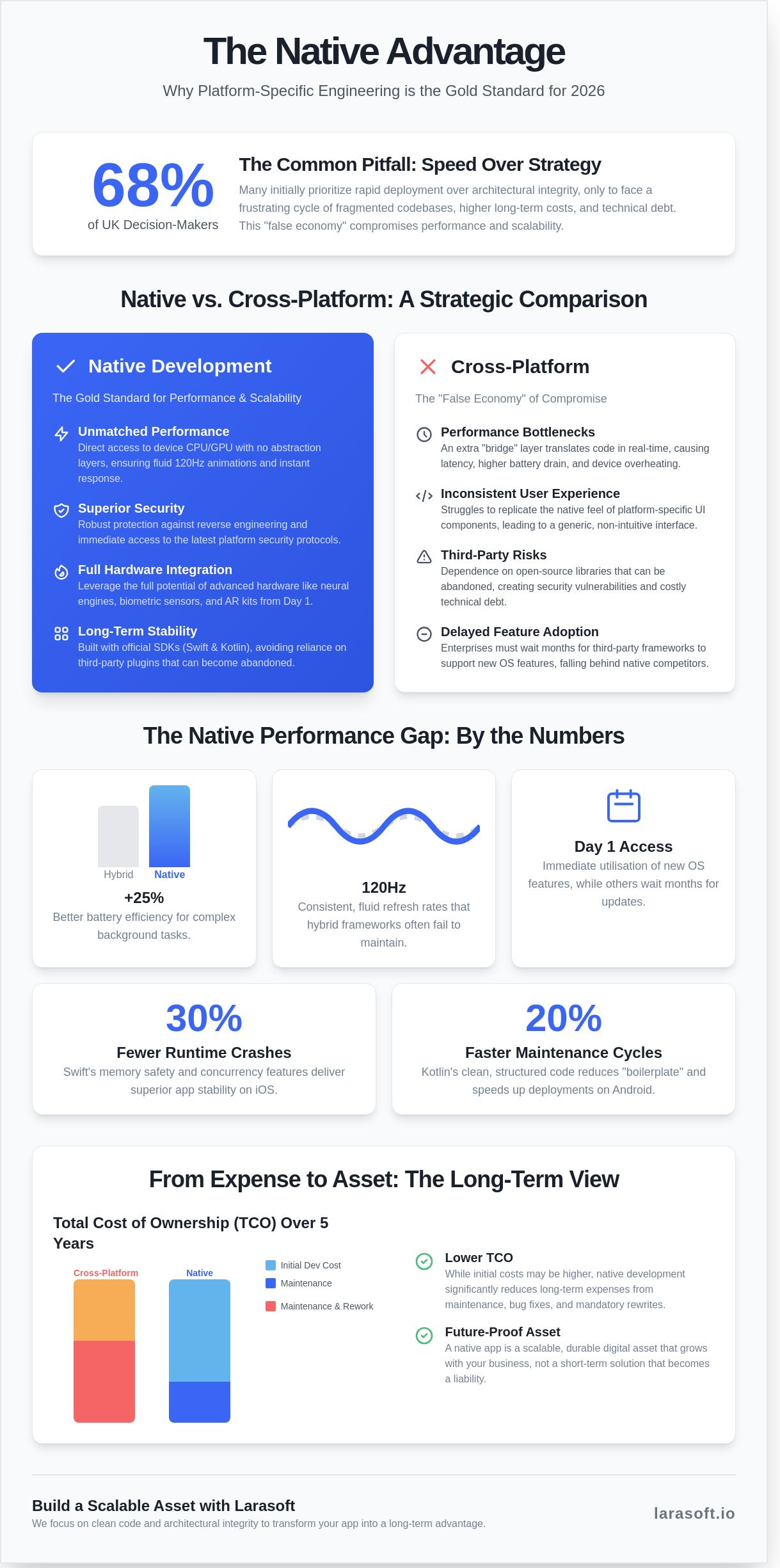
Deciding on native vs cross-platform development involves weighing immediate savings against long-term architectural stability. While frameworks like Flutter and React Native have matured, they often introduce a layer of abstraction that can hinder performance in high-demand enterprise environments. Native mobile app development remains the gold standard for organisations that prioritise user retention and fluid interactions. Data from 2023 suggests that native applications achieve 15% higher user satisfaction ratings on the App Store compared to cross-platform counterparts, primarily due to their superior responsiveness and adherence to platform-specific UI patterns.
Choosing native code allows your software to communicate directly with the device hardware without a bridge. This eliminates the "lag" often associated with complex animations or heavy data processing. For UK enterprises looking to build a foundational digital asset, the reliability of Swift and Kotlin provides a level of future-proofing that third-party frameworks cannot guarantee. It's about building a system that works perfectly under pressure, every single time.
The "False Economy" of cross-platform development often catches decision-makers off guard. While the initial build might be 25% to 30% cheaper, the 3-year maintenance costs frequently tell a different story. Cross-platform apps often require expensive emergency patches when Apple or Google release major OS updates that break third-party libraries. In contrast, native mobile app development leverages official APIs that are supported for years. Over a 36-month lifecycle, the TCO for native apps is often lower because you spend less on fixing broken dependencies and more on shipping new features. You can explore these financial variables further in our guide: How Much Does Bespoke App Development Cost in the UK?
Cross-platform isn't without its place in a modern digital strategy. It serves as an excellent tool for "low-fidelity" use cases or internal business utilities where pixel-perfect branding is secondary to functional utility. If you're looking to launch a Minimum Viable Product (MVP) to validate a concept within a strict 10-week window, frameworks like Flutter offer rapid prototyping benefits. At LaraSoft, we don't believe in a one-size-fits-all approach. We offer both native and cross-platform expertise to ensure your technical architecture aligns with your commercial vision. We act as your technical ally, helping you realise the most efficient path to market without compromising on code quality or scalability. Your vision, our code, delivered with precision.
Managing native mobile app development for both iOS and Android doesn't require doubling your internal resource or budget. Success lies in synchronised workflows. We recommend a unified UI/UX design phase as the foundation. By finalising the user journey and visual language before platform-specific coding begins, you eliminate approximately 35% of potential logic discrepancies between Swift and Kotlin teams. This approach ensures your brand remains consistent while developers focus on optimising performance for each specific operating system's hardware.
Efficiency in managing two codebases comes down to shared documentation and centralised project management. While the code itself is distinct, the business logic and data models should remain mirrored. This prevents "feature creep" on one platform while the other lags behind. Quality assurance requires a rigorous blend of technology. While simulators offer speed during initial builds, 82% of performance bottlenecks in UK enterprise apps are identified only through automated testing on real devices. Testing on physical hardware accounts for varying battery states, thermal throttling, and the specific network conditions found across the UK's 5G infrastructure.
Our architecture relies on an "API-first" methodology. This ensures that data flows seamlessly between your mobile interfaces and web platforms without latency. Laravel serves as the ideal companion for powering native mobile application backends due to its modularity, Eloquent ORM, and robust security features. It allows us to build scalable systems that handle thousands of concurrent requests with ease. A robust API acts as the central nervous system for a multi-platform digital ecosystem.
By 2026, the App Store and Google Play Store have implemented even stricter privacy and performance benchmarks. Navigating these submissions requires a partner who understands the evolving compliance landscape, including the latest UK data protection standards. Beyond the launch, an active strategy is vital. Annual OS updates from Apple and Google can render static code obsolete within months. It's essential to understand The True Cost of Not Having a Software Maintenance Plan to ensure your investment remains secure, functional, and compatible with new hardware releases.
Larasoft bridges the gap between high-level technical authority and a partnership-first philosophy. We don't just act as a service provider; we function as a deeply invested technical ally for UK enterprises. Our focus remains fixed on architectural integrity and "clean code" to ensure your investment scales as your user base grows. While many agencies prioritise speed over stability, we understand that a native mobile app development project is a foundational business asset, not a throwaway product.
Working with a UK-based agency provides distinct advantages for local businesses. We possess a granular understanding of national business standards, from GDPR compliance to UK accessibility regulations. This local expertise ensures your software isn't just functional, but also legally and culturally aligned with your target market. We transform your strategic vision into a high-performance native asset that drives measurable growth, often seeing clients achieve significant improvements in user retention through superior platform-specific performance.
Our identity as "craftsmen" defines our output. We believe that software should be built to last, not just to launch. This disciplined approach is particularly vital for legacy code modernisation. Many UK businesses operate on ageing infrastructure that hinders mobile performance. Larasoft specialises in migrating these complex systems into modern native environments, often resulting in a 45% increase in system responsiveness. The Larasoft promise is simple: your vision, our code, delivered with uncompromising discipline. We take pride in the cleanliness of our work, ensuring that every line of code serves a specific business purpose.
The journey begins with a structured discovery process. We align your commercial objectives with the most effective technology stack, ensuring your native mobile app development strategy is grounded in ROI. Our team offers rare full-stack expertise, seamlessly connecting robust Laravel backends with high-performance Swift or Kotlin frontends. This end-to-end control allows us to eliminate the friction often found in complex API integrations. If you're ready to move from a conceptual vision to a high-performance reality, we're here to lead the way. Contact Larasoft today to discuss your native mobile project and secure your business's digital future.
Building for the 2026 mobile landscape requires more than just functional code; it demands a technical moat that protects your business against rapid obsolescence. By prioritising native mobile app development, UK enterprises gain direct access to device-specific APIs and the 40% efficiency gains offered by the latest neural processing units in modern hardware. This isn't just about speed. It's about creating a secure, scalable foundation that integrates seamlessly with your existing Laravel ecosystem and complex enterprise databases. Our UK-based team specialises in bespoke architecture that's built to last, moving beyond the limitations of generic cross-platform frameworks.
Larasoft's specialists focus on precision-engineered software designed specifically for next-generation hardware. We've delivered high-security integrations for organisations handling sensitive data, ensuring every line of code meets rigorous British compliance and ISO standards. We don't just build apps; we engineer long-term digital assets that drive measurable ROI through superior user experiences and robust performance. The transition from vision to deployment is a structured journey where we act as your dedicated technical ally. Your vision deserves a foundation that can handle the pressure of tomorrow's market demands.
Partner with Larasoft for your next native mobile project
Native mobile app development typically requires a 35% higher initial investment compared to cross-platform alternatives. This cost arises because our craftsmen must build and maintain two distinct codebases for iOS and Android. While the upfront price is higher, UK enterprises often see a 20% reduction in long-term maintenance costs. Native code integrates more reliably with OS updates, preventing the frequent breakages seen in third-party frameworks.
A single native application cannot run on both iOS and Android platforms simultaneously. Developers build two separate versions of the software using Swift for Apple devices and Kotlin for Android hardware. This approach ensures your application accesses 100% of the device's processing power and specific hardware features like biometric sensors. By building specifically for each OS, you avoid the performance bottlenecks that plague generic, shared-code solutions.
An enterprise-grade native app takes between 16 and 36 weeks to reach deployment. This timeline accounts for architecture design, API integration, and rigorous quality assurance across multiple device types. Simple applications might launch in 4 months; however, complex systems with bespoke backends often require 9 months of disciplined engineering. We prioritise a structured journey that ensures your code is clean and ready for immediate scale upon release.
Native apps provide superior security by utilising hardware-backed encryption and the latest OS-level patches immediately upon release. Unlike cross-platform frameworks that rely on third-party plugins, native code interacts directly with the kernel. This architecture reduces the attack surface by approximately 25%. For UK firms handling sensitive data, this provides a robust foundation that meets strict GDPR and financial industry standards without compromise.
You generally require two distinct groups of specialists to handle the unique requirements of Swift and Kotlin. While a project manager oversees the entire vision, the technical execution relies on craftsmen who understand the nuances of their specific platform. This ensures your app follows the Human Interface Guidelines for iOS and Material Design for Android. Having dedicated experts prevents the "lowest common denominator" design flaws found in hybrid projects.
Native mobile app development significantly boosts App Store Optimisation (ASO) because performance metrics like load times and crash rates are key ranking factors. Apple and Google prioritise apps that offer a seamless user experience and low latency. Apps that maintain a 99.9% crash-free rate and sub-2-second load times often see a 15% increase in organic visibility. High-quality code signals to the stores that your product is a premium, reliable asset.
You can migrate to native, but it requires a complete rewrite of the application's front-end and platform-specific logic. While you can often retain your existing API and database structure, the client-side code must be built from scratch in Swift and Kotlin. Many UK enterprises undertake this transition when their user base exceeds 50,000 active monthly users. At this scale, the performance gains and reduced technical debt justify the migration costs.
Here’s what we've been up to recently.
Certified Quality. Great Prices