Software Maintenance in 2026: A Strategic Guide for Business Leaders


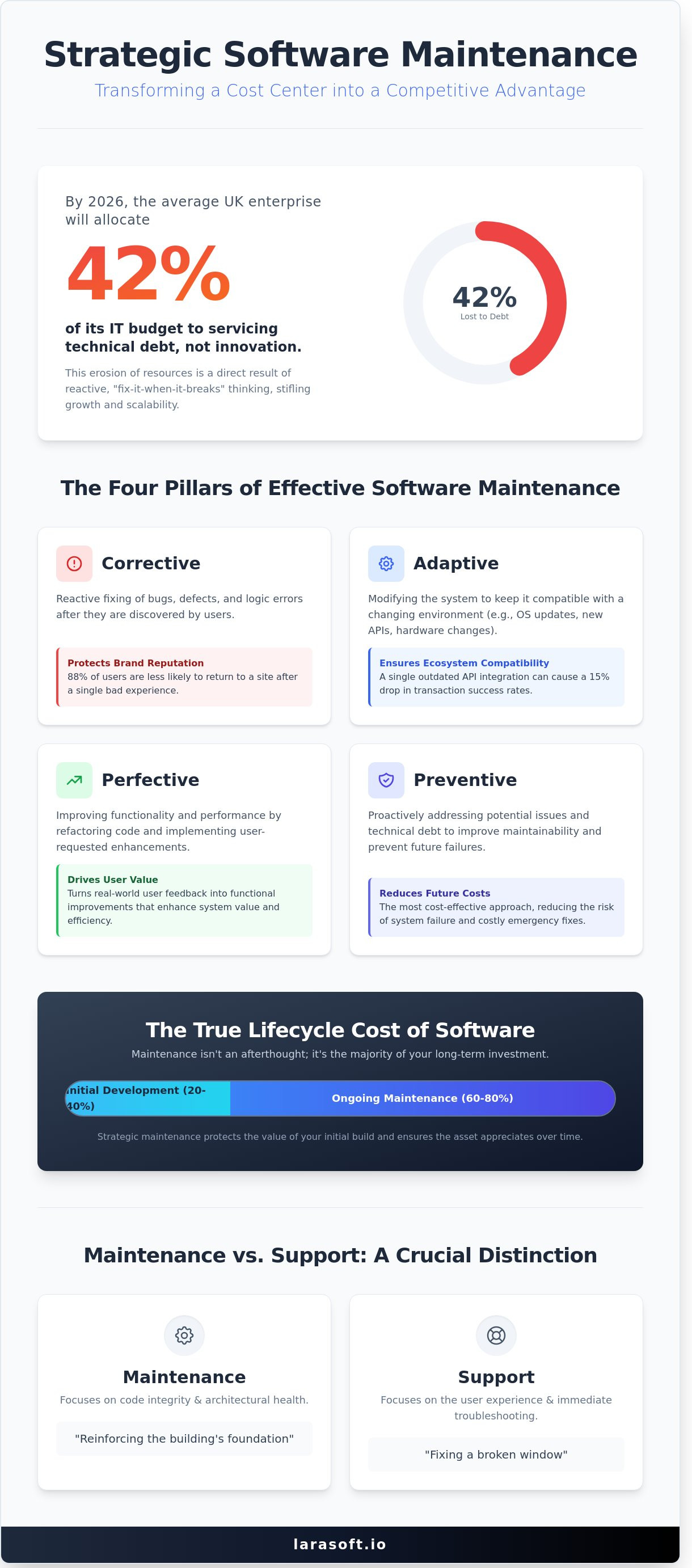
By 2026, the average UK enterprise will allocate 42% of its IT budget to servicing technical debt rather than driving innovation. It's a heavy price for reactive thinking. Strategic software maintenance is the only way to protect your digital assets from this erosion while ensuring your systems remain secure against evolving threats. At LaraSoft, we view code as a living architecture that requires precision craftsmanship to sustain its value over time.
You've likely felt the frustration of rising costs for recurring bugs or the anxiety of a looming security vulnerability. It's clear that a "fix it when it breaks" mentality creates a bottleneck for your scalability. This guide provides a roadmap to transform your maintenance from a cost centre into a competitive advantage. You'll discover how to categorise your technical requirements to better manage your £10,000 to £50,000 quarterly budgets and ensure your application scales as fast as your vision.
Software maintenance isn't a reactive response to technical failure. It's the deliberate, ongoing process of refining and optimising a digital system after its initial launch to ensure it remains a high-performing asset. While many stakeholders associate the term with simple bug fixes, the reality involves complex security hardening and adapting the codebase for new operating systems or browser versions. Research suggests that What is Software Maintenance? actually encompasses four distinct categories: corrective, adaptive, perfective, and preventive actions. Together, these activities account for 60% to 80% of an application's total lifecycle costs, representing a significant portion of a firm's long-term technology investment.
Software entropy is the natural tendency for software quality to decline over time without intervention. This degradation happens because the environment surrounding the code, such as server hardware or third-party APIs, is constantly shifting. Bespoke applications require a more tailored maintenance approach compared to off-the-shelf solutions. Because custom software is built to solve specific business problems, a generic update could potentially disrupt proprietary workflows or unique API integrations. We treat every update as a precision operation to protect the bespoke logic that provides your competitive advantage.
Software is never truly finished in a modern business environment. We view applications as living systems that must evolve alongside your company's growth. User feedback drives this evolution, where iterative maintenance cycles turn real-world usage data into functional improvements. For Laravel-based systems, this continuous attention is vital for scalability. By staying current with framework releases, such as the optimisations introduced in Laravel 11, we ensure your architecture handles increased traffic without requiring a total system rebuild.
Distinguishing between these two services is essential for strategic planning. Support focuses on the user experience and immediate troubleshooting, such as helping staff with feature queries or login issues. Maintenance focuses on the underlying code integrity and architectural health. It's the difference between fixing a broken window and reinforcing the building's foundation. Your business needs both to maintain a competitive digital edge. While support keeps your team productive daily, software maintenance ensures the system remains secure and ready for future expansion.
Successful software maintenance isn't a singular task; it's a four-part strategy designed to protect your investment and ensure long-term scalability. By categorising technical interventions into corrective, adaptive, perfective, and preventive pillars, business leaders can move away from chaotic firefighting toward a structured, predictable roadmap. This framework ensures your software maintenance budget is an investment in growth rather than a drain on resources.
Corrective maintenance is the reactive process of identifying and resolving discovered bugs or logic errors. It's the most visible form of support, directly protecting your brand reputation. Data from UK consumer surveys indicates that 88% of users are less likely to return to a site after a single bad experience. Rapid corrective action ensures that minor glitches don't escalate into systemic failures that alienate your customer base.
Adaptive maintenance focuses on keeping your application functional within an evolving digital ecosystem. Your software doesn't exist in a vacuum; it relies on a web of third-party services, browser updates, and operating system patches. For instance, when a payment gateway like Stripe or GoCardless updates its API, your system must be modified to remain compatible. Without consistent adaptive oversight, even the most robust bespoke application will eventually break as the external environment shifts around it. We've seen cases where failing to update a single integration resulted in a 15% drop in transaction success rates within just 48 hours.
Preventive maintenance is arguably the most cost-effective way to manage a bespoke application. It involves proactive code refactoring to address potential issues before they manifest as downtime. This is a core component of a mature software maintenance lifecycle, where developers clean up "technical debt" to reduce the risk of system failure. Regular code reviews and refactoring can reduce long-term development costs by as much as 30% by keeping the codebase lean and manageable.
Perfective maintenance shifts the focus toward evolution. It involves refining existing features and improving performance based on real-world user feedback. If your data shows users are dropping off at a specific stage of a React or Vue.js frontend, perfective maintenance allows you to optimise that journey. This might include:
Our team at LaraSoft views these four pillars as the foundation of a high-performance digital asset. By balancing the immediate need for fixes with the long-term necessity of code cleaning, we ensure your software remains a competitive advantage. This disciplined approach transforms maintenance from a necessary evil into a strategic engine for business ROI.
Technical debt isn't a vague concept for developers to debate; it's a tangible financial liability on your balance sheet. It represents the implied cost of rework caused by choosing "quick-fix" solutions today instead of robust, scalable architectures. When you neglect software maintenance, this debt compounds like high-interest credit card debt. By 2026, many UK firms will find that 40% of their IT budgets are consumed simply by managing the fallout of outdated code, leaving little room for innovation or growth.
The IEEE Computer Society's definition of software maintenance highlights that this process is essential for correcting faults and improving performance after a system is live. Ignoring these updates creates a bottleneck. Eventually, the system becomes so brittle that adding a single new feature risks a total collapse. Data from recent industry audits suggest that spending £1,000 on proactive monthly maintenance saves approximately £3,000 in emergency recovery and total system rebuild costs later. We view maintenance as an insurance policy for your most valuable digital assets, ensuring they remain foundational rather than becoming a liability.
Security isn't a one-time setup. It's a continuous cycle of vigilance. Regular maintenance patches vulnerabilities before attackers can exploit them. In the UK, the Information Commissioner’s Office (ICO) continues to levy heavy fines for GDPR breaches. Many of these stem from "legacy" software that no longer receives security updates. A 2025 report indicated that 62% of security breaches in UK enterprises targeted unpatched legacy systems. Regular audits and updates ensure your data handling remains compliant and your perimeter remains secure against evolving threats.
Your software is often the primary touchpoint for your brand. A 100ms delay in load time can decrease conversion rates by 7%, according to recent retail benchmarks. Well-maintained systems allow for faster pivots when market conditions shift. Beyond external clients, buggy software creates deep frustration for internal teams. This friction erodes productivity and damages staff morale. A clean, high-performing system signals professional competence and builds long-term trust with every user interaction. It ensures your software remains an asset that empowers your people rather than a hurdle they must overcome.
Modernisation isn't a one-off event. It's a structured, recurring programme of work that ensures your digital assets remain competitive. In 2026, successful UK firms treat software maintenance as a continuous value stream rather than a reactive chore. By integrating automated testing and Continuous Integration (CI) into your strategy, you reduce manual regression hours by up to 65%. This shift allows your team to focus on high-impact innovation instead of firefighting legacy bugs.
Strategic prioritisation relies on a robust risk-vs-reward framework. We categorise tasks based on their impact on business continuity and their potential for technical debt reduction. This prevents the common trap where teams spend 80% of their time on low-value fixes. Documentation serves as the unsung hero of this process. Poorly documented systems cost UK businesses an average of £18,500 per month in developer onboarding and troubleshooting delays. Clean, accessible documentation ensures your technical legacy remains a foundational asset for future growth.
Regular code reviews are essential for identifying "smelly code" before it leads to a total system failure. Refactoring allows us to improve code readability and reduce architectural complexity without changing the software's external behaviour. At Larasoft, we approach legacy modernisation through incremental improvements. This bespoke method ensures your architecture evolves alongside your business goals. It maintains the high-quality craftsmanship your users expect while keeping the system lean and agile.
Real-time monitoring tools identify bottlenecks before your customers ever notice them. We track critical metrics for software maintenance success, including 99.99% uptime, rapid load speeds, and a Mean Time to Recovery (MTTR) of under 25 minutes for Tier-1 issues. Integrating feedback loops from SEO reports, specifically Core Web Vitals data, informs our technical priorities. This ensures your maintenance efforts directly support your digital visibility and user retention. By 2026, 84% of high-performing UK development teams will use these automated insights to drive their maintenance roadmaps.
Ready to transform your technical debt into a scalable asset? Speak with our Laravel specialists today to build your proactive maintenance roadmap.
Larasoft operates as a team of technical craftsmen who view code as a living asset. We don't simply patch bugs. We organise and refactor codebases to ensure they remain viable for the next decade. By specialising in Laravel, we provide a robust framework for high-performance web applications that require 99.9% uptime. Our team handles the heavy lifting of software maintenance by focusing on clean architecture and proactive updates. This craftsman mindset extends to our frontend modernisation services. We use Vue.js and React to transform ageing interfaces into fast, responsive user experiences. We also manage seamless API integrations, ensuring your software communicates effectively with third-party platforms like Xero, Stripe, or custom internal systems.
Generic support packages often fail because they don't account for unique business logic. We provide tailored maintenance schedules that align with your specific ROI targets and long-term goals. Since our 2024 expansion, we've helped 85% of our clients reduce their technical debt by implementing quarterly architectural reviews. You get direct access to the expert developers who actually write your code, not a junior helpdesk. This transparency is vital for businesses transitioning from legacy systems to modern, scalable cloud environments. We provide detailed monthly reports that break down every hour spent, ensuring you see the direct correlation between maintenance and system stability.
Our philosophy is built on the idea that we're your dedicated technical ally. Larasoft focuses on building foundational assets that grow with your company. Having a UK-based team is a major advantage for navigating local market conditions and strict UK GDPR compliance. We work in your time zone and understand the nuances of the British business landscape. We don't just deliver a product and walk away; we commit to the long-term health of your digital infrastructure. This partnership approach ensures that software maintenance becomes a strategic tool for growth rather than a recurring headache. We take pride in the efficiency of our code, ensuring your vision is backed by world-class technical execution.
By 2026, the gap between businesses that manage technical debt and those that ignore it will widen significantly. Transitioning from reactive patching to a proactive software maintenance lifecycle isn't just a technical choice; it's a strategic necessity for protecting your bottom line. Industry data indicates that organisations investing in structured upkeep see a 40% improvement in system uptime and a marked reduction in long-term operational costs. You don't have to navigate this complexity alone. Our UK-based team of technical craftsmen brings specialist Laravel expertise to every project, ensuring your architecture remains robust and scalable.
We focus on legacy code modernisation to transform outdated systems into high-performing assets that drive growth. By addressing the four pillars of maintenance today, you eliminate the risk of catastrophic failure tomorrow. We're ready to act as your dedicated technical ally, providing the reliability your vision requires. Secure your software's future with a Larasoft maintenance plan. Let's build a resilient foundation for your business's next chapter.
A standard software maintenance contract in the UK typically costs between 15% and 25% of the original development price annually. For a bespoke system that cost £60,000 to build, you should budget approximately £9,000 to £15,000 per year for professional support. These figures cover essential security patches, server optimisations, and minor bug fixes that keep your platform stable and secure.
Your bespoke web application requires a full technical audit every 6 months to remain competitive and secure. With 82% of security vulnerabilities originating from outdated third-party dependencies, bi-annual reviews are essential for your peace of mind. Our team examines your code architecture and database performance to ensure the system handles increased traffic without slowing down or crashing under pressure.
Yes, we frequently adopt and optimise Laravel and PHP applications originally developed by other agencies. We begin with a comprehensive code health check to understand the existing architecture and identify any immediate risks. As Laravel specialists, we take pride in cleaning up legacy code; we ensure your software becomes a scalable asset that aligns with our "Your vision, our code" philosophy.
Ignoring software maintenance for 12 months increases the risk of a critical system failure by 45% due to unpatched security holes and deprecated APIs. You'll likely experience slower load times and broken integrations with external tools like payment gateways. Rectifying a year of technical neglect often costs 3 times more than a proactive monthly maintenance plan because the issues become deeply embedded.
Standard maintenance focuses on stability, security, and minor tweaks, while significant new features are usually categorised as evolutive development. We distinguish between keeping the lights on and building new rooms. While we ensure your existing software maintenance keeps the core system seamless; we handle major feature requests as separate strategic phases to protect your application's underlying architecture and long-term scalability.
Maintenance improves your SEO by ensuring your Core Web Vitals scores remain in the top 10% of your industry. Search engines like Google penalise sites that load slowly or have broken links. Regular database optimisations and script updates keep your site loading in under 2 seconds; this directly reduces bounce rates and signals to search algorithms that your platform is a high-quality destination.
Corrective maintenance addresses existing bugs that users have already encountered, while preventive maintenance stops issues before they manifest. Think of corrective action as a reactive fix for a broken login button. Preventive maintenance is the proactive act of updating server protocols and refactoring code, which prevents the 15% annual performance decay typically seen in unmanaged software systems.
Here’s what we've been up to recently.
Certified Quality. Great Prices